Light Combat Aircraft (LCA) Tejas
India's Indigenous Fighter
The Tejas is a small, light fighter jet designed and built in India. It has one engine and a triangle-shaped "delta" wing, and it can fight other aircraft in the air as well as attack targets on the ground. It was designed by the Aeronautical Development Agency (ADA) and is built by Hindustan Aeronautics Limited (HAL). It is the main symbol of India's effort to make its own fighter jets instead of buying them from abroad.
Why does India need its own fighter?
For decades, India bought almost all its fighters from other countries, mainly the Soviet Union and later Russia, France and the UK. Buying from abroad has three big problems. Spare parts and upgrades depend on the seller. A seller can stop supplies during a war or a dispute. And the money and skilled jobs go out of the country. A home-grown fighter fixes these problems, and it also builds an aviation industry that can make better jets later.
Where did it come from?
The story goes back to the early 1980s.
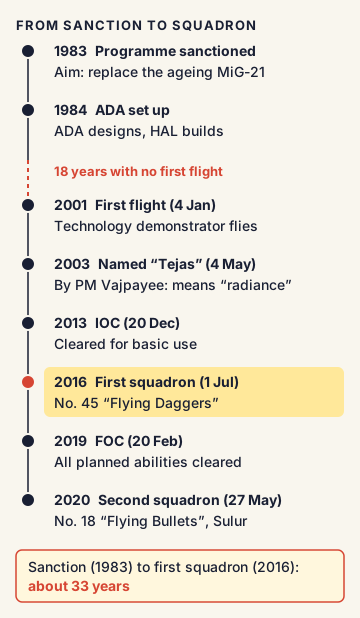
- 1983: The government sanctioned the Light Combat Aircraft (LCA) programme. Its main aim was to replace the ageing MiG-21 fleet.
- 1984: The Aeronautical Development Agency (ADA) was set up to manage the design, with HAL as the main builder.
- 4 January 2001: The first technology demonstrator (a test version that proves the design works) made its first flight.
- 4 May 2003: Prime Minister Atal Bihari Vajpayee named the aircraft "Tejas", a Sanskrit word meaning "radiance" or "brilliance".
- 20 December 2013: It got Initial Operational Clearance (IOC).
- 1 July 2016: The IAF formed its first Tejas squadron, No. 45 Squadron "Flying Daggers".
- 20 February 2019: It got Final Operational Clearance (FOC).
- 27 May 2020: The second squadron, No. 18 Squadron "Flying Bullets", was formed at Air Force Station Sulur in Tamil Nadu with FOC-standard jets.
So the jet took about 18 years from sanction to first flight, and about 33 years to enter squadron service. This long gap is a big part of today's debate.
What do IOC and FOC mean?
Think of a new doctor. IOC is like getting a basic degree: the aircraft is safe to fly and can do basic missions, so the Air Force can start using and learning it. FOC is like finishing specialisation: all planned abilities have been tested and cleared. For the Tejas, FOC added things like mid-air refuelling and beyond-visual-range missiles, which hit targets the pilot cannot see with the naked eye.
How is the Tejas built?
Several features make it modern:
- Fly-by-wire controls: the pilot's stick movements go to a computer, which moves the control surfaces. The computer keeps the jet stable even in sharp turns.
- Composite materials: light but strong man-made materials make up about 45% of the airframe by weight and about 90% by surface area. This keeps the jet light.
- Engine: the Tejas Mk1 and Mk1A use the American General Electric F404-IN20 engine. India's own engine, the Kaveri, built by the Gas Turbine Research Establishment (GTRE), was not powerful enough for the Tejas.
- Class: it is usually described as a 4.5-generation, single-engine, multirole fighter.
What are the different versions?
Students often mix these up:
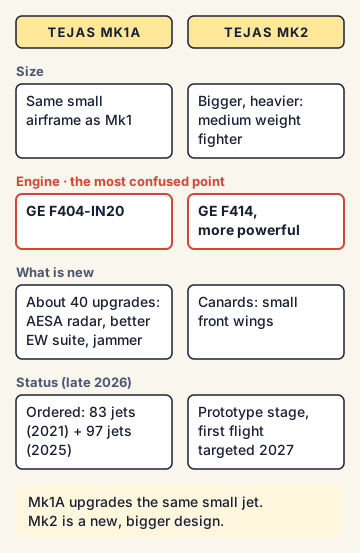
- Tejas Mk1: the first version. 40 jets were ordered in two batches of 20 (one in IOC standard, one in FOC standard). The last two trainer jets of these orders were handed over only in September 2026.
- Tejas Mk1A: an improved Mk1 with about 40 upgrades, including an AESA radar (a modern radar that steers its beam electronically), a better electronic warfare suite and a self-protection jammer. 83 jets (73 fighters and 10 trainers) were ordered on 3 February 2021 for about ₹48,000 crore. A further 97 jets (68 fighters and 29 trainers) were ordered on 25 September 2025 for over ₹62,370 crore, with deliveries planned from September 2027 to September 2033.
- Tejas Mk2: a larger, heavier "medium weight fighter" with a more powerful GE F414 engine and small front wings called canards. It is still in the prototype stage. As of late 2026, its first flight is targeted for 2027.
- Naval version (LCA Navy): prototypes were built to fly from aircraft carriers, but the Navy left the programme in December 2016. The Navy's future need is now meant to be met by the separate Twin Engine Deck Based Fighter (TEDBF) project.
India's position and the fighter gap
The IAF is sanctioned to have 42 fighter squadrons (a squadron usually has about 16 to 18 jets). After the last MiG-21s retired on 26 September 2025 at Chandigarh, its strength fell to about 29 squadrons, the lowest in about six decades. The Tejas Mk1A is meant to replace these old jets quickly. HAL has three Tejas production lines, two in Bengaluru and one in Nashik, which together can make about 24 jets a year.
Commonly confused concepts
- ADA vs HAL vs DRDO: ADA (under the Defence Research and Development Organisation, DRDO) designs the aircraft. HAL, a public sector company under the Ministry of Defence, builds it. DRDO is the parent research body.
- Tejas (LCA) vs AMCA: Tejas is a light, single-engine 4.5-generation jet already in service. AMCA is a planned twin-engine, fifth-generation stealth jet that is still on the drawing board.
- Tejas Mk1A vs Mk2: Mk1A is an upgraded version of the same small airframe with the F404 engine. Mk2 is a bigger new design with the F414 engine.
- IOC vs FOC: IOC means cleared for basic use; FOC means cleared for the full set of planned abilities.
- Tejas vs HTT-40: the HTT-40 is HAL's basic trainer aircraft for new pilots, not a fighter.
Issues, criticism and the way forward
- Long delays: design work, testing and certification have often lagged behind production orders. The first Mk1A was due in February 2024, but as of September 2026 none had been handed over to the IAF.
- Engine dependence: the late supply of F404 engines from GE in the US has been a major bottleneck. HAL has imposed penalties (liquidated damages) on GE for the delays. This shows the risk of relying on a foreign engine even for a home-grown jet.
- Too many projects at once: the same small pool of designers works on Tejas Mk1A, Mk2, AMCA and TEDBF, so time is split across all of them.
- Safety and confidence: a Tejas crashed during a display at the Dubai Airshow on 21 November 2025, killing the pilot. It was only the second known Tejas crash, but it raised questions before export talks.
- Way forward: experts and the IAF suggest fewer parallel programmes, fixed delivery timelines with penalties, more private sector production partners, faster certification, and a strong push for an Indian fighter engine (such as an improved Kaveri) so that future jets do not depend on imports.
Concepts to Know
- Squadron: a basic fighting unit of an air force. In the IAF a fighter squadron usually has about 16 to 18 aircraft.
- Indigenous: made within the country, using its own design and industry.
- Multirole fighter: a jet that can do many jobs, such as air combat, ground attack and gathering information.
- Delta wing: a wing shaped like a triangle, which gives strength and good performance at high speed.
- AESA radar (Active Electronically Scanned Array): a radar made of many small transmitters. It steers its beam electronically instead of physically turning the antenna, so it is faster and harder to jam.
- Electronic warfare: using radio signals to confuse or block enemy radars and missiles, and to protect one's own aircraft.
- Liquidated damages: a fixed money penalty written into a contract, which a supplier must pay if it delivers late.
- LCA programme sanctioned: 1983; ADA set up: 1984
- First flight (technology demonstrator): 4 January 2001
- Named "Tejas" by PM Atal Bihari Vajpayee: 4 May 2003
- IOC: 20 December 2013; FOC: 20 February 2019
- First squadron: No. 45 "Flying Daggers" (1 July 2016); second: No. 18 "Flying Bullets", Sulur (27 May 2020)
- Engine: GE F404-IN20 (Mk1, Mk1A); GE F414 (Mk2)
- Composites: about 45% of airframe weight, about 90% of surface area
- Mk1A orders: 83 jets (3 February 2021, about ₹48,000 crore); 97 jets (25 September 2025, over ₹62,370 crore, deliveries September 2027 to September 2033)
- HAL Tejas production capacity: about 24 jets a year (third line at Nashik)
- IAF sanctioned strength: 42 squadrons; about 29 after MiG-21 retirement on 26 September 2025
● Tracked since February 05, 2026 · last seen October 03, 2026 · updates as the daily brief publishes