Kaveri Engine Programme
The Kaveri is a jet engine that India started developing on its own in 1989 to power the Tejas fighter. It is being developed by the Gas Turbine Research Establishment (GTRE), a laboratory of the Defence Research and Development Organisation (DRDO) in Bengaluru. Its official name is GTX-35VS Kaveri. The Kaveri could not reach the power needed for the Tejas, so the Tejas uses an American engine instead.
But the programme gave India valuable experience, and a version of it is now being developed for an unmanned combat drone.
Why does India need its own jet engine?
The engine is the heart of a fighter jet. It is also the hardest part to make. Only a few countries, such as the US, the UK, France and Russia, can make modern fighter engines on their own. If India depends on a foreign company for engines, its fighter production depends on that company's factories, supply chains and its government's export rules. The Tejas Mk1A delay shows this risk clearly: India has ready airframes but is waiting for engines from abroad.
Where did it come from?
- In the 1980s, India planned the Light Combat Aircraft and decided it should also have a home-made engine.
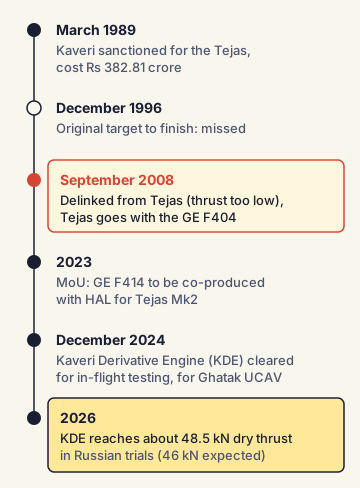
- The government sanctioned the Kaveri project in March 1989 at a cost of Rs 382.81 crore, with a target to finish by December 1996.
- The engine faced repeated problems with weight, thrust (pushing power) and reliability. The cost was later revised to about Rs 2,839 crore. A Rajya Sabha reply in 2021 put spending at about Rs 2,035.56 crore.
- In September 2008, the Kaveri was officially delinked (separated) from the Tejas programme, because it could not meet the Tejas's needs in time. The Tejas then went ahead with the GE F404 engine.
- India explored a partnership with French company Snecma (now part of Safran) to complete the Kaveri, but this did not become a final deal at the time.
- Because India has no high-altitude engine test facility, Kaveri engines have been tested in Russia, at the Central Institute of Aviation Motors (CIAM) and the Gromov Flight Research Institute, using a modified Ilyushin Il-76 aircraft as a flying test bed.
How does a jet engine work?
A jet engine works on a simple idea: push air backwards very hard, and the plane moves forward (Newton's third law). It works in four steps:
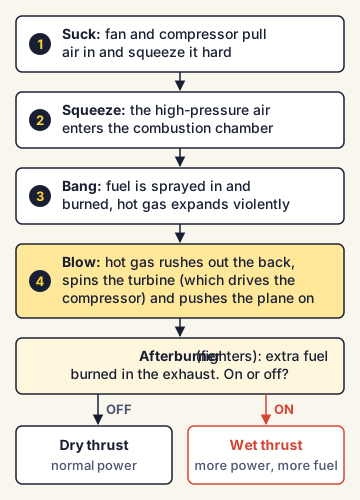
- Suck: A fan and compressor pull air in and squeeze it to very high pressure.
- Squeeze: The compressed air goes into a combustion chamber.
- Bang: Fuel is sprayed in and burned. The hot gas expands violently.
- Blow: The hot gas rushes out of the back, spinning a turbine on the way (which drives the compressor) and pushing the plane forward.
Fighters also have an afterburner, which sprays extra fuel into the hot exhaust for a short, powerful boost. Thrust with the afterburner on is called "wet thrust"; without it, "dry thrust". The hardest part is making turbine blades that can survive temperatures above their own melting point. This needs special single-crystal blade technology, which very few countries have.
What did the Kaveri achieve?
The Tejas needed about 80 to 85 kN (kilonewtons) of wet thrust. The Kaveri reached roughly 70 to 75 kN of wet thrust, which was not enough. It was also heavier than planned. Still, the programme built India's knowledge of engine design, materials and testing, and trained a generation of engineers.
What are its newer versions?
- Kaveri Derivative Engine (KDE): a dry (non-afterburning) version being developed to power the Ghatak, DRDO's stealth Unmanned Combat Aerial Vehicle (UCAV). It was cleared for in-flight testing in December 2024. Reports in 2026 said it reached a peak dry thrust of about 48.5 kN in Russian trials, above the expected 46 kN. Its results will be reviewed by CEMILAC (Centre for Military Airworthiness and Certification) before it can be certified.
- Kaveri Marine Gas Turbine (KMGT): a version for ships, which used the Kaveri's core and demonstrated about 12 MW of shaft power at the Naval Dockyard, Visakhapatnam.
India's position and the bigger engine plan
India currently relies on foreign engines for almost all its military aircraft. Its plan has three parts:
- Buy and co-produce: F404 engines for Tejas Mk1A, and co-production of the GE F414 with HAL for Tejas Mk2 under a 2023 MoU.
- Co-develop: a new 120 kN-class engine for the Advanced Medium Combat Aircraft (AMCA), India's planned fifth-generation stealth fighter. A partnership between GTRE and France's Safran has been reported as the chosen path.
- Grow its own: continue the Kaveri line (KDE) for drones and build testing infrastructure at home.
Commonly confused concepts
- Kaveri vs F404 vs F414: Kaveri is India's own engine by GTRE (DRDO). F404 is GE's engine that powers Tejas Mk1 and Mk1A. F414 is GE's more powerful engine chosen for Tejas Mk2.
- GTRE vs ADA vs HAL: GTRE (DRDO) designs engines. ADA designs the Tejas aircraft. HAL is the public sector company that manufactures the aircraft.
- Wet thrust vs dry thrust: Wet thrust is with the afterburner on (more power, much more fuel). Dry thrust is without it.
- Ghatak vs Tejas: Ghatak is an unmanned stealth combat drone. Tejas is a manned fighter jet.
Issues, criticism and the way forward
- Long delays and cost overruns: The project, meant to finish in 1996, still has no fighter-ready engine. The Comptroller and Auditor General (CAG) has criticised delays in key components such as the compressor, turbine and engine controls.
- Low funding: Experts say the Kaveri got far less money than engine programmes abroad, which typically cost billions of dollars.
- Missing materials and test facilities: India lacks a high-altitude test facility and has limited capacity in advanced materials like single-crystal turbine blades, so it still depends on Russia for testing.
- Strategic risk of dependence: The F404 delays show how supply problems abroad can ground India's own programmes.
- Way forward: Experts recommend steady, long-term funding, a national high-altitude test facility, deep technology transfer in foreign partnerships (especially for the AMCA engine), and building a supplier base in private industry and MSMEs for engine parts.
Concepts to Know
- Thrust: The pushing force an engine produces, measured in kilonewtons (kN). More thrust means a plane can carry more weight and fly faster.
- Afterburner: A part at the back of a fighter engine that burns extra fuel in the exhaust for a short burst of extra power, used for take-off or combat.
- Airframe: The body of an aircraft (fuselage, wings, tail) without the engine.
- Flying test bed: An existing aircraft modified to carry a new engine so that engine can be tested safely in real flight.
- Delinking: Separating one project from another so that one's delay does not hold up the other.
- Technology transfer: When a foreign company shares its know-how and designs so that the buying country can make the item itself.
- Developer: Gas Turbine Research Establishment (GTRE), DRDO, Bengaluru; official name GTX-35VS Kaveri
- Sanctioned: March 1989, Rs 382.81 crore; original completion target December 1996
- Revised cost: about Rs 2,839 crore; spending about Rs 2,035.56 crore (Rajya Sabha reply, 2021)
- Delinked from Tejas: September 2008
- Wet thrust achieved: about 70 to 75 kN, against a Tejas need of about 80 to 85 kN
- Kaveri Derivative Engine (dry, for Ghatak UCAV): cleared for in-flight testing December 2024; about 48.5 kN dry thrust reported in 2026 Russian trials
- Kaveri Marine Gas Turbine: about 12 MW shaft power demonstrated
- Airworthiness certification body: CEMILAC
● Tracked since August 14, 2026 · last seen October 07, 2026 · updates as the daily brief publishes