Active Electronically Scanned Array (AESA) Radar
How Modern Fighter Radars Work
An AESA radar is a modern radar used in fighter jets, warships and air-defence systems. Instead of one big dish that turns around, it has a flat panel made of hundreds or thousands of tiny transmitters and receivers. Each tiny unit sends out its own radio signal. By controlling these signals electronically, the radar can "look" in different directions in a split second, without any part of it moving.
What is a radar in the first place?
A radar sends out radio waves. When these waves hit an object, such as an aircraft, some of them bounce back. The radar catches the echo and works out where the object is, how far away it is and how fast it is moving. The word "radar" comes from "RAdio Detection And Ranging". Think of it like shouting in a valley and listening for the echo: the time the echo takes tells you how far the hill is.
Why do fighter jets need a better radar?
A fighter pilot's main eye is the radar. The jet that sees the enemy first and fires first usually wins. Older radars had a dish that physically swung left and right, like a table fan turning its head. This was slow and the moving parts often broke down. Modern air combat needs a radar that can:
- track many targets at the same time,
- guide missiles to targets far beyond what the pilot can see (beyond-visual-range combat),
- resist enemy jamming (deliberate noise sent to blind a radar),
- and stay hard for the enemy to detect.
How did radars develop?
Radar technology moved through three main stages:
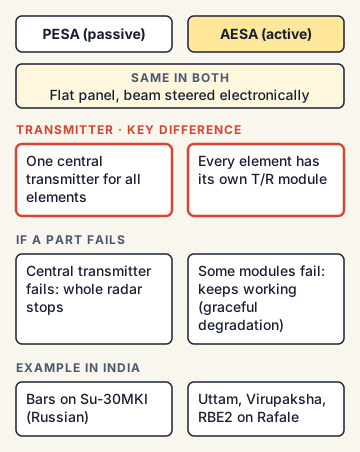
- Mechanically scanned radar: A dish antenna that is physically turned by a motor. It can look in only one direction at a time.
- Passive Electronically Scanned Array (PESA): A flat panel with many small elements, but all of them are fed by one central transmitter. Small devices called phase shifters steer the beam electronically. It is faster than a dish, but if the central transmitter fails, the whole radar stops.
- Active Electronically Scanned Array (AESA): Every element has its own transmitter and receiver, called a transmit/receive (T/R) module. This is the most advanced stage.
The first fighter jets with AESA radars entered service around 2000: Japan's Mitsubishi F-2 (J/APG-1 radar) and the American F-15C (APG-63(V)2 radar). Sources differ on which came first.
How does an AESA radar steer its beam without moving?
Imagine a long line of people in a stadium doing a "Mexican wave". If each person stands up a tiny bit after the person next to them, the wave seems to move in one direction. An AESA radar does something similar with radio waves. A computer tells each T/R module to send its signal with a tiny time difference (called a "phase" difference).
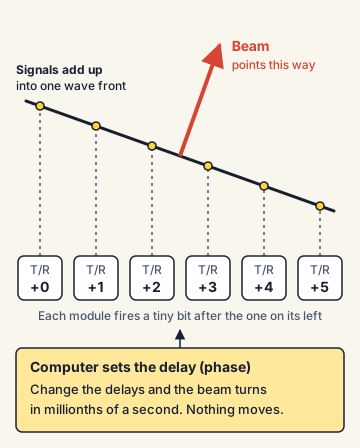
The signals add up into a strong beam in one chosen direction. By changing these tiny differences, the computer can point the beam anywhere in a few millionths of a second.
Why is AESA better?
- Many tasks at once: Groups of modules can work separately. So one part of the radar can track enemy jets while another part maps the ground or jams an enemy radar.
- Hard to detect: It can keep changing its frequency very quickly. This makes it hard for enemy warning systems to notice it. Such a radar is called a "Low Probability of Intercept" (LPI) radar.
- Hard to jam: Because it hops across frequencies, enemy jamming is less effective.
- Reliable: If some modules fail, the radar keeps working with slightly lower performance. This is called "graceful degradation". A PESA or dish radar can fail completely if its single transmitter breaks.
- Longer range and better tracking: It can detect smaller targets at longer distances.
What makes up a T/R module?
Each module has a power amplifier (to make the outgoing signal strong), a low-noise amplifier (to make the faint echo clear) and circuits to control the signal's phase. The modules are made from special semiconductor materials. Older modules use gallium arsenide (GaAs). Newer ones use gallium nitride (GaN), which gives more power, handles heat better and makes a more powerful radar in the same space.
What are the drawbacks?
AESA radars are costly. They use a lot of electric power and produce a lot of heat, so they need strong cooling systems. Making thousands of identical modules needs advanced factories. This is why only a few countries can design and build fighter AESA radars on their own.
India's position and Indian examples
- Uttam: India's own fighter AESA radar. It is designed by the Electronics and Radar Development Establishment (LRDE), a laboratory of the Defence Research and Development Organisation (DRDO) in Bengaluru. It uses GaAs-based T/R modules. Its version for the Tejas Mk1A is most often reported to have 912 T/R modules [Unverified]. It has been flight-tested on Tejas test aircraft and is planned for later Tejas jets.
- ELTA EL/M-2052: An AESA radar made by ELTA Systems, a part of Israel Aerospace Industries. It has been chosen for the first 83 Tejas Mk1A jets.
- Virupaksha: A large GaN-based AESA radar being developed by LRDE for the planned upgrade of the IAF's Su-30MKI fleet. It is reported to have about 2,400 T/R modules. It will replace the Su-30MKI's Russian "Bars" radar, which is a PESA radar.
- Rafale: The IAF's French Rafale jets carry the Thales RBE2 AESA radar. Bharat Electronics Limited (BEL) makes T/R modules for this radar in India.
- Netra: India's airborne early warning and control (AEW&C) aircraft, developed by DRDO's Centre for Airborne Systems (CABS), uses an Indian-made AESA antenna mounted on an Embraer ERJ-145 jet.
Commonly confused concepts
- AESA vs PESA: Both steer the beam electronically. In AESA, every element has its own transmitter and receiver. In PESA, all elements share one central transmitter.
- AESA radar vs AWACS/AEW&C: An AESA radar is a type of radar technology. An AWACS or AEW&C is a whole aircraft that carries a big radar to watch a large area of sky. An AEW&C aircraft may use an AESA radar, like Netra does.
- GaAs vs GaN: Both are semiconductor materials for T/R modules. GaN is newer and gives more power and better heat handling.
- Stealth vs LPI: Stealth is about making the aircraft itself hard to see on radar (through shape and special materials). LPI is about making the aircraft's own radar signals hard for the enemy to notice.
Issues, criticism and the way forward
- Import dependence: India's first batch of Tejas Mk1A jets uses a foreign radar. This means dependence on another country for spare parts, software updates and access to the radar's inner workings.
- Certification delays: Indian radars like Uttam take a long time to pass all the tests needed before the IAF accepts them. Faster and better-funded testing is often suggested.
- Semiconductor base: India needs its own large-scale production of GaN chips and modules to build radars like Virupaksha in large numbers. Private and public firms are being encouraged to build this supply chain.
- Integration: A radar has to work smoothly with the jet's computers, weapons and electronic warfare systems. Integration problems are a common reason for delays.
Concepts to Know
- Phase: The position of a wave in its up-down cycle at a given moment. Shifting the phase slightly between neighbouring signals lets them combine into a beam pointing in a chosen direction.
- Jamming: Sending strong, noisy radio signals to confuse or blind an enemy radar.
- Beyond-visual-range (BVR) missile: A missile that can hit an enemy aircraft too far away for the pilot to see with their eyes, usually tens of kilometres away. It depends on radar guidance.
- Semiconductor: A material, such as silicon, gallium arsenide or gallium nitride, that is used to make electronic chips.
- Electronic warfare (EW): The use of radio signals to detect, confuse or block the enemy's radars and communications, and to protect one's own.
- AESA = Active Electronically Scanned Array; PESA = Passive Electronically Scanned Array.
- Each AESA element is a transmit/receive (T/R) module; newer modules use gallium nitride (GaN), older ones gallium arsenide (GaAs).
- First fighter AESA radars in service around 2000: Japan's F-2 (J/APG-1) and the US F-15C (APG-63(V)2).
- Uttam: India's fighter AESA radar, designed by LRDE (DRDO), Bengaluru.
- EL/M-2052: Israeli AESA radar by ELTA (Israel Aerospace Industries), chosen for the first 83 Tejas Mk1A jets.
- Virupaksha: GaN AESA radar by LRDE for the Su-30MKI upgrade; about 2,400 T/R modules; replaces the Russian Bars PESA radar.
- Rafale carries the Thales RBE2 AESA radar; Netra AEW&C (DRDO/CABS) uses an Indian AESA antenna on an Embraer ERJ-145.
● Tracked since November 13, 2026 · last seen November 13, 2026 · updates as the daily brief publishes