National Board for Wildlife (NBWL)
The National Board for Wildlife (NBWL) is India's top body for wildlife protection. It is a statutory body, which means it was created by a law passed by Parliament: the Wildlife (Protection) Act, 1972. It is chaired by the Prime Minister. It advises the government on wildlife policy and, most importantly, its permission is needed before many kinds of projects can come up inside or change the boundaries of protected areas like national parks, sanctuaries and tiger reserves.
Why does it exist?
Protected areas are valuable land. There is always pressure to build roads, dams, mines, power lines and hotels inside them. If any one department could approve such projects alone, forests would slowly be cut into pieces. The NBWL works like a gatekeeper: one national body, with experts and senior officials, that must look at the project and its effect on wildlife before it goes ahead.
Where did it come from?
- 1952: The Indian Board for Wildlife (IBWL) was set up as an advisory body. It held its first meeting in November 1952 in Mysore. It had no legal power of its own.
- 1972: The Wildlife (Protection) Act was passed. It gave India its main wildlife law, but the IBWL stayed only advisory.
- 2002 amendment: The Wild Life (Protection) Amendment Act, 2002 added Section 5A, which created the National Board for Wildlife as a legal body in place of the IBWL. It came into being in 2003.
- 2014: The Board was reconstituted with fewer independent members than the law requires. The Supreme Court put its decisions on hold in August 2014, and later accepted a reconstitution with proper independent members.
- 2022 amendment: The Wild Life (Protection) Amendment Act, 2022 (in force from 1 April 2023) made small changes, such as adding a NITI Aayog member and adding a Standing Committee for State Boards too.
Who is in the NBWL? (Section 5A)
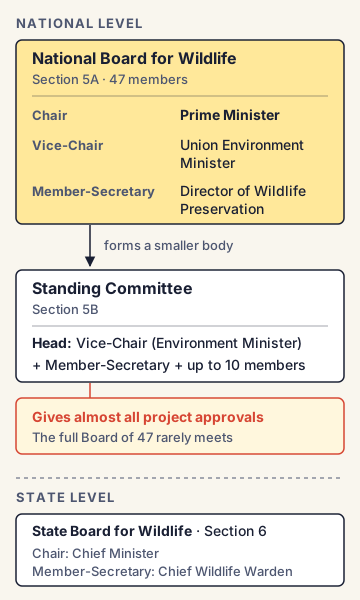
The Board has 47 members. The main ones are:
- The Prime Minister as Chairperson
- The Union Minister in charge of Forests and Wildlife as Vice-Chairperson
- Three Members of Parliament (two from Lok Sabha, one from Rajya Sabha)
- A NITI Aayog member in charge of environment, forests and climate change
- Five representatives of NGOs (non-government organisations) and ten eminent conservationists or ecologists, nominated by the Centre
- Senior officials: the Chief of the Army Staff, Secretaries of Environment, Defence, Information and Broadcasting, Expenditure and Tribal Affairs, the Director-General of Forests, and heads of scientific bodies like the Wildlife Institute of India, Zoological Survey of India and Botanical Survey of India
- One representative each from ten States and Union Territories, by rotation
- The Director of Wildlife Preservation as Member-Secretary
The Standing Committee (Section 5B): where the real work happens
A board of 47 people, chaired by the Prime Minister, cannot meet often. So the law allows the NBWL to form a smaller Standing Committee. It has the Vice-Chairperson (the Environment Minister) as its head, the Member-Secretary, and not more than ten members chosen from the Board. In practice, almost all project approvals are given by this Standing Committee, not the full Board.
What does the NBWL do? (Section 5C)
- Frames policies and advises the Centre and States on protecting wildlife and stopping poaching and illegal wildlife trade.
- Recommends setting up and managing national parks, sanctuaries and other protected areas.
- Studies the effect of projects on wildlife and their homes (impact assessment).
- Reviews progress in wildlife conservation.
- Publishes a status report on wildlife at least once every two years.
When is NBWL approval needed?
This is the most important part for both Prelims and Mains.
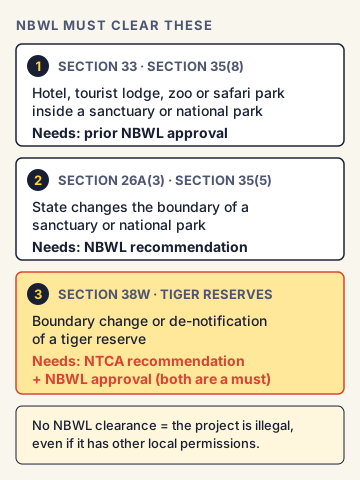
- Section 33 (sanctuaries): No commercial tourist lodge (including government lodges run commercially), hotel, zoo or safari park can be built inside a sanctuary without the prior approval of the National Board.
- Section 35(8) (national parks): The same rule applies to national parks.
- Sections 26A(3) and 35(5): The boundaries of a sanctuary or national park cannot be changed by a State without the recommendation of the National Board.
- Section 38W (tiger reserves): The boundaries of a tiger reserve cannot be changed, and a tiger reserve cannot be de-notified, without the recommendation of the National Tiger Conservation Authority (NTCA) and the approval of the NBWL.
- Supreme Court directions: The Supreme Court has also made the Standing Committee's recommendation a must for projects inside national parks and sanctuaries.
A simple example: if a company wants to build a hotel inside a sanctuary, the State's Chief Wildlife Warden cannot simply say yes. The proposal must go to the NBWL's Standing Committee. Without that approval, the building is illegal, even if it has other local permissions.
State Boards for Wildlife (Section 6)
Each State has its own State Board for Wildlife, chaired by the Chief Minister, with the Chief Wildlife Warden as Member-Secretary. It advises the State on choosing and managing protected areas and on wildlife policy. Since 2023, State Boards can also have a Standing Committee (Section 6A).
Commonly confused concepts
- NBWL vs NTCA: The NBWL looks after all wildlife and all protected areas, and is chaired by the Prime Minister. The NTCA (Section 38L, created in 2006) looks after tigers and tiger reserves only, and is chaired by the Environment Minister.
- NBWL vs State Board for Wildlife: NBWL is national, chaired by the PM; State Board is chaired by the Chief Minister.
- Wildlife clearance vs forest clearance vs environmental clearance: Wildlife clearance (from NBWL) is needed for projects in or near protected areas. Forest clearance is needed to use forest land for non-forest purposes (under the forest conservation law). Environmental clearance is needed for big projects under the EIA Notification, 2006. A project may need all three.
- NBWL vs IBWL: IBWL (1952) was only advisory; NBWL (2003) is a legal body with approval powers.
Issues, criticism and the way forward
- The full Board rarely meets: The NBWL Rules, 2003 require at least one meeting a year, but the full Board has met rarely. Most powers have been left to the Standing Committee. This has been challenged in the Supreme Court.
- "Rubber stamp" criticism: Environmental groups say the Standing Committee approves most projects placed before it, often with conditions that are not checked later.
- Fewer independent voices: Critics point out that the number of independent experts has often been small compared with officials.
- The government's view: The government says the Standing Committee examines every proposal with site visits and expert reports, puts conditions to reduce harm, and that development projects like roads and power lines are also needed by people living near forests.
- Way forward: Experts suggest regular meetings of the full Board, more independent scientists, public disclosure of site inspection reports, and proper follow-up of conditions attached to approvals.
Concepts to Know
- Statutory body: A body created by a law passed by Parliament or a State legislature. (A constitutional body, like the Election Commission, is created by the Constitution itself.)
- Chief Wildlife Warden: The top wildlife officer of a State, who manages its protected areas under the Wildlife Act.
- De-notify: To officially remove the protected status of an area, so it is no longer a sanctuary, national park or tiger reserve.
- Ex officio member: A person who is a member because of the post they hold (for example, the Army Chief), not because they were chosen personally.
- Legal basis: Section 5A, Wildlife (Protection) Act, 1972 (inserted by the 2002 amendment); constituted in 2003
- Predecessor: Indian Board for Wildlife (1952), advisory only
- Members: 47; Chairperson: Prime Minister; Vice-Chairperson: Union Environment Minister; Member-Secretary: Director of Wildlife Preservation
- Standing Committee (Section 5B): Vice-Chairperson, Member-Secretary and up to 10 members
- Functions: Section 5C; wildlife status report at least once every two years
- Approval needed for commercial lodges, hotels, zoos and safari parks in sanctuaries (Section 33) and national parks (Section 35(8))
- Boundary change of sanctuary or national park: Sections 26A(3) and 35(5); of tiger reserve: Section 38W (NTCA recommendation plus NBWL approval)
- State Board for Wildlife: Section 6, chaired by Chief Minister
● Tracked since February 06, 2026 · last seen November 03, 2026 · updates as the daily brief publishes