Project Tiger and the National Tiger Conservation Authority (NTCA)
Updated 9 Oct 2026: Added that the 2022 tiger count report found India's tiger numbers growing at about 6.1% a year.
Project Tiger is India's national programme to save the tiger. It began on 1 April 1973 with 9 tiger reserves. Today it protects tigers through a network of special forests called tiger reserves. The National Tiger Conservation Authority (NTCA) is the legal body, set up under the Wildlife (Protection) Act, 1972, that runs and supervises this programme.
Why was Project Tiger needed?
In the early 1900s, India may have had tens of thousands of tigers. By the late 1960s and early 1970s, hunting for sport, the trade in tiger skins, and the clearing of forests for farms and dams had pushed tigers close to disappearing. The first all-India count in 1972 found only about 1,800 tigers. The government realised that if nothing was done, India's national animal could vanish.
Why save one animal with a whole programme?
The tiger is called an umbrella species and an apex predator. An apex predator sits at the very top of the food chain; nothing hunts it. To keep a tiger alive, you must protect a large forest, enough deer and other prey, clean water and grasslands. So when you protect the tiger, you automatically protect thousands of other plants and animals under the same "umbrella". Tiger forests also store carbon and feed many rivers.
Where did it come from?
The first steps were taken in 1970, when tiger hunting was banned across India. The Wildlife (Protection) Act, 1972 then gave the tiger the highest level of legal protection. Project Tiger was launched on 1 April 1973, at Jim Corbett National Park in present-day Uttarakhand. It began with 9 tiger reserves spread across Assam, Bihar, Karnataka, Madhya Pradesh, Maharashtra, Odisha, Rajasthan, Uttar Pradesh and West Bengal.
The 2005 crisis and the birth of NTCA
In 2004–05, it came to light that Sariska Tiger Reserve in Rajasthan had lost all its tigers to poaching (illegal hunting). This shocked the country. A Tiger Task Force headed by environmentalist Sunita Narain was set up in 2005 to study what had gone wrong. Following its recommendations, Parliament passed the Wild Life (Protection) Amendment Act, 2006.
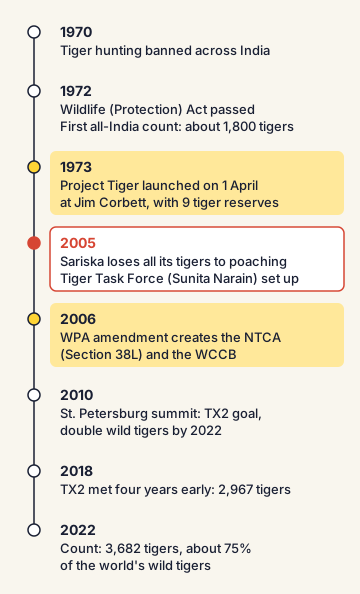
This added a new chapter (Chapter IVB) to the 1972 Act and created the National Tiger Conservation Authority under Section 38L. The same amendment also created the Tiger and Other Endangered Species Crime Control Bureau (now called the Wildlife Crime Control Bureau) to fight wildlife smuggling.
Who sits in the NTCA?
The NTCA is chaired by the Union Minister in charge of Environment, Forest and Climate Change. Its main members are:
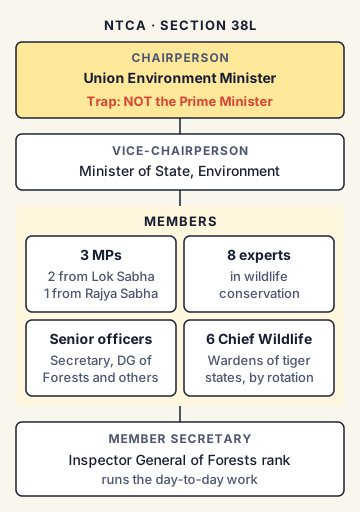
- The Minister of State in the same ministry, as Vice-Chairperson
- Three Members of Parliament (two from the Lok Sabha and one from the Rajya Sabha)
- Eight experts in wildlife conservation
- Senior officers such as the Secretary of the ministry, the Director General of Forests and the Director of Wildlife Preservation
- Chief Wildlife Wardens of six tiger reserve states, by rotation
An officer of the rank of Inspector General of Forests serves as its Member Secretary, who runs its day-to-day work. Note: the NTCA is not chaired by the Prime Minister. This is a common exam trap.
What does the NTCA do?
Its powers are listed in Section 38O of the Act. In simple words, it:
- Approves the Tiger Conservation Plan that each state prepares for its tiger reserves
- Stops harmful land use, such as mining or big industries, inside tiger reserves
- Sets rules for tourism in tiger reserves, so that safaris do not disturb the animals
- Gives money and technical guidance to states for tiger protection
- Prepares a report on tigers every year for Parliament
- Looks after other big-cat work too. The NTCA is the main body that runs Project Cheetah, India's plan to bring cheetahs back to its forests. In May 2023, it set up a Cheetah Project Steering Committee of experts to watch over and guide this project.
How does a tiger reserve work?
A tiger reserve is not just a fence around a forest. Under Section 38V, the state government, on the NTCA's advice, notifies an area as a tiger reserve. Each reserve has two parts:
- Core area (Critical Tiger Habitat): the heart of the reserve. It is kept as free of human activity as possible ("inviolate") so tigers can breed safely. This must be decided on scientific grounds, and the rights of tribal people and forest dwellers must be settled first.
- Buffer area: the ring of land around the core. People live and work here, but some limits apply. It acts like a cushion between the core and the busy world outside, and gives young tigers room to spread out.
Every reserve must also have a Tiger Conservation Plan with three parts: a core plan, a buffer plan, and a plan for the corridors that connect it to other forests. Under Section 38X, each state must set up a Tiger Conservation Foundation for its reserves. This body supports local people through eco-tourism and eco-development, so that villagers gain from the forest instead of seeing it as a burden.
How is Project Tiger funded?
Project Tiger is a Centrally Sponsored Scheme. This means the Centre and the states share the cost. For most states, the share is 60:40 (Centre:State). For the North-Eastern and Himalayan states, the Centre pays 90%. In 2023, the government merged the offices of Project Tiger and Project Elephant into one Project Tiger and Elephant Division in the environment ministry.
How are tigers counted?
India counts its tigers every four years through the All India Tiger Estimation (AITE), run by the NTCA with the Wildlife Institute of India. Forest staff look for tiger signs (pugmarks, scratch marks, droppings), set up camera traps (cameras that click when an animal walks past) and collect samples for DNA testing. Each tiger's stripe pattern is unique, like a human fingerprint, so the cameras can tell tigers apart.
- 2006: about 1,411 tigers
- 2018: 2,967 tigers
- 2022 (the fifth cycle): 3,682 tigers on average (range up to 3,925), about 75% of the world's wild tigers. Madhya Pradesh had the most tigers of any state (785), followed by Karnataka (563) and Uttarakhand (560). The full report, released in July 2023, said India's tiger numbers were growing at about 6.1% a year.
The sixth cycle began in January 2026, and its report is expected in 2027.
India's position and the wider picture
As of 2026, India has 58 tiger reserves across 18 states. The 58th, Madhav Tiger Reserve in Madhya Pradesh, was notified in March 2025. Madhya Pradesh has the most reserves (9). Nagarjunsagar-Srisailam (Andhra Pradesh and Telangana) is the largest. Internationally:
- The Global Tiger Forum, an inter-government body of tiger range countries, was set up in 1994 with its headquarters in New Delhi.
- At the St. Petersburg Tiger Summit (2010), 13 tiger range countries agreed on TX2: doubling wild tiger numbers by 2022. India achieved this goal four years early, in 2018.
- The tiger is listed as Endangered on the IUCN Red List, is in Schedule I of the Wildlife (Protection) Act, and in Appendix I of CITES (the global treaty on wildlife trade).
- India launched the International Big Cat Alliance (IBCA) in 2023, during the 50th year of Project Tiger, to protect seven big cats worldwide.
Commonly confused concepts
- Tiger Reserve vs National Park vs Wildlife Sanctuary: A National Park and a Wildlife Sanctuary are protected areas created under the Wildlife (Protection) Act. A National Park has stricter rules: no human rights such as grazing are allowed inside. A Sanctuary may allow some regulated activity. A Tiger Reserve is a special label, usually covering a National Park or Sanctuary as its core plus a buffer zone, created under Section 38V for tiger conservation.
- NTCA vs Wildlife Crime Control Bureau (WCCB): Both were created by the 2006 amendment. The NTCA plans and supervises tiger conservation. The WCCB fights wildlife smuggling and crime.
- Project Tiger vs NTCA: Project Tiger is the programme (the scheme and its money). NTCA is the legal body (the authority) that runs it.
- Core vs Buffer: Core is kept inviolate for tigers; buffer allows human use with limits.
Issues, criticism and the way forward
- Too many tigers in some places, none in others: Reserves like Corbett, Bandipur and Kanha are full, while many forests in the Northeast, Odisha and Jharkhand have very few tigers. This is why moving tigers (translocation) is now being used.
- Human-tiger conflict: As tigers increase and spill out of reserves, they come into contact with villages, killing cattle and sometimes people. This creates anger against conservation.
- Relocation of villages: Making core areas inviolate means moving people out. Critics argue this is sometimes done without full consent or fair compensation, which goes against the Forest Rights Act, 2006. The official rule is that relocation must be voluntary.
- Broken corridors: Roads, railways, mines and canals cut the forest paths that tigers use to travel between reserves. Isolated groups of tigers lose genetic diversity (inbreeding).
- Poaching has reduced but not ended, because the illegal demand for tiger parts continues.
- Way forward: experts suggest protecting corridors, faster and fairer compensation for losses, involving local communities in eco-tourism income, and reviving prey in empty forests before bringing tigers back.
Concepts to Know
- Umbrella species: A species whose protection automatically protects many other species living in the same area.
- Apex predator: An animal at the very top of the food chain, which no other animal hunts.
- Poaching: Illegal hunting or capture of wild animals, usually to sell their body parts.
- Inviolate: Kept completely free from human disturbance.
- Centrally Sponsored Scheme: A government scheme where the Centre and the states share the cost, and the states carry it out.
- Camera trap: A camera fixed in the forest that clicks a photo automatically when an animal passes by.
- CITES: The Convention on International Trade in Endangered Species, a global treaty that controls trade in wild animals and plants. Appendix I species cannot be traded for commercial purposes.
- Tiger range countries: The 13 countries where wild tigers still live, such as India, Nepal, Bhutan, Bangladesh, Russia and Indonesia.
- Project Tiger launched: 1 April 1973, with 9 reserves; tiger hunting banned in 1970
- NTCA: created by the Wild Life (Protection) Amendment Act, 2006 (operational from late 2005 as an administrative step); Section 38L; Chapter IVB
- NTCA chair: Union Environment Minister; Vice-Chair: Minister of State, Environment
- Section 38O: powers of NTCA; Section 38V: tiger reserves, core and buffer, Tiger Conservation Plan; Section 38X: Tiger Conservation Foundation
- NTCA is the main implementing body of Project Cheetah; it set up the Cheetah Project Steering Committee in May 2023
- Funding: 60:40 (general states), 90:10 (North-Eastern and Himalayan states)
- AITE 2022: 3,682 tigers (about 75% of world's wild tigers), growing about 6.1% a year; AITE is done every 4 years; top state: Madhya Pradesh (785)
- 58 tiger reserves (as of 2026); 58th: Madhav (Madhya Pradesh), March 2025
- Global Tiger Forum: 1994, New Delhi; TX2 goal: St. Petersburg, 2010
- Tiger: IUCN Endangered; WPA Schedule I; CITES Appendix I
- 9 Oct 2026Added that the 2022 tiger count report found India's tiger numbers growing at about 6.1% a year.
- 8 Oct 2026Added the NTCA's role in running Project Cheetah and Madhya Pradesh's top state tiger count (785) from the 2022 estimation.
● Tracked since February 06, 2026 · last seen October 08, 2026 · updates as the daily brief publishes