Veerangana Durgavati Tiger Reserve
Veerangana Durgavati Tiger Reserve (VDTR) is a tiger reserve in central Madhya Pradesh, spread across Sagar, Damoh and Narsinghpur districts. It is also called the Nauradehi Tiger Reserve. With an area of about 2,339 sq km, it is Madhya Pradesh's largest tiger reserve. It was notified in September 2023 as India's 54th tiger reserve and Madhya Pradesh's seventh.
Why was it created?
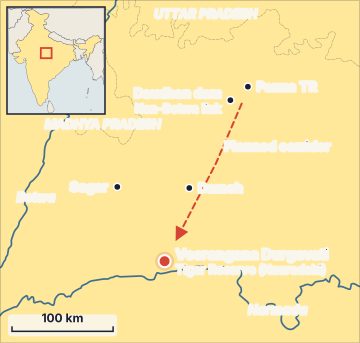
The biggest reason is the Ken-Betwa River Link Project. This project will build a dam on the Ken river to send extra water to the Betwa river for Bundelkhand. Part of Panna Tiger Reserve will go under water because of it. When the Central Government approved the project, one of its conditions was to give tigers new, protected space. So two existing sanctuaries were joined to form VDTR. A green corridor linking Panna to VDTR is planned, so that tigers can move between the two.
Where did it come from?
The reserve was built by joining two older protected areas:
- Nauradehi Wildlife Sanctuary, declared in 1975, about 1,197 sq km. It was the largest wildlife sanctuary in Madhya Pradesh.
- Veerangana Durgavati Wildlife Sanctuary, a small sanctuary in Damoh district, notified in the mid-1990s (sources give 1996 or 1997).
Nauradehi had lost its tigers. In 2018, the forest department brought a tigress named Radha from Kanha and a male named Kishan from Bandhavgarh. In 2019, Radha gave birth to cubs, the first tiger births there in many years. This successful reintroduction (bringing back a species to a place it had disappeared from) helped make the case for a tiger reserve.
Who was Rani Durgavati?
The reserve is named after Rani Durgavati (1524 to 1564), a queen of the Gond kingdom of Garha-Katanga in central India. She ruled as regent (on behalf of her young son) after her husband died. In 1564, the Mughal commander Asaf Khan attacked her kingdom. She fought him at Narrai, between hills and the Gaur and Narmada rivers. When she was badly wounded, she took her own life rather than be captured. "Veerangana" means brave woman warrior.
How is it laid out?
Like every tiger reserve, VDTR has two zones:
- Core (critical tiger habitat): about 1,414 sq km, kept free of most human use so tigers can breed safely.
- Buffer: about 925 sq km around the core, where people live and work but activities are managed so that wildlife and people can share the land.
The reserve sits on the plateau of the Vindhyan range. About three-fourths of the old Nauradehi area drains into the Yamuna (Ganga) basin and about one-fourth into the Narmada basin. It works as a wildlife corridor connecting Panna in the north towards Satpura and other central Indian forests.
What lives there?
The forest is tropical dry deciduous (trees shed leaves in the dry season), with teak as the main tree, plus open grasslands, scrub and rocky patches.
- Predators: tiger, leopard, Indian wolf, striped hyena, jackal and sloth bear
- Herbivores: chital, sambar, nilgai, chinkara, blackbuck and four-horned antelope
- Birds: about 177 species recorded; the area is important for India's endangered vultures
The mix of open grassland and prey such as chinkara is the reason it suits cheetahs.
India's tiger reserves and Madhya Pradesh
Tiger reserves are notified by state governments under Section 38V of the Wildlife (Protection) Act, 1972, on the advice of the National Tiger Conservation Authority (NTCA). Madhya Pradesh is called the "Tiger State" because it had the most tigers (785) in the 2022 All India Tiger Estimation. Its tiger reserves are Kanha, Bandhavgarh, Pench, Satpura, Panna, Sanjay-Dubri, Veerangana Durgavati, Ratapani and Madhav. VDTR was the seventh; Ratapani and Madhav were added later, making nine.
Commonly confused concepts
- Wildlife Sanctuary vs National Park vs Tiger Reserve: A sanctuary (Section 18) allows some regulated human activities, such as grazing. A National Park (Section 35) gives stricter protection, with no grazing or private rights. A Tiger Reserve (Section 38V) is a special label laid over such areas, with a core and buffer, and is supervised by the NTCA. VDTR was formed from two sanctuaries.
- VDTR vs Panna Tiger Reserve: Both are in Bundelkhand. Panna (in Panna and Chhatarpur districts) is the older reserve famous for bringing tigers back after losing all of them by 2009. VDTR is the new reserve created partly to make up for Panna land lost to the Ken-Betwa project.
- Nauradehi vs Noradehi: These are just two spellings of the same place.
Issues, criticism and the way forward
- Village relocation: Many villages lie inside the reserve. Moving them out of the core must be voluntary and fair, with proper compensation under the law.
- Corridor gaps: Roads, farms and canals can cut the planned link to Panna. Without a working corridor, tigers displaced by the Ken-Betwa project may not reach VDTR.
- Irrigation projects: Reports say a proposed irrigation project (Kopra) could affect about 272 hectares of forest in the reserve.
- Prey base: Both tigers and cheetahs need enough prey. Building up chital, sambar and chinkara numbers is necessary before adding more big cats.
- Way forward: Experts suggest secure corridors, community benefit-sharing (such as eco-tourism income and homestays), and careful monitoring of how tigers, leopards and cheetahs share the same space.
Concepts to Know
- Tiger reserve: An area set aside mainly to protect tigers and their habitat, made up of a core zone and a buffer zone, and monitored by the NTCA.
- Critical tiger habitat: The core area of a tiger reserve that must be kept free of human disturbance so tigers can breed and live safely.
- River linking (interlinking of rivers): Building dams and canals to move extra water from one river to another river that has less water.
- Wildlife corridor: A strip of forest or natural land that connects two protected areas, so animals can move safely between them.
- Regent: A person who rules on behalf of a king or queen who is too young to rule.
- Dry deciduous forest: A forest whose trees drop their leaves in the hot, dry months to save water.
- Location: Sagar, Damoh and Narsinghpur districts, Madhya Pradesh (Bundelkhand region)
- Area: about 2,339 sq km (core about 1,414 sq km; buffer about 925 sq km); MP's largest tiger reserve
- Notified: September 2023; India's 54th tiger reserve and MP's 7th
- Formed from Nauradehi Wildlife Sanctuary (1975, about 1,197 sq km) and Veerangana Durgavati Wildlife Sanctuary (Damoh)
- Created partly as a condition of the Ken-Betwa River Link Project, which will submerge part of Panna Tiger Reserve
- Tigers reintroduced to Nauradehi in 2018 (Radha from Kanha, Kishan from Bandhavgarh)
- Named after Rani Durgavati (1524 to 1564), Gond queen of Garha-Katanga; died after the battle near Narrai (1564)
- Vindhyan plateau; drains to the Yamuna (Ganga) and Narmada basins; tropical dry deciduous forest with teak
- Legal basis for tiger reserves: Section 38V, Wildlife (Protection) Act, 1972
- MP now has nine tiger reserves; it had 785 tigers in the 2022 tiger estimation
● Tracked since February 06, 2026 · last seen October 07, 2026 · updates as the daily brief publishes