Sathyamangalam Tiger Reserve (STR)
Sathyamangalam Tiger Reserve (STR) is a tiger reserve in Erode district of Tamil Nadu, close to the Karnataka border. It covers about 1,408 sq km. It is special because it sits exactly where the Western Ghats and the Eastern Ghats meet, so it acts like a bridge that lets animals move between these two great hill ranges. It was notified as a tiger reserve in March 2013, the fourth in Tamil Nadu.
Why is it important?
Picture the forests of south India as rooms in a big house. If the doors between rooms are shut, animals in each room get trapped and slowly weaken because they can only breed among themselves. STR is one of the main "doors". It connects some of the most important tiger and elephant forests of the country, so tigers and elephants can move, find mates and new territory. This movement keeps their populations healthy. That is why scientists call such areas wildlife corridors.
Where did it come from?
STR was built up in steps:
- 22 August 1980: The Sathyamangalam Forest Division was formed.
- 3 November 2008: The lower part of the forest (524.34 sq km) was declared the Sathyamangalam Wildlife Sanctuary.
- August 2011: An upper part of 887.26 sq km was added, taking the sanctuary to about 1,411.6 sq km. This made it the largest wildlife sanctuary in Tamil Nadu.
- March 2013: The area was notified as the Sathyamangalam Tiger Reserve (the State order is dated 15 March 2013). It became the fourth tiger reserve in Tamil Nadu.
How is it laid out?
Like every tiger reserve, STR has two zones:
- Core zone (critical tiger habitat): about 793 sq km. This is the heart of the reserve, kept free of human disturbance as far as possible.
- Buffer zone: about 615 sq km. This is the outer ring around the core where people live and some regulated activity is allowed, but in a way that does not harm wildlife.
The reserve is run by the Tamil Nadu Forest Department through two divisions, Sathyamangalam and Hasanur. It spreads over parts of the Sathyamangalam and Talavadi (Thalavady) taluks.
Where exactly is it on the map?
STR lies in the north-western corner of Tamil Nadu. Its neighbours form one long chain of protected forests:
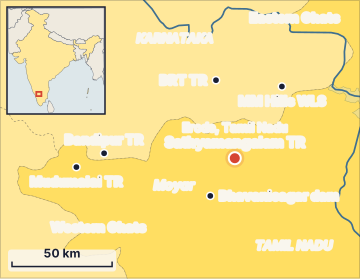
- Mudumalai Tiger Reserve (Tamil Nadu) and Bandipur Tiger Reserve (Karnataka) to the west
- Biligiri Ranganaswamy Temple (BRT) Tiger Reserve and Male Mahadeshwara (MM) Hills Wildlife Sanctuary (Karnataka) to the north
- Cauvery Wildlife Sanctuary (Karnataka) further to the north-east
- The Sigur Plateau to the south-west
Two rivers mark its edges: the Moyar and the Bhavani. The Bhavanisagar dam on the Bhavani river lies at the reserve's southern edge. STR is also part of the Nilgiri Biosphere Reserve, India's first biosphere reserve (1986), and of the Nilgiri-Eastern Ghats Elephant Reserve.
What lives there?
STR has five forest types: evergreen (shola), semi-evergreen, mixed deciduous, dry deciduous and thorn forest. Most of it is dry deciduous forest, where trees shed their leaves in the dry season.
- Tigers: The official count rose from about 18 in 2010 to about 112 in the 2024-25 camera-trap census. Because of this rise, STR received the TX2 award in 2022, given for doubling wild tiger numbers.
- Asian elephants: several hundred; the reserve is a key elephant corridor.
- Other animals: leopards, striped hyenas, Indian gaur, blackbuck, sloth bears and spotted deer.
- Vultures: The Moyar river valley is one of the last nesting areas in south India for vultures, including the critically endangered white-rumped and long-billed vultures.
- Birds: more than 220 species recorded.
People and history
Tribal communities such as the Irulas and Soligas live in and around the forest. For many years the area was known for the forest brigand Veerappan, who smuggled sandalwood and ivory. He was killed by the Tamil Nadu Police in October 2004. After that, the forest became safer, and protection work could grow.
Commonly confused concepts
- Sathyamangalam vs Mudumalai: Both are Tamil Nadu tiger reserves in the Nilgiri landscape. Mudumalai (notified 2007) lies in the Nilgiris district; Sathyamangalam (2013) lies in Erode district and connects the Western and Eastern Ghats.
- Tamil Nadu's tiger reserves (5): Kalakad-Mundanthurai, Anamalai, Mudumalai, Sathyamangalam and Srivilliputhur-Megamalai (the newest, 2021).
- Tiger reserve vs wildlife sanctuary: STR is both. The sanctuary is the legal protected area under the Wildlife Act; the tiger reserve is an extra layer, notified under Section 38V of the same Act, with core and buffer zones and a tiger conservation plan.
- Biosphere reserve vs tiger reserve: A biosphere reserve (like the Nilgiri Biosphere Reserve) is a large landscape recognised mainly for research and sustainable use, with no separate strong law behind it. A tiger reserve has legal protection under the Wildlife (Protection) Act, 1972.
Issues, criticism and the way forward
- Illegal tourism buildings: Resorts, lodges and farmhouses have come up in and around the reserve without approval. They bring lights, noise, vehicles, fences and waste into animal paths.
- Roads through the forest: National Highway 948 passes through the reserve. Many animals were killed by vehicles at night. Since February 2022, vehicles have been banned on the Bannari-Dhimbam stretch from 6 pm to 6 am, with exemptions for local villagers. The Madras High Court upheld this ban. Farmers and transporters say it hurts their business.
- Human-elephant conflict: Elephants raid crops, and some have died from illegal electric fences.
- Other threats: forest fires, cattle grazing inside the forest, and invasive plants like Lantana that crowd out grass for deer and gaur.
- Way forward: Experts suggest strict action on illegal buildings, notified eco-sensitive zones, safe animal crossings on highways, and community-based tourism that gives local tribal people jobs without harming the forest.
Concepts to Know
- Wildlife corridor: A strip of forest that connects two larger forests, so animals can move safely between them.
- Critical tiger habitat: The core area of a tiger reserve that must be kept free of disturbance for tigers to breed and live.
- TX2: A global goal, agreed by 13 tiger-range countries in 2010, to double the number of wild tigers by 2022. The TX2 award is given to sites that achieve this.
- Critically endangered: The most serious IUCN Red List category before a species becomes extinct in the wild.
- Deciduous forest: A forest whose trees shed their leaves in one season (usually the dry summer) to save water.
- Location: Erode district, Tamil Nadu; junction of Western and Eastern Ghats
- Total area: about 1,408 sq km (core about 793 sq km, buffer about 615 sq km)
- Wildlife sanctuary: 3 November 2008; expanded in August 2011 to about 1,411.6 sq km (largest in Tamil Nadu)
- Tiger reserve: notified March 2013; 4th in Tamil Nadu
- Rivers: Moyar and Bhavani
- Part of Nilgiri Biosphere Reserve and Nilgiri-Eastern Ghats Elephant Reserve
- Tigers: about 18 (2010) to about 112 (2024-25); TX2 award in 2022
- Night traffic ban on NH 948 (Bannari-Dhimbam), 6 pm to 6 am, since February 2022
● Tracked since November 03, 2026 · last seen November 03, 2026 · updates as the daily brief publishes