Rashtriya Gram Swaraj Abhiyan (RGSA)
The Rashtriya Gram Swaraj Abhiyan (RGSA) was a Centrally Sponsored Scheme of the Ministry of Panchayati Raj that helped panchayats become stronger. It paid for training of elected representatives, buildings and computers for panchayats, digital systems for accounts and planning, and awards for good-performing panchayats. Its last phase ran from 2022-23 to 2025-26. The Pradhan Mantri Viksit Gram Swaraj Yojana, approved in October 2026, continues similar work for 2026-31.
Why does it exist?
The Constitution gives panchayats a place, but a newly elected sarpanch may not know how to make a plan, keep accounts or use a government portal. Many panchayats did not even have their own office building. Without help, panchayats cannot use the powers and money they receive. RGSA was created to build this capacity: the skills, systems and buildings panchayats need to work well.
Think of it like a new shop owner who has got a licence but now needs training, a counter and a billing machine.
Where did it come from?
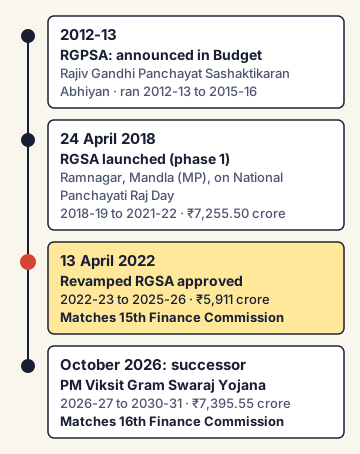
- Rajiv Gandhi Panchayat Sashaktikaran Abhiyan (RGPSA): Announced in the Union Budget 2012-13, it ran from 2012-13 to 2015-16 with similar goals, including stronger Gram Sabhas in PESA areas.
- RGSA, first phase (2018-19 to 2021-22): Approved by the Cabinet in April 2018 with an outlay of ₹7,255.50 crore (Centre ₹4,500 crore, states ₹2,755.50 crore). It was launched on 24 April 2018, National Panchayati Raj Day, at Ramnagar in Mandla district, Madhya Pradesh.
- Revamped RGSA (2022-23 to 2025-26): Approved on 13 April 2022 with an outlay of ₹5,911 crore (Centre ₹3,700 crore, states ₹2,211 crore). Its period matched that of the Fifteenth Finance Commission.
- PM Viksit Gram Swaraj Yojana (2026-27 to 2030-31): Approved in October 2026 with ₹7,395.55 crore, matching the Sixteenth Finance Commission period.
How does it work?
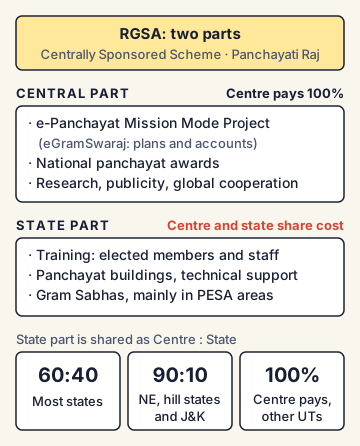
The scheme has two parts:
- Central component: Paid fully by the Centre. It included the e-Panchayat Mission Mode Project (digital tools like eGramSwaraj for planning and accounts), incentivisation of panchayats (national panchayat awards), action research and publicity, and international cooperation.
- State component: Shared between the Centre and states. It covered training of elected representatives and staff, panchayat buildings, technical support, and help to Gram Sabhas, especially in PESA areas.
Each state prepared an annual action plan saying what training and support it needed. A central committee approved it, and money was released in instalments.
Funding pattern (state component)
- 60:40 (Centre : State) for most states
- 90:10 for North-Eastern and Himalayan (hill) states and Jammu and Kashmir
- 100% central funding for other Union Territories
Focus on local SDGs
The revamped RGSA pushed panchayats to plan around Localisation of Sustainable Development Goals (LSDGs). Instead of 17 global goals, panchayats work on simpler themes such as a poverty-free village, a healthy village, a child-friendly village, a water-sufficient village, a clean and green village, and a women-friendly village. This made village plans focus on outcomes, not just construction.
Commonly confused concepts
- RGSA vs SVAMITVA: RGSA builds panchayat capacity. SVAMITVA is a separate Central Sector Scheme that uses drones to map village homes and give property cards.
- RGSA vs Finance Commission grants: RGSA money pays for training, systems and buildings. Finance Commission grants (under Article 280) are larger untied and tied funds that panchayats spend on local works like water and sanitation.
- Centrally Sponsored Scheme vs Central Sector Scheme: In a CSS (like RGSA and PM-VGSY), the Centre and states share the cost and states implement it. In a Central Sector Scheme, the Centre pays 100% and runs it through its own agencies.
Issues, criticism and the way forward
- Training without follow-up: One-time training sessions often do not change how a panchayat works. Experts suggest regular, hands-on, local-language training.
- Low state share and delays: Some states release their share late, which slows down training and buildings.
- Focus on inputs: Success was often measured by "number of people trained" instead of better services in villages.
- Way forward: Link funding to results (better plans, timely audits, more own revenue), use digital tools for tracking, and let panchayats decide their own priorities. The new PM-VGSY claims to move in this direction.
Concepts to Know
- Capacity building: Giving people and institutions the skills, tools and systems they need to do their job well.
- Centrally Sponsored Scheme (CSS): A scheme designed by the Centre but carried out by states, with the cost shared in a fixed ratio.
- Mission Mode Project: A large government IT project with clear goals, timelines and funding, like e-Panchayat.
- eGramSwaraj: A government web portal where panchayats prepare plans, record spending and track progress of works.
- Outlay: The total amount of money the government plans to spend on a scheme over a period.
- Nodal ministry: Ministry of Panchayati Raj
- Predecessor: Rajiv Gandhi Panchayat Sashaktikaran Abhiyan (from Budget 2012-13)
- RGSA phase 1: 2018-19 to 2021-22, ₹7,255.50 crore; launched 24 April 2018 at Ramnagar (Mandla, MP)
- Revamped RGSA: approved 13 April 2022, 2022-23 to 2025-26, ₹5,911 crore (Centre ₹3,700 crore; states ₹2,211 crore)
- Funding: 60:40; 90:10 for NE, hill states and J&K; 100% for other UTs
- Successor: PM Viksit Gram Swaraj Yojana, 2026-27 to 2030-31, ₹7,395.55 crore
● Tracked since October 28, 2026 · last seen October 28, 2026 · updates as the daily brief publishes