Gram Panchayat Development Plan (GPDP)
A Gram Panchayat Development Plan (GPDP) is a yearly plan that each village panchayat makes to decide what development work it will do and how it will pay for it. The people of the village, through the Gram Sabha, say what they need: a water tank, a road, a school wall or a drain. The panchayat then matches these needs with the money it has from the Finance Commission, state funds and central schemes. In short, it is "planning from below": the village decides, instead of officers in a distant office.
Why does it exist?
For decades, most rural development was planned at the top. A ministry in Delhi or a state capital designed a scheme and sent it to every village in the same form. A village with plenty of water might get a water scheme, while one that needed a bridge got nothing. Money also came in many separate streams, each with its own rules.
Different departments sometimes built the same thing twice. A GPDP tries to fix this. The people who live in the village know its needs best. One combined plan helps all the money streams work together. This joining of schemes is called convergence.
What does the Constitution say?
The base is the 73rd Constitutional Amendment Act, 1992, which came into force on 24 April 1993. (That is why 24 April is observed as National Panchayati Raj Day.)
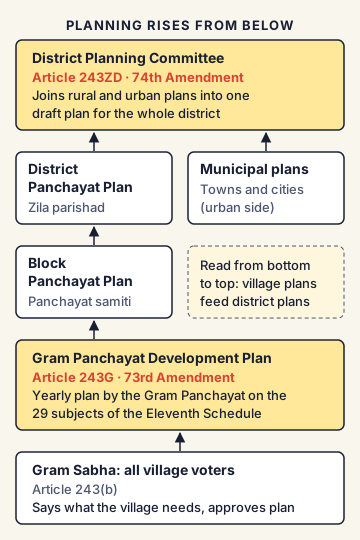
- Article 243G says the state legislature may give panchayats powers to prepare plans for economic development and social justice, and to carry out schemes. This includes the 29 subjects listed in the Eleventh Schedule, such as agriculture, drinking water, minor irrigation, rural roads, poverty reduction and primary education.
- Article 243(b) defines the Gram Sabha as the body of all people on the voter list of a village panchayat area.
- Article 243ZD (added by the 74th Amendment) provides for a District Planning Committee in every district. It joins the plans of panchayats and municipalities into a draft plan for the whole district.
So the Constitution expects planning to start at the village and rise up to the district.
Where did it come from?
Bottom-up planning has a long history in India.
- Kerala's People's Plan Campaign, launched in August 1996, was a pioneer. Kerala decided to give 35-40% of its plan funds to local governments and asked them to make their own plans with public participation.
- In 2015, the 14th Finance Commission (award period 2015-20) gave large grants directly to gram panchayats: about ₹2,00,292 crore for five years. The money came with a condition: it should be spent through a proper plan. So from 2015-16, every gram panchayat had to prepare a GPDP.
- In 2017-18, the Mission Antyodaya survey began. It collects data on facilities and gaps in every gram panchayat (for example, whether a village has a school, a health centre or piped water). This data helps panchayats see what is missing.
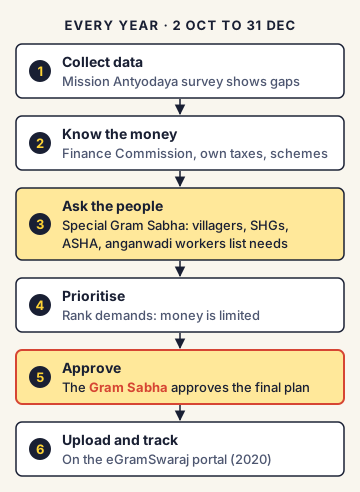
- On 2 October 2018, the Ministry of Panchayati Raj launched the People's Plan Campaign, called "Sabki Yojana Sabka Vikas" ("everyone's plan, everyone's development"). It now runs every year from 2 October to 31 December, when Gram Sabhas meet to make the next year's plan.
- The 15th Finance Commission gave panchayats ₹2,36,805 crore for 2021-26, split into untied grants (for any of the 29 subjects) and tied grants (for water and sanitation).
- Planning was later extended to the block level (Block Panchayat Development Plan) and district level (District Panchayat Development Plan).
How is a GPDP made, step by step?
- Collect data: The panchayat studies its situation using the Mission Antyodaya survey and its own records. This shows the gaps.
- Know the money: It lists the funds it can expect in the coming year: Finance Commission grants, its own taxes and fees, state funds and scheme money.
- Ask the people: A special Gram Sabha meets. Villagers, women's self-help groups and frontline workers (like anganwadi and ASHA workers) say what the village needs.
- Prioritise: The panchayat ranks the demands, because money is limited.
- Approve: The Gram Sabha approves the final plan.
- Upload and track: The plan is uploaded on the eGramSwaraj portal, launched on 24 April 2020, which also tracks spending and progress.
Think of it like a family budget. The family first checks its monthly income, then lists what it needs (school fees, ration, repairs), and finally decides together what comes first.
Thematic planning (the SDG link)
The Ministry of Panchayati Raj grouped the 17 UN Sustainable Development Goals (SDGs) into nine themes for villages. This is called Localisation of SDGs (LSDGs). Panchayats choose themes and plan around them:
- Poverty-free and enhanced livelihood panchayat
- Healthy panchayat
- Child-friendly panchayat
- Water-sufficient panchayat
- Clean and green panchayat
- Self-sufficient infrastructure panchayat
- Socially secured panchayat
- Panchayat with good governance
- Women-friendly panchayat
India's position and examples
As per official data, more than 17.7 lakh GPDPs were uploaded between 2019-20 and 2025-26. Under the VB-G RAM G Act, 2025, the panchayat plan has a new form called the Viksit Gram Panchayat Plan (VGPP). All rural job works must come from the VGPP, approved by the Gram Sabha. These plans are mapped onto PM Gati Shakti and combined nationally through the Viksit Bharat National Rural Infrastructure Stack.
Commonly confused concepts
- GPDP vs Gram Sabha: The GPDP is the plan. The Gram Sabha is the assembly of village voters that discusses and approves it.
- Gram Sabha vs Gram Panchayat: The Gram Sabha is all adult voters of the village. The Gram Panchayat is the smaller elected body (sarpanch and ward members) that runs the village and carries out the plan.
- Article 243G vs Article 243ZD: Article 243G lets states give panchayats planning powers. Article 243ZD creates the District Planning Committee that joins rural and urban plans for a district.
- Eleventh vs Twelfth Schedule: The Eleventh Schedule lists 29 subjects for panchayats (73rd Amendment). The Twelfth Schedule lists 18 subjects for municipalities (74th Amendment).
- Untied vs tied grants: Untied grants can be spent on any local need within the 29 subjects. Tied grants must be used for set purposes, such as water and sanitation.
Issues, criticism and the way forward
- Weak devolution: Article 243G uses the word "may", so the transfer of powers depends on each state. Many states have not fully handed over the "3 Fs": funds, functions and functionaries (staff).
- Low participation: Gram Sabha meetings often have low attendance, especially of women and marginalised groups. Some plans are written by officials and only approved as a formality.
- Wish lists: Many plans list demands without matching them to real money, so they cannot be carried out.
- Lack of technical staff: Panchayats often lack engineers, accountants and planners.
- Scheme-driven plans: When most money comes tied to central schemes, the plan may follow scheme rules more than village needs.
- Way forward: Experts and official reviews suggest fuller devolution of the 3 Fs, stronger panchayat staff, better training for elected members, wider use of village data for gap analysis, and making District Planning Committees work properly so village plans feed into district plans.
Concepts to Know
- Panchayati Raj: India's system of rural local self-government with three levels: village (gram panchayat), block (panchayat samiti) and district (zila parishad).
- Devolution: Handing over real powers, money and staff from a higher government to a lower one.
- Convergence: Joining different schemes and funds in one plan so they support each other instead of overlapping.
- Gap analysis: Comparing what a village has with what it should have, to find what is missing.
- Finance Commission: A body set up under Article 280 every five years to recommend how tax money is shared between the Centre and states, and grants for local bodies.
- Eleventh Schedule: The part of the Constitution listing 29 subjects, like agriculture and drinking water, that states may hand over to panchayats.
- 73rd Constitutional Amendment Act, 1992; in force 24 April 1993 (National Panchayati Raj Day)
- Article 243G: panchayats may prepare plans for economic development and social justice; Eleventh Schedule has 29 subjects
- Article 243ZD: District Planning Committee (74th Amendment)
- GPDP mandatory from 2015-16, linked to 14th Finance Commission grants of about ₹2,00,292 crore to gram panchayats (2015-20)
- 15th Finance Commission grants to rural local bodies: ₹2,36,805 crore (2021-26), untied and tied (water and sanitation)
- People's Plan Campaign "Sabki Yojana Sabka Vikas": launched 2 October 2018; held 2 October to 31 December each year
- eGramSwaraj portal: launched 24 April 2020
- LSDGs: 17 SDGs grouped into 9 themes for panchayats
- Kerala People's Plan Campaign: August 1996; 35-40% of plan funds to local bodies
- Under VB-G RAM G: Viksit Gram Panchayat Plan (VGPP), approved by the Gram Sabha, aggregated through the Viksit Bharat National Rural Infrastructure Stack
● Tracked since October 06, 2026 · last seen October 06, 2026 · updates as the daily brief publishes