Gram Sabha
Updated 10 Oct 2026: Added how the Gram Sabha works under the Forest Rights Act: its quorum, the Forest Rights Committee and community forest committees.
The Gram Sabha is the assembly of all adult voters of a village. Every person whose name is on the electoral roll (voter list) of the village panchayat area is automatically a member. It is the foundation of the Panchayati Raj system and the only body in India's government where citizens take part directly, without electing someone to speak for them. The Constitution defines it in Article 243(b) and gives it a role through Article 243A.
Why does it exist?
In a village, the elected panchayat makes decisions for everyone. But who checks the panchayat? The Gram Sabha does. It is like the general body meeting of a housing society: the elected committee runs things day to day, but all residents meet to approve the budget, question the committee and set priorities. The Gram Sabha brings direct democracy, transparency and accountability to the village level.
Where did it come from?
- Article 40 (a Directive Principle of State Policy) asks the State to organise village panchayats and give them powers to work as units of self-government. Mahatma Gandhi's idea of Gram Swaraj (village self-rule) inspired this.
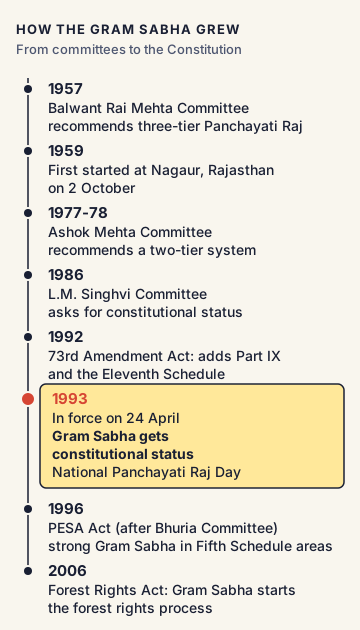
- Balwant Rai Mehta Committee (1957): recommended a three-tier Panchayati Raj system (village, block, district). Rajasthan was the first state to start it, at Nagaur on 2 October 1959.
- Ashok Mehta Committee (1977-78): recommended a two-tier system.
- L.M. Singhvi Committee (1986): recommended constitutional status for panchayats and called the Gram Sabha the embodiment of direct democracy.
- 73rd Constitutional Amendment Act, 1992: added Part IX (Articles 243 to 243O) and the Eleventh Schedule to the Constitution. It came into force on 24 April 1993, now celebrated as National Panchayati Raj Day. For the first time, the Gram Sabha got constitutional recognition.
What does the Constitution say?
- Article 243(b): defines "Gram Sabha" as a body made up of persons registered in the electoral rolls relating to a village within the area of a Panchayat at the village level.
- Article 243A: says the Gram Sabha may exercise such powers and perform such functions at the village level as the State Legislature may provide by law.
This means the Constitution creates the Gram Sabha, but each state decides its exact powers through its own Panchayati Raj Act. That is why its role differs from state to state.
What does a Gram Sabha usually do?
Under most state laws, it:
- Approves the Gram Panchayat Development Plan (GPDP), the village's yearly plan for spending its funds
- Selects or approves beneficiaries of government schemes (for example, housing, pensions)
- Identifies and ranks the works for the rural jobs guarantee. Under the VB-G RAM G Act, 2025 (Viksit Bharat: Guarantee for Rozgar and Ajeevika Mission (Gramin)), these works go into the Viksit Gram Panchayat Plan (VGPP). The Gram Panchayat prepares this plan through the Gram Sabha.
- Conducts social audits, checking whether money under rural job schemes was spent properly. MGNREGA (2005) first gave Gram Sabhas this role. Its replacement, the VB-G RAM G Act, keeps a strengthened social audit.
- Reviews the panchayat's accounts and the progress of works
- Passes resolutions, such as certifying a village as Har Ghar Jal or Open Defecation Free (ODF)
How often does it meet?
State laws usually require at least two to four meetings a year. The Ministry of Panchayati Raj encourages states to hold Gram Sabhas on four national days: 26 January (Republic Day), 1 May (Labour Day), 15 August (Independence Day) and 2 October (Gandhi Jayanti). Each state sets a quorum (minimum attendance needed for a valid meeting), often a fixed share of members, sometimes with a minimum number of women.
Special powers in tribal and forest areas
- PESA Act, 1996 (Panchayats (Extension to the Scheduled Areas) Act): extends Part IX to Fifth Schedule areas (tribal areas in ten states) with changes. It gives the Gram Sabha strong powers: approving development plans, identifying beneficiaries, ownership of minor forest produce, being consulted before land acquisition, and preventing the alienation (transfer) of tribal land. It followed the Bhuria Committee report of January 1995.
- Forest Rights Act, 2006: makes the Gram Sabha the body that starts the process of recognising individual and community forest rights (Section 6). The FRA Rules, as amended in 2012, set out how it works:
- Quorum: at least one-half of all members must attend (earlier it was two-thirds). At least one-third of those present must be women.
- Forest Rights Committee: the Gram Sabha elects a committee of 10 to 15 members. At least two-thirds must be Scheduled Tribes and at least one-third must be women. This committee helps prepare and check the claims.
- Community forests: the Gram Sabha forms a committee to protect and manage its Community Forest Resource, the forest the village has traditionally protected and used. This committee prepares the plan for looking after that forest.
- Niyamgiri case (2013): In Orissa Mining Corporation v. Ministry of Environment and Forest, the Supreme Court asked the Gram Sabhas of the Niyamgiri hills (Odisha) to decide whether bauxite mining would affect their religious and cultural rights. The Gram Sabhas rejected the project, and it did not go ahead.
Commonly confused concepts
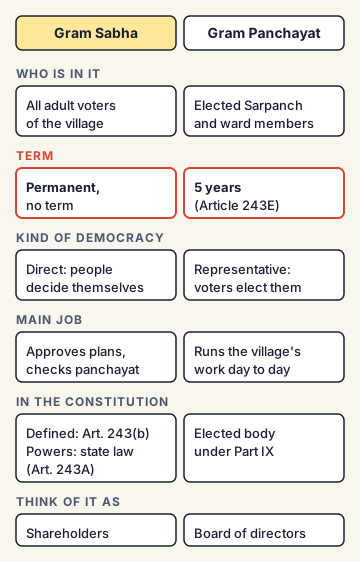
- Gram Sabha vs Gram Panchayat: The Gram Sabha is all adult voters of the village: a permanent body with no term. The Gram Panchayat is the elected executive body (Sarpanch/Pradhan and ward members), elected for five years (Article 243E). The Gram Sabha is like the shareholders; the Gram Panchayat is like the board of directors.
- Article 243(b) vs Article 243A: 243(b) only defines the Gram Sabha; 243A deals with its powers, which come from state law.
- Gram Sabha vs Ward Sabha: A Ward Sabha is a meeting of voters of one ward (a part of a panchayat or municipality). Some states have Ward Sabhas in villages too; in cities, the 74th Amendment provides for Ward Committees (Article 243S), not Gram Sabhas.
- Fifth Schedule vs Sixth Schedule: PESA applies to Fifth Schedule areas. Sixth Schedule areas (tribal areas of Assam, Meghalaya, Tripura and Mizoram) have their own Autonomous District Councils instead.
Issues, criticism and the way forward
- Low attendance: Many Gram Sabhas see poor turnout, especially of women and marginalised groups. Meetings are sometimes held only on paper.
- Weak powers: Because Article 243A leaves powers to the states, many states have given Gram Sabhas only advisory roles.
- Domination by local elites: Powerful families or groups can control discussions, so the poor may not speak freely.
- Poor information: Villagers often do not get the agenda, budgets or scheme details in advance.
- PESA implementation: Several states were slow to frame PESA rules, which limited the Gram Sabha's powers in tribal areas.
- Way forward: Experts suggest fixed meeting calendars, separate Mahila Sabhas (women's meetings) before the main meeting, publishing agendas and accounts in local languages, video recording and digital attendance, and giving real decision-making roles, as in the People's Plan Campaign (Sabki Yojana Sabka Vikas) and JJM's VWSCs.
Concepts to Know
- Electoral roll: The official list of people who can vote in an area.
- Direct democracy: A system where citizens make decisions themselves, instead of only electing representatives to decide for them.
- Directive Principles of State Policy (DPSP): Guidelines in Part IV of the Constitution that the government should follow while making laws. Courts cannot enforce them.
- Eleventh Schedule: A list of 29 subjects, such as agriculture, drinking water and primary education, that states may hand over to panchayats.
- Social audit: A public check by the people themselves of how government money was spent on a scheme in their area.
- Quorum: The minimum number of members who must be present for a meeting to take valid decisions.
- Fifth Schedule areas: Tribal-majority areas in states like Jharkhand, Chhattisgarh, Odisha and Madhya Pradesh that get special protection under the Fifth Schedule of the Constitution.
- VB-G RAM G Act, 2025: The rural jobs law that replaced MGNREGA from 1 July 2026. It promises every rural household at least 125 days of paid manual work a year (up from 100 days).
- Viksit Gram Panchayat Plan (VGPP): The village plan under the VB-G RAM G Act that lists the works where rural job money will be spent. It is linked with national map-based planning tools such as PM Gati Shakti.
- Defined in Article 243(b); powers under Article 243A (as provided by State Legislature)
- 73rd Constitutional Amendment Act, 1992: added Part IX (Articles 243 to 243O) and the Eleventh Schedule (29 subjects); in force from 24 April 1993 (National Panchayati Raj Day)
- Article 40 (DPSP): organisation of village panchayats
- Balwant Rai Mehta Committee (1957): three-tier system; first started in Nagaur, Rajasthan, on 2 October 1959
- Ashok Mehta Committee (1977-78): two-tier system; L.M. Singhvi Committee (1986): constitutional status
- Ministry of Panchayati Raj created in 2004
- Gram Sabhas encouraged on 26 January, 1 May, 15 August and 2 October
- PESA Act, 1996: Gram Sabha powers in Fifth Schedule areas (ten states); based on Bhuria Committee report (January 1995)
- Forest Rights Act, 2006 (Section 6): Gram Sabha starts forest rights claims; FRA Rules (amended 2012): quorum one-half of members, one-third of those present women; Forest Rights Committee of 10 to 15 members
- VB-G RAM G Act, 2025 (in force from 1 July 2026, replacing MGNREGA): rural job works are identified through the Gram Sabha in the Viksit Gram Panchayat Plan; social audits continue
- Gram Panchayat term: 5 years (Article 243E); Gram Sabha is permanent
- 10 Oct 2026Added how the Gram Sabha works under the Forest Rights Act: its quorum, the Forest Rights Committee and community forest committees.
- 7 Oct 2026Added the Gram Sabha's role under the VB-G RAM G Act, which replaced MGNREGA from 1 July 2026.
● Tracked since February 11, 2026 · last seen October 10, 2026 · updates as the daily brief publishes