Centrally Sponsored Schemes (CSS)
Updated 10 Oct 2026: Added that VB-G RAM G replaced MGNREGA from July 2026 with 60:40 sharing and a fixed state-wise normative allocation.
A Centrally Sponsored Scheme (CSS) is a government programme that the Centre designs and part-funds, but the states carry out and also part-fund. For example, under a 60:40 scheme, the Centre pays ₹60 and the state pays ₹40 out of every ₹100 spent. Many of India's biggest welfare programmes in health, education, housing, water and rural jobs are run as CSS.
Why does it exist?
Under India's Constitution, many welfare subjects like health, agriculture and local government are in the State List. So states are the ones who deliver these services. But the Centre collects a larger share of the country's taxes. CSS is a bridge between the two. The Centre uses its money to push national goals, like every home getting a tap connection, while the states use their staff and local knowledge to deliver it.
Think of a parent giving a child pocket money but saying it must be spent on books: the money comes with a purpose attached.
Where does the power come from?
The main constitutional basis is Article 282. It allows the Union and the states to give grants "for any public purpose", even if the subject is not in their own list of powers. Grants under CSS are tied grants, meaning the money can be used only for that scheme. They are different from untied money like the states' share in central taxes, which states can spend as they wish.
Where did it come from?
CSS grew from the Five-Year Plan era. Over time the number of schemes became very large and states complained that too many small schemes with rigid rules took away their freedom. In 2015, the 14th Finance Commission raised the states' share in central taxes from 32% to 42%, giving states more untied money. In March 2015, a Sub-Group of Chief Ministers on Rationalisation of CSS was set up through NITI Aayog. Based on its report, the Union Cabinet in 2016 cut 66 schemes down to 28 umbrella schemes from 2016-17.
How are schemes grouped and funded?
After the 2016 rationalisation, CSS fall into three groups:
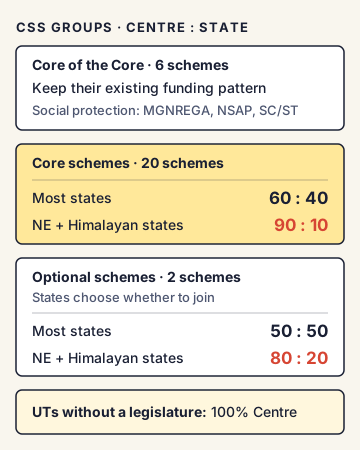
- Core of the Core schemes (6): Mainly social protection and inclusion. These keep their existing funding pattern. MGNREGA, the National Social Assistance Programme and umbrella schemes for Scheduled Castes, Scheduled Tribes, minorities and backward/vulnerable groups were in this list. Under MGNREGA, the Centre paid almost the full wage bill.
- Core schemes: Shared 60:40 between Centre and states. For the 8 North-Eastern states and the Himalayan states, the ratio is 90:10.
- Optional schemes: States can choose whether to join. These are shared 50:50 (80:20 for North-Eastern and Himalayan states).
- Union Territories without a legislature get 100% central funding.
- Scheme-specific ratios: A few schemes set their own ratio. For example, the Jal Jeevan Mission (tap water for every rural home) is shared 50:50 for most states, 90:10 for North-Eastern and Himalayan states, and 100% central for UTs without a legislature. So always check the ratio of the particular scheme.
How does money reach the ground?
The state prepares a yearly plan for the scheme. The Centre approves it and releases its share. The state then adds its own share. Since 2021-22, the Centre uses the Single Nodal Agency (SNA) system: each state opens one account per scheme, so the Centre can track how much money is lying unused. The newer SNA-SPARSH system releases central money "just in time", only when it is actually needed for payments. This saves the Centre from borrowing money that sits idle in state accounts.
India's examples
Jal Jeevan Mission, PM Awaas Yojana-Gramin, Samagra Shiksha, National Health Mission, PM POSHAN and, since 2026, the VB-G RAM G rural job guarantee are all CSS. As of the end of 2025, government data spoke of 81 notified CSS.
- VB-G RAM G (Viksit Bharat Guarantee for Rozgar and Ajeevika Mission (Gramin) Act, 2025) replaced MGNREGA from 1 July 2026.
- It is shared 60:40 for most states, 90:10 for North-Eastern and Himalayan states, and 100% central for UTs without a legislature.
- Each year the Centre fixes a normative allocation for every state: a set amount of central money, worked out by a formula. If a state spends more than this amount, the state pays the extra.
Commonly confused concepts
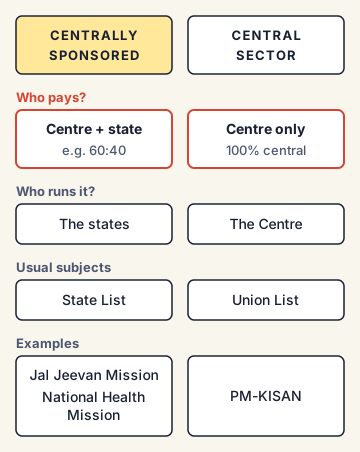
- Centrally Sponsored Scheme vs Central Sector Scheme: A Central Sector Scheme is 100% funded and run by the Centre, usually on Union List subjects (for example, PM-KISAN, which pays money directly to farmers). A CSS is shared between Centre and states and is run by the states, usually on State List subjects.
- Tied grants (Article 282) vs Finance Commission transfers (Articles 270 and 275): Under Article 270, states get a share of central taxes as decided by the Finance Commission. This money is untied. Article 275 gives grants-in-aid to states that need help, also on Finance Commission advice. CSS money under Article 282 is tied to a purpose and decided by the Centre.
- Core vs Core of the Core: Core of the Core schemes are the highest priority (social protection) and keep their older funding pattern. Core schemes follow 60:40.
Issues, criticism and the way forward
- "One size fits all": States say rigid central rules do not suit local needs. A scheme designed for one state may not work well in another.
- Burden on state budgets: States must find matching money for every CSS. Poorer states may cut their own priority spending to get central money.
- Shifting the cost: When a scheme's ratio changes in favour of the Centre (for example from almost full central funding to 60:40), states must suddenly pay more. Critics see this as weakening fiscal federalism (the fair sharing of money powers between Centre and states). The Centre argues that sharing costs makes states more responsible. The move from MGNREGA to VB-G RAM G in 2026 is a major example: the Centre earlier paid almost all wages, but states now pay 40% (10% for North-Eastern and Himalayan states). Critics also say a fixed normative allocation turns a demand-driven job guarantee into a budget-capped scheme.
- Too many schemes: Even after 2016, the number of schemes and sub-schemes is large. Experts and Finance Commissions have suggested setting a minimum size for a CSS, a fixed end date (sunset) for each scheme, and regular third-party review.
- Way forward: More flexible funds within schemes, faster and predictable releases, and more say for states in designing schemes.
Concepts to Know
- State List: The list of subjects in the Seventh Schedule of the Constitution on which only states can normally make laws, such as police, public health and agriculture.
- Tied grant: Money given for a fixed purpose that cannot be spent on anything else.
- Fiscal federalism: How taxing and spending powers are divided between the Centre and the states.
- Finance Commission: A body set up every five years under Article 280 that recommends how central taxes are shared with the states.
- NITI Aayog: The government's policy think tank, which replaced the Planning Commission on 1 January 2015.
- Normative allocation: A fixed amount of money the Centre sets for each state for a year, worked out by a formula. Any spending above it must come from the state's own budget.
- Demand-driven scheme: A scheme where money is released according to how many people ask for help, with no fixed upper limit. A budget-capped scheme has a fixed limit instead.
- Constitutional basis: Article 282 (grants for any public purpose)
- 14th Finance Commission: states' share in central taxes raised from 32% to 42%
- Sub-Group of Chief Ministers on Rationalisation of CSS: set up March 2015 (NITI Aayog)
- 2016 rationalisation: 66 schemes merged into 28 umbrella schemes from 2016-17
- 6 Core of the Core, 20 Core, 2 Optional (2016 classification)
- Core schemes: 60:40; North-Eastern and Himalayan states: 90:10; Optional schemes: 50:50; UTs without legislature: 100% Centre
- Some schemes use their own ratio: Jal Jeevan Mission is 50:50 for most states (90:10 North-Eastern and Himalayan; 100% UTs without legislature)
- Single Nodal Agency (SNA) fund flow system: from 2021-22; SNA-SPARSH for just-in-time release
- VB-G RAM G Act, 2025 replaced MGNREGA (a Core of the Core scheme) from 1 July 2026: 60:40 (90:10 North-Eastern and Himalayan; 100% UTs without legislature), with a state-wise normative allocation; states pay any spending above it
- 10 Oct 2026Added that VB-G RAM G replaced MGNREGA from July 2026 with 60:40 sharing and a fixed state-wise normative allocation.
- 6 Oct 2026Added that some schemes set their own funding ratio, such as Jal Jeevan Mission at 50:50 for most states.
● Tracked since February 12, 2026 · last seen October 09, 2026 · updates as the daily brief publishes