Own Source Revenue of Panchayats
How Villages Raise Their Own Money
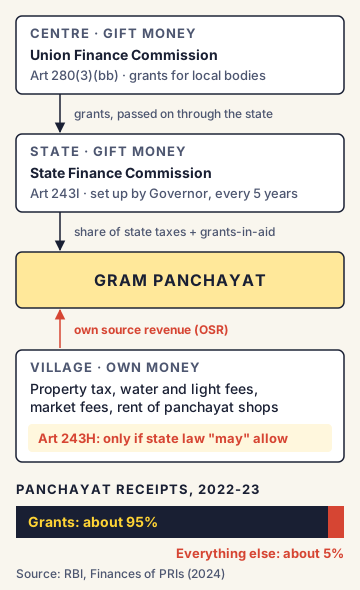
Own source revenue (OSR) is the money a panchayat earns by itself, instead of receiving it as a grant from the Centre or the state. It includes local taxes like property tax, and fees and charges for things like water supply, markets or renting out panchayat land. Think of a family: the salary a member earns is "own income", while money sent by a relative is a "gift". For most Indian panchayats, almost all money is still the "gift" kind.
Why does own revenue matter?
A government that depends fully on grants must wait for others to decide how much it gets and when. Grants often come with conditions on how they are spent. Own revenue gives a panchayat freedom to fix local problems that matter to its own people, like a broken drain or a street light. There is also an accountability reason.
When people pay a local tax, they are more likely to ask the panchayat how the money was used. Experts sum this up as "no taxation without representation" working in reverse: taxes make citizens watch their local government more closely.
What does the Constitution say?
The 73rd Constitutional Amendment Act, 1992 gave panchayats a place in the Constitution (Part IX). It added three money-related provisions:
- Article 243H: The state legislature may, by law, allow a panchayat to levy (impose), collect and keep certain taxes, duties, tolls and fees. It may also give panchayats a share of state taxes, give grants-in-aid from the state's Consolidated Fund, and set up funds for panchayat money.
- Article 243I: The Governor must set up a State Finance Commission (SFC) every five years. The SFC reviews panchayat finances and recommends how state taxes and grants should be shared with panchayats.
- Article 280(3)(bb): The Union Finance Commission must suggest steps to add to a state's Consolidated Fund so that the state can support its panchayats, based on the SFC's advice.
Notice the key word in Article 243H: "may". The Constitution does not itself give a panchayat any tax. Each state decides by its own Panchayati Raj Act which taxes its panchayats can collect. This is why OSR varies hugely from state to state.
What can panchayats collect?
The exact list depends on the state law, but common sources are:
- Tax revenue: property or house tax, tax on land and buildings, professional tax in some states, tax on fairs and entertainment, and vehicle or animal taxes in some states.
- Non-tax revenue: fees for water supply, street lighting and sanitation (often called user charges), rent from panchayat shops and community halls, market and cattle-fair fees, and income from ponds, fisheries or common land.
- Fees for services: building permission fees, trade licence fees and fees for certificates.
How little do panchayats raise today?
A Reserve Bank of India (RBI) study, Finances of Panchayati Raj Institutions (2024), found that own revenue was only about 1.1% of panchayats' total revenue in the years it studied. Non-tax revenue added about 3.3%. In 2022-23, grants made up about 95% of panchayat receipts, with central grants alone at about 80%. Summaries of the report put the average own tax revenue at only about ₹21,000 per panchayat per year. In plain words, almost every rupee a typical village council spends comes from someone else.
Why is own revenue so low?
Several reasons come together:
- Elected members fear losing votes. Collecting tax from neighbours and relatives is socially hard in a small village.
- Old and incomplete property records. A panchayat cannot tax a house that is not in its records, or whose value is not known.
- Weak staff and systems. Many panchayats have no trained accountant or tax collector.
- States keep the best tax bases. States often do not hand over buoyant (growing) taxes to panchayats under Article 243H.
- "Grant habit". With large Finance Commission grants coming in, there is little pressure to raise local money.
How do Finance Commissions push own revenue?
The Union Finance Commission gives large grants to rural local bodies but adds conditions. The 15th Finance Commission recommended ₹2,36,805 crore for rural local bodies for 2021-26. Part of this was tied (to be spent only on sanitation and drinking water) and part untied (spent on local needs). To get grants, panchayats had to publish their accounts.
The 16th Finance Commission (2026-31) recommended about ₹4.35 lakh crore for rural local bodies, roughly 84% more than before. About 80% is a basic grant and 20% a performance grant. Half of the basic grant is tied to sanitation and solid waste management or water management. As reported, a Gram Panchayat qualifies for the performance grant if its own revenue reaches at least ₹1,200 per household per year, or meets a set growth rate.
The grants can also be held back if panchayat elections are not held on time, or if states do not set up State Finance Commissions and act on their reports.
India's position and examples
A few states do much better than the rest. Kerala, Karnataka and Goa are often cited as exceptions where own revenue forms a bigger share of panchayat income. Karnataka's gram panchayats, for example, collected a record ₹863 crore in property tax in one year after shifting to a tax based on the capital value of property and using a software system for billing.
The Ministry of Panchayati Raj has also built the SAMARTH Panchayat portal with the National Informatics Centre (NIC). It helps panchayats register taxpayers, map properties, raise demand notices and collect tax digitally. Alongside it came Model Own Source Revenue Rules for states to adopt and an Atmanirbhar Panchayat Programme to help panchayats turn local assets into income.
The SVAMITVA scheme, which uses drones to map village houses and give owners property cards, also helps, because a mapped house can be taxed fairly.
Commonly confused concepts
- Own source revenue vs devolved revenue: OSR is collected by the panchayat itself. A share of state taxes given to it (decided after the SFC's advice) is devolution, not own revenue.
- Tied grant vs untied grant: A tied grant can be spent only on fixed purposes (like water or sanitation). An untied grant can be spent on any local need, except things like salaries.
- State Finance Commission (Article 243I) vs Union Finance Commission (Article 280): The SFC is set up by the Governor and advises on sharing state money with panchayats and municipalities. The Union Finance Commission is set up by the President and advises on sharing central money with states, including grants meant for local bodies.
- Article 243H vs Article 243X: 243H gives the taxation power for panchayats; 243X is the matching provision for municipalities under the 74th Amendment.
Issues, criticism and the way forward
- Heavy grant dependence: With grants at about 95% of receipts, panchayats act more like spending agents of higher governments than real local governments.
- Weak State Finance Commissions: Many states set up SFCs late, and their reports are often not acted upon. The 16th Finance Commission tied grants to timely SFCs to fix this.
- Inflation and real value: Some experts argue that the bigger grants under the 16th Finance Commission are not adjusted for inflation, so the real increase is smaller.
- Fairness: Poor and remote panchayats have a small tax base. Pushing OSR targets too hard could punish them, so growth-based criteria (not only fixed amounts) matter.
- Way forward suggested by experts and official bodies: update property records using SVAMITVA and GIS maps; move to simple, transparent property tax methods; use digital billing and payment; give panchayats clear tax powers in state law; train panchayat staff; and reward panchayats that improve their collection.
Concepts to Know
- Grant-in-aid: Money given by a higher government to a lower one, usually for a purpose. It does not have to be paid back.
- Consolidated Fund of a State: The main account of a state government into which all its revenue goes and from which it spends, with the legislature's approval.
- User charges: Small fees paid for a specific service you use, like a water connection fee. Unlike a tax, you pay because you use the service.
- Capital value method of property tax: Tax is based on the market value of the property, so a bigger or better-located house pays more.
- Buoyant tax: A tax whose collection grows quickly as the economy grows, like GST or income tax.
- Traditional local bodies: Village councils in areas outside Part IX of the Constitution (such as some Sixth Schedule areas and parts of the North-East), which follow customary systems instead of elected panchayats.
- Article 243H: state law may let panchayats levy, collect and keep taxes, duties, tolls and fees
- Article 243I: State Finance Commission every five years, set up by the Governor
- Article 280(3)(bb): Union Finance Commission to suggest measures to supplement panchayat resources; added by the 73rd Amendment (1992)
- RBI study (2024): own revenue about 1.1% of panchayat total revenue; grants about 95% of receipts in 2022-23
- 15th Finance Commission: ₹2,36,805 crore for rural local bodies (2021-26)
- 16th Finance Commission: about ₹4.35 lakh crore for rural local bodies (2026-31); 80% basic, 20% performance; half of the basic grant tied
- Reported OSR benchmark for the performance grant: ₹1,200 per household per year, or a growth criterion
- SAMARTH Panchayat portal: built by NIC for the Ministry of Panchayati Raj to manage own revenue digitally
● Tracked since October 28, 2026 · last seen October 28, 2026 · updates as the daily brief publishes