Periodic Revision of Backward Classes Lists
Why OBC Status Is Not Permanent
In India, communities that are socially and educationally backward are placed on an official list of Backward Classes (commonly called Other Backward Classes or OBCs). People from these communities get reservation in government jobs and in admission to colleges. But backwardness is not meant to be a permanent label. As a community makes progress, it may no longer need help, while some other group may be left behind.
Periodic revision means checking these lists from time to time: adding communities that are truly backward, and removing those that have moved ahead.
Why does revision matter?
Reservation is a limited pool. In central government jobs, OBCs get 27% of seats. If a community that has already moved ahead stays on the list, it keeps taking a large share of these seats. The weakest communities on the same list then get less. Think of a school giving free tuition to weak students. If students who now score 90% are never removed from the free class, there is less room for those still struggling. Revision is how the system stays fair.
Where did the idea come from?
The idea took shape through Supreme Court rulings:
- Indra Sawhney v. Union of India (1992): A nine-judge bench, decided on 16 November 1992, upheld 27% OBC reservation in central jobs (the Mandal Commission recommendation). It also said the "creamy layer" (the better-off people among OBCs) must be left out. It directed the Centre and every state to set up a permanent body to look into requests for inclusion in, and complaints of wrong inclusion in, the backward class lists. The Court said such a body could also be consulted on periodic revision of the lists.
- National Commission for Backward Classes (NCBC) Act, 1993: Parliament set up the NCBC as a statutory body to follow this direction. Section 11 of the Act told the Central Government to revise the lists every ten years, so as to remove classes that had stopped being backward and add new backward classes, after consulting the Commission.
- Ram Singh v. Union of India (2015): On 17 March 2015, the Supreme Court cancelled a March 2014 notification that had added the Jat community to the Central OBC list for nine states. The Court said the government had gone against the NCBC's advice and had no current, measurable data showing that Jats were backward. It also said backwardness must be judged by fresh, scientific study, not by old data or by a community's own claim. It noted that new forms of backwardness can appear, and gave transgender persons as an example.
What does the Constitution say today?
The rules changed in 2018 and 2021:
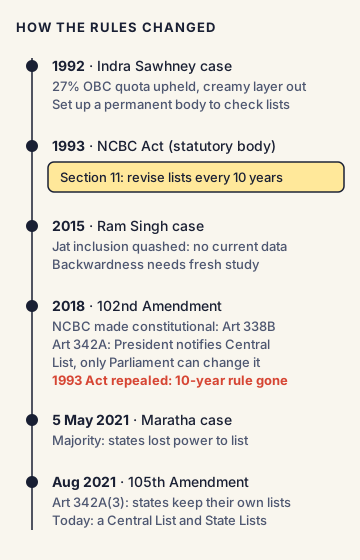
- 102nd Amendment Act, 2018: Gave the NCBC constitutional status under a new Article 338B. It added Article 342A, under which the President notifies the Central List of Socially and Educationally Backward Classes (SEBCs), and only Parliament can change it by law. The NCBC Act, 1993 was repealed in 2018, so its ten-year revision rule (Section 11) is no longer in force.
- Jaishri Laxmanrao Patil v. Chief Minister (2021): On 5 May 2021, a five-judge bench struck down the Maratha reservation in Maharashtra. A majority also read the 102nd Amendment as taking away the states' power to identify backward classes.
- 105th Amendment Act, 2021: Added Article 342A(3), which restored the power of states and Union Territories to prepare and keep their own lists of backward classes. These state lists can differ from the Central List. It came into force on 15 August 2021.
So today there are two kinds of lists: the Central List (for central jobs and central institutions) and each State List (for state jobs and state institutions). Each is revised by its own government, with the help of its commission: the NCBC for the Centre, and State Backward Classes Commissions for the states.
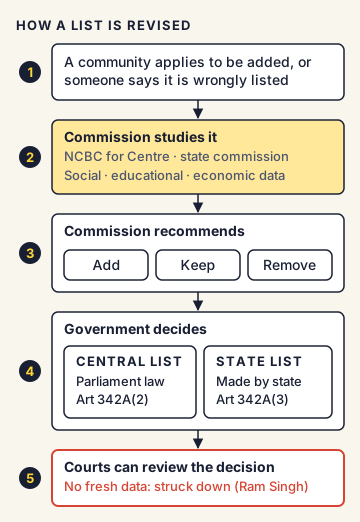
How does the process work, step by step?
- A community applies for inclusion, or someone complains that a community is wrongly listed.
- The backward classes commission studies the community. It looks at social backwardness (for example, how others in society treat it, kinds of work, early marriage), educational backwardness (literacy, school drop-outs) and economic backwardness (land, income, housing).
- The commission recommends adding, keeping or removing the community.
- The government decides and notifies the list. For the Central List, a change now needs a law by Parliament under Article 342A(2).
- Courts can review the decision. Following Ram Singh, a decision without sound, current data can be struck down.
India's position and Indian examples
- Tamil Nadu: Its First Backward Classes Commission (A.N. Sattanathan) was set up in November 1969 and reported in 1970. The Second Commission (J.A. Ambashankar) was set up in December 1982 and reported in February 1985. The state today has a permanent Tamil Nadu Backward Classes Commission. The state's total reservation is 69%, protected by a 1994 state law placed in the Ninth Schedule.
- Central sub-categorisation: The Justice G. Rohini Commission, set up on 2 October 2017 under Article 340, studied how evenly OBC benefits were shared. Its report, submitted to the President on 31 July 2023, has not been made public. Its earlier analysis found that a small number of communities had taken most central OBC jobs and seats, while many communities had received almost none [Unverified].
- Maharashtra (Marathas) and Haryana (Jats) are well-known cases where courts struck down inclusions because the backing data was not strong enough.
Commonly confused concepts
- Periodic revision vs creamy layer: Revision looks at a whole community: should it be on the list at all? The creamy layer looks at individuals or families inside a listed community: are they too well-off to use the quota?
- Central List vs State List: The Central List (Article 342A(1) and (2)) applies to central jobs and institutions and is notified by the President and changed by Parliament. The State List (Article 342A(3)) applies within the state and is prepared by the state.
- NCBC Act, 1993 vs Article 338B: The 1993 Act made the NCBC a statutory body and had the ten-year revision rule. Article 338B (2018) made it a constitutional body; the 1993 Act was repealed.
- Inclusion vs retention: Courts usually look closely at a new inclusion. The Madras High Court's 2026 order says retention of an old entry must also be justified if it is challenged.
Issues, criticism and the way forward
- Revision rarely happens: Lists in India have mostly grown; removals are very rare. Strong communities resist removal, and governments find it politically difficult.
- Old data: The last full caste count in the census was in 1931. Without fresh data, it is hard to judge who is still backward. The 2027 Census is to collect caste data, which may help.
- Uneven sharing: If a few strong communities take most benefits, the weakest stay behind. Sub-categorisation (a quota within the quota) is one suggested fix.
- Religion and conversion: OBC status is based on community, not religion, but questions arise when people convert. Courts are looking at whether conversion can create or carry over backward status.
- Way forward: Experts suggest regular, data-based reviews by commissions, a fixed time cycle for revision, publishing the data used, and protecting the most backward groups through sub-categorisation.
Concepts to Know
- Socially and Educationally Backward Classes (SEBCs): The Constitution's term for backward classes; in practice, the OBCs.
- Creamy layer: The better-off people among OBCs (for example, families with income above a set limit, or children of senior officers) who are not allowed to use OBC reservation.
- Statutory body vs constitutional body: A statutory body is created by a law of Parliament and can be changed by another law. A constitutional body is created by the Constitution and can be changed only by a constitutional amendment.
- Ninth Schedule: A list of laws in the Constitution that was meant to protect them from being challenged in court. After I.R. Coelho (2007), laws added after 24 April 1973 can still be reviewed if they harm the basic structure.
- Article 340: Lets the President appoint a commission to study the condition of backward classes.
- Writ petition: A case filed directly in a High Court (Article 226) or the Supreme Court (Article 32) asking it to enforce rights.
- Indra Sawhney (16 November 1992, 9 judges): upheld 27% OBC quota, creamy layer exclusion, 50% ceiling; directed a permanent body in the Centre and each state
- NCBC Act, 1993, Section 11: revision of the Central List every 10 years (Act repealed in 2018)
- Ram Singh v. Union of India (17 March 2015): Jat inclusion in the Central OBC list (notification of 4 March 2014, nine states) quashed for lack of current data and for ignoring NCBC advice
- 102nd Amendment, 2018: Article 338B (NCBC constitutional status), Article 342A (Central List by President; changes by Parliament)
- Jaishri Laxmanrao Patil (5 May 2021): Maratha quota struck down
- 105th Amendment, 2021: Article 342A(3) restored states' power to keep their own lists; in force 15 August 2021
- Rohini Commission: set up 2 October 2017 (Article 340); report submitted 31 July 2023
- Tamil Nadu: Sattanathan Commission (1969 to 1970); Ambashankar Commission (1982 to 1985)
● Tracked since November 13, 2026 · last seen November 13, 2026 · updates as the daily brief publishes