Religious Conversion and Reservation
SC, ST and OBC Status
In India, some groups get reservation (reserved seats in jobs, colleges and legislatures) because they faced deep social disadvantage. The three main groups are Scheduled Castes (SCs), Scheduled Tribes (STs) and Other Backward Classes (OBCs). When a person changes religion, a key question arises: does the person keep the reservation status of the group he was born into? The answer is different for each group, and this difference is a favourite UPSC topic.
Why does conversion matter at all?
Reservation is meant to correct disadvantage that a group actually suffers. For SCs, the disadvantage is untouchability, which the Constitution makers linked to the caste system inside Hinduism. For OBCs, it is social and educational backwardness of a community as it exists today. So courts keep asking one question: after conversion, does the person still suffer the same disadvantage, in the same community?
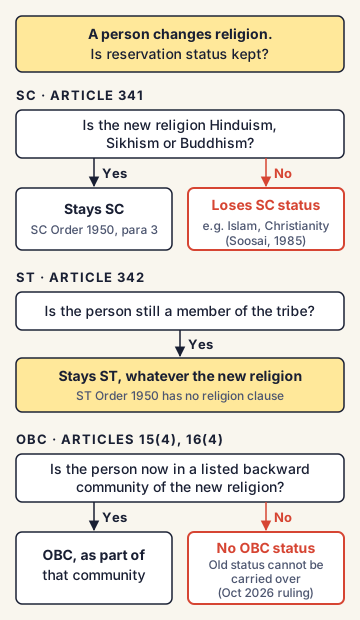
Rule 1: Scheduled Castes are tied to religion
- Article 341 lets the President notify the SC list for each state. Parliament alone can change it later.
- Paragraph 3 of the Constitution (Scheduled Castes) Order, 1950 says only a person who professes Hinduism, Sikhism or Buddhism can be an SC. Sikhs were added in 1956 and Buddhists in 1990.
- So a Dalit who converts to Islam or Christianity loses SC status. In Soosai v. Union of India (1985), the Supreme Court refused SC benefits to a Dalit Christian.
Rule 2: Scheduled Tribes are not tied to religion
The Constitution (Scheduled Tribes) Order, 1950, issued under Article 342, has no religion clause. A tribal person who becomes a Christian or follows any other faith remains an ST, as long as he is still a member of the tribe. This is why many Christian tribal people in the North-East and Jharkhand are STs.
Rule 3: OBC status is religion-neutral, but community-based
Articles 15(4) and 16(4) speak of "backward classes of citizens", not of any religion. The Mandal Commission (report 1980) identified backward classes among non-Hindus too, and central and state OBC lists include many Muslim and Christian communities. But the list names specific communities, not "anyone who was backward once". A person is an OBC because he belongs to a listed backward community now.
You can think of it like a school's scholarship for students of a particular hostel: if you move to another hostel, you can claim only what that hostel's students get.
The 2026 ruling on converts and OBC status
In October 2026, the Supreme Court held that a Hindu backward class person who converts to Islam cannot carry his old backward status into the new religion. Backwardness suffered in the earlier social order cannot be "carried forward". Conversion also does not automatically make him a member of a backward Muslim community listed by the state. A private religious body's certificate cannot settle a legal right to reservation.
The Tamil Nadu example
- Tamil Nadu reserves 30% for Backward Classes. Since the Tamil Nadu Act 33 of 2007, 3.5% of this is set apart for Backward Class Muslims. (A similar 3.5% for Backward Class Christians was withdrawn in 2008 at the community's request.)
- The state has notified seven Backward Class Muslim groups, including Ansar, Dekkani Muslims, Dubekula, Labbais (with Rowthar and Marakayar), Mapilla, Sheikh and Syed.
- The state's G.O. of 9 March 2024 let converts from backward, most backward, denotified and SC communities get BC (Muslim) certificates. The Madras High Court struck it down on 25 June 2026, and the Supreme Court upheld that result in October 2026.
What happens on reconversion?
If a person returns to his original religion, status is not automatic. In Kailash Sonkar v. Maya Devi (1984) and K.P. Manu v. Chairman, Scrutiny Committee (2015), the Supreme Court said the person must show three things:
- Clear proof that he originally belonged to the listed caste.
- A genuine return to the original religion.
- Acceptance back by his caste community.
The Supreme Court's October 2026 ruling also says the competent authority must decide such a case by a fact-based inquiry.
Can you gain reserved status by choice?
No. In Valsamma Paul v. Cochin University (1996), the Supreme Court held that a woman from a forward class could not claim backward status by marrying a man from a backward community. In C. Selvarani (2024), it said converting only to get reservation, without real faith, is a "fraud on the Constitution". The common principle: reserved status comes from sharing a group's disadvantage from birth, not from a voluntary move.
Commonly confused concepts
- SC vs ST vs OBC on conversion: SC status is lost on conversion to any religion other than Hinduism, Sikhism or Buddhism. ST status is not lost on conversion. OBC status depends on whether the person belongs to a listed backward community in his current religion.
- Article 341 vs Article 342: Article 341 is for the SC list; Article 342 is for the ST list. Both lists are issued by the President and changed only by Parliament.
- Article 25 vs reservation: Article 25 protects the freedom to follow and spread one's religion. Courts have held that this freedom does not include a right to carry reservation benefits across religions.
- OBC list vs Muslim reservation as a whole: States like Tamil Nadu and Kerala reserve seats for backward Muslim communities, not for all Muslims. Reservation on the basis of religion alone is not allowed, because Articles 15 and 16 bar discrimination on the ground of religion.
Issues, criticism and the way forward
- The equality argument: Petitioners for Dalit Christians and Muslims argue that caste discrimination continues after conversion, so the religion bar in paragraph 3 violates Articles 14, 15 and 25. The Ranganath Misra Commission (2007) recommended removing paragraph 3 to make SC status religion-neutral, like ST status; the government did not accept it.
- The government's argument: The Union has argued that untouchability is a feature of the Hindu caste system, and that Islam and Christianity do not recognise caste. It set up the K.G. Balakrishnan Commission (October 2022) to study the issue; its deadline was extended to June 2026.
- Freedom of religion concern: Tamil Nadu argued that losing reservation for converting puts a price on the freedom of religion under Article 25. Critics of the state's view reply that reservation must track real, present disadvantage, not past status.
- Misuse concern: Courts worry about "conversion for convenience", where people convert or reconvert only to qualify for a quota.
- Way forward: Experts suggest decisions be based on fresh data on the actual social and educational condition of converted communities, gathered by backward classes commissions, rather than on assumptions about any religion.
Concepts to Know
- Reservation: Keeping a fixed share of seats in jobs, colleges or legislatures for disadvantaged groups, so they get a fair chance.
- Presidential Order: An order issued by the President under a specific article of the Constitution. The SC and ST lists are such orders.
- Community certificate (caste certificate): An official document from the state government (usually a Tahsildar or Revenue officer) that proves which caste or community a person belongs to. It is needed to claim reservation.
- Creamy layer: The better-off section of an OBC community (for example, high-income families), which is kept out of OBC reservation so that benefits reach those who really need them.
- Fraud on the Constitution: A phrase courts use when someone follows the outward form of a law but in reality defeats its purpose.
- SC Order 1950, para 3: only Hindus, Sikhs (added 1956) and Buddhists (added 1990) can be SCs
- ST Order 1950 (Article 342): no religion clause
- OBC basis: Articles 15(4) and 16(4), "backward classes of citizens", religion-neutral
- Soosai v. Union of India (1985): Dalit convert to Christianity not entitled to SC benefits
- Kailash Sonkar v. Maya Devi (1984), K.P. Manu (2015): tests for reconversion
- Valsamma Paul v. Cochin University (1996): backward status cannot be gained by marriage
- C. Selvarani (26 November 2024): conversion only for reservation is a "fraud on the Constitution"
- Ranganath Misra Commission (2007): recommended deleting para 3
- K.G. Balakrishnan Commission: set up October 2022
- Tamil Nadu: 30% BC quota; 3.5% inside it for BC Muslims (Act 33 of 2007); seven notified BC Muslim groups
● Tracked since October 15, 2026 · last seen October 15, 2026 · updates as the daily brief publishes