Articles 15(4) and 16(4)
Reservation for Backward Classes
Article 15 and Article 16 are part of the Right to Equality in Part III of the Constitution (the Fundamental Rights). Article 15 stops the State from discriminating on grounds such as religion, race, caste, sex or place of birth. Article 16 promises equal opportunity in government jobs. But equal treatment of unequal people can keep the weak behind.
So clause (4) of each Article lets the State make special provisions, including reservation, for backward groups. In short: Article 15(4) covers education and other benefits, and Article 16(4) covers government jobs.
Why do these clauses exist?
Imagine a 100-metre race where some runners start 30 metres behind because their families were kept out of schools and jobs for centuries. Saying "everyone runs by the same rules" is not truly fair. The framers of the Constitution knew that caste had blocked many groups from education, land and government service. So they allowed the State to give these groups a fair starting line.
The Supreme Court has said these clauses are not an exception to equality but a way to achieve real equality (State of Kerala v. N.M. Thomas, 1976, and again in Indra Sawhney, 1992).
Where did they come from?
- Article 16(4) was in the original Constitution of 1950.
- Article 15(4) was not. In State of Madras v. Champakam Dorairajan (1951), the Supreme Court struck down Madras's caste-based seat quota in medical and engineering colleges, because Article 15 had no clause allowing it. Parliament responded with the First Amendment Act, 1951, which added Article 15(4).
- In M.R. Balaji v. State of Mysore (1962), the court struck down a 68% reservation order and said reservation should generally stay below 50%. Indra Sawhney (1992) made this the settled rule.
What exactly do the two clauses say?
- Article 15(4): nothing in Article 15 (or Article 29(2), on admission to State-funded colleges) stops the State from making any special provision for the advancement of socially and educationally backward classes of citizens, or for Scheduled Castes (SCs) and Scheduled Tribes (STs).
- Article 16(4): nothing in Article 16 stops the State from reserving appointments or posts for any backward class of citizens which, in the opinion of the State, is not adequately represented in the services under the State.
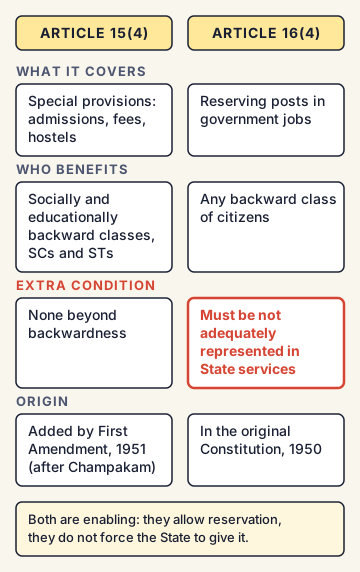
Two words carry the weight here. "Backward" means the group must really be held back socially and educationally. "Not adequately represented" means the State must show that the group's share in government jobs is too low. A court can check both with data.
How has the system grown over time?
Parliament added several related clauses:
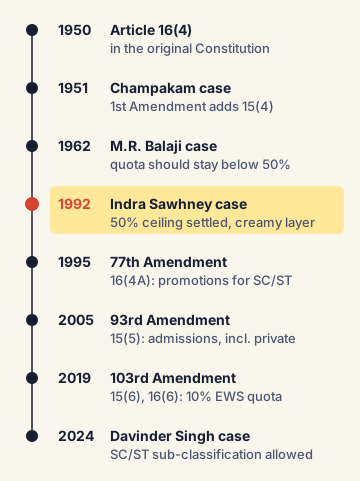
- Article 16(4A) (77th Amendment, 1995): reservation in promotions for SCs and STs. The 85th Amendment, 2001 added "consequential seniority" (keeping the seniority gained through a reserved promotion).
- Article 16(4B) (81st Amendment, 2000): unfilled reserved posts of a year can be carried forward as a separate group, and the 50% ceiling is not applied to these backlog posts.
- Proviso to Article 335 (82nd Amendment, 2000): allows relaxed qualifying marks for SCs and STs in promotions.
- Article 15(5) (93rd Amendment, 2005): reservation in admissions to educational institutions, including private ones, but not minority institutions.
- Articles 15(6) and 16(6) (103rd Amendment, 2019): up to 10% reservation for Economically Weaker Sections (EWS) not covered by other quotas.
- Article 342A (102nd Amendment, 2018, changed by the 105th Amendment, 2021): the 105th Amendment restored the power of States to prepare their own lists of socially and educationally backward classes.
What did the courts add?
- Indra Sawhney (1992): the 50% ceiling; the creamy layer exclusion for OBCs; no reservation in promotions under 16(4) (later reversed by 16(4A)); caste can be a basis for identifying backward classes.
- M. Nagaraj (2006): upheld 16(4A) and 16(4B), but said the State must show backwardness, inadequate representation and administrative efficiency (Article 335) before giving promotion quotas.
- Jarnail Singh (2018): said the State need not collect data on the backwardness of SCs and STs, but must still show inadequate representation.
- Jaishri Laxmanrao Patil (2021): struck down the Maratha quota and refused to revisit the 50% ceiling.
- Janhit Abhiyan (2022): upheld the 10% EWS quota by a 3:2 majority.
- State of Punjab v. Davinder Singh (2024): a 7-judge bench allowed States to sub-classify SCs and STs (make smaller groups within them) by a 6:1 majority.
How does it work in practice?
First, a State or the Centre identifies backward groups, usually through a Backward Classes Commission that studies data. Next, it fixes a percentage for each group by law or order. When jobs are advertised, a share of posts is set aside for each group. Candidates from reserved groups who score high enough also compete for open (unreserved) seats; this is called "merit migration". So a group's actual share can be higher than its quota.
India's position and examples
- Central jobs: OBC 27%, SC 15%, ST 7.5%, plus EWS 10%. The OBC 27% came from the Mandal Commission (report 1980; implemented by an Office Memorandum of 13 August 1990).
- States set their own figures based on their population mix. Some States, like Tamil Nadu (69%), cross 50% with Ninth Schedule protection. Others, like Maharashtra (Maratha quota) and Madhya Pradesh (27% OBC), have had their increases struck down.
- Article 46 (a Directive Principle) asks the State to promote the educational and economic interests of weaker sections, especially SCs and STs. Articles 15(4) and 16(4) are the tools that make this possible.
Commonly confused concepts
- Article 15(4) vs Article 16(4): 15(4) is about special provisions in general (admissions, fee waivers, hostels) for "socially and educationally backward classes", SCs and STs. 16(4) is only about government jobs for "any backward class" that is not adequately represented.
- Article 16(4) vs Article 16(4A): 16(4) is for appointments (entry level). 16(4A) is for promotions, and only for SCs and STs.
- Enabling vs mandatory: these clauses allow reservation; they do not force the State to give it. A court cannot order a State to create a quota.
- Creamy layer: applies to OBCs. It does not apply to SCs and STs in the same way, though some judges in Davinder Singh (2024) suggested it should.
- Constitutional ceiling vs court ceiling: the 50% limit is not written in the Constitution. It is a rule made by the Supreme Court.
Issues, criticism and the way forward
- Data gap: India's last full caste count (beyond SC/ST) was in the 1931 Census. Without fresh data, it is hard to prove backwardness or inadequate representation, and many quota increases fail in court for this reason.
- Rigid 50% ceiling: some argue that States where backward groups form most of the population need more than 50%. Others say the ceiling protects equality of opportunity for everyone.
- Benefits going to a few: studies show that dominant sub-groups take most benefits within a category. Sub-classification (allowed since 2024) and the Rohini Commission on OBC sub-categorisation (report submitted 2023) aim to spread benefits more evenly.
- Way forward: reliable caste and socio-economic data, regular review by Backward Classes Commissions, and sub-classification based on evidence rather than sudden increases in quota size.
Concepts to Know
- Fundamental Rights: basic rights in Part III of the Constitution (Articles 12 to 35) that citizens can enforce in court.
- Other Backward Classes (OBCs): groups that are socially and educationally backward but are not SCs or STs. They are identified by central and State commissions.
- Creamy layer: the better-off members of the OBCs (by income, wealth or status of parents) who are left out of reservation so that the benefit reaches those who need it.
- Ninth Schedule: a list of laws in the Constitution (added by the First Amendment, 1951) that were meant to be protected from court challenge. Since I.R. Coelho (2007), laws added after 24 April 1973 can still be checked against the basic structure.
- Economically Weaker Section (EWS): people from groups not covered by SC/ST/OBC quotas whose family income is below a set limit.
- Sub-classification: dividing a reserved group into smaller groups so that the most backward among them get a fixed share.
- Article 15(4): added by the First Amendment, 1951, after Champakam Dorairajan (1951)
- Article 16(4): in the original Constitution; condition: backward class not adequately represented
- 16(4A): 77th Amendment, 1995 (promotions for SC/ST); 16(4B): 81st Amendment, 2000 (carry forward)
- 15(5): 93rd Amendment, 2005 (admissions, including private unaided; minority institutions excluded)
- 15(6) and 16(6): 103rd Amendment, 2019 (EWS up to 10%), upheld 3:2 in Janhit Abhiyan (2022)
- 50% ceiling: suggested in M.R. Balaji (1962), settled in Indra Sawhney (1992), reaffirmed in Jaishri Laxmanrao Patil (2021)
- Central quotas: OBC 27%, SC 15%, ST 7.5%, EWS 10%
- Sub-classification of SC/ST allowed: State of Punjab v. Davinder Singh (2024), 7-judge bench, 6:1
● Tracked since October 09, 2026 · last seen October 09, 2026 · updates as the daily brief publishes