Indra Sawhney v. Union of India (1992)
The 50% Ceiling Rule
Updated 13 Oct 2026: Added High Court rulings striking down Bihar's 65% (June 2024) and Karnataka's 56% (October 2026) quota hikes under the 50% ceiling.
Indra Sawhney v. Union of India is the most important Supreme Court case on reservation in India. Decided in 1992, it upheld 27% reservation for Other Backward Classes (OBCs) in central government jobs. It also set three famous rules: the "creamy layer" of OBCs must be left out, total reservation should not normally exceed 50%, and reservation cannot be given in promotions. It is often called the Mandal case, because it came out of the Mandal Commission report.
Why does reservation exist at all?
For centuries, some groups in India were kept out of education, land and good jobs because of their caste. Even after the Constitution promised equality, these groups started far behind. Reservation is a way to give them a fair chance. You can think of it like a race where some runners were made to start far behind the line. Reservation tries to bring them closer to the same starting line.
What does the Constitution say?
- Article 14: Equality before law.
- Article 15(4): The State can make special provisions for socially and educationally backward classes, SCs and STs (for example, in education).
- Article 16(1): Equal opportunity for all in public jobs.
- Article 16(4): The State can reserve posts for any backward class of citizens that is not adequately represented in government jobs.
Where did the case come from? The Mandal Commission
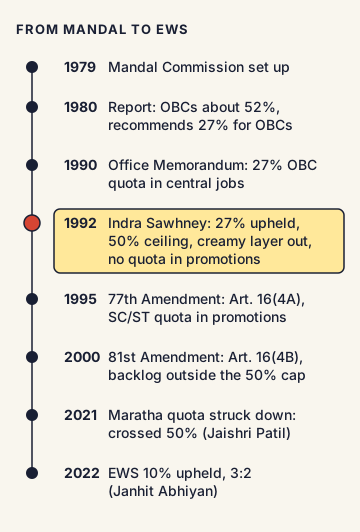
The Second Backward Classes Commission was set up on 1 January 1979, headed by B.P. Mandal. It submitted its report in 1980. It estimated that OBCs were about 52% of India's population. It recommended 27% reservation for OBCs in central government jobs. Since SCs and STs already had 22.5%, this kept total reservation at 49.5%, just under half.
The report was not implemented for ten years. On 13 August 1990, the central government issued an Office Memorandum (an official order) giving 27% reservation to OBCs. In September 1991, another order added 10% for "economically backward sections" among those not covered by any reservation. Both orders were challenged in court.
What did the Court decide?
A nine-judge bench gave its judgment on 16 November 1992, by a 6:3 majority. The main rulings were:
- 27% OBC reservation upheld. Caste can be used to identify a backward class, because in India caste is often linked to social backwardness.
- Creamy layer must be excluded. Rich and well-placed members of OBCs (children of senior officers, big landowners, high earners) must not get the benefit. Otherwise they would take most of the seats meant for the truly backward.
- 50% ceiling. Total reservation should not exceed 50%, except in extraordinary situations. The Court gave the example of people from far-flung, remote areas who are out of the mainstream. Even then, extreme caution was needed.
- Adequate, not proportionate, representation. Article 16(4) aims to give a backward class an adequate share of government jobs. It does not promise a share equal to its share of the population.
- No reservation in promotions. Article 16(4) covers only the first appointment, not promotions.
- No reservation purely on economic grounds. The 10% quota for the economically backward among forward groups was struck down, because Article 16(4) is about backwardness that is social, not only about income.
- Backlog limit. Unfilled reserved posts carried forward to the next year should also stay within the 50% limit in any year.
- A permanent body should be set up to examine requests to add or remove groups from the OBC list. This led to the National Commission for Backward Classes (NCBC) in 1993.
Why 50%?
The Court reasoned that Article 16(4) is an exception to the rule of equal opportunity in Article 16(1). If reservation goes beyond half, the exception would swallow the rule. Merit and efficiency of administration (mentioned in Article 335) also had to be balanced.
How did things change after the judgment?
- 77th Amendment Act, 1995: Added Article 16(4A), allowing reservation in promotions for SCs and STs. This undid the "no reservation in promotion" ruling for them.
- 81st Amendment Act, 2000: Added Article 16(4B). Unfilled reserved vacancies of earlier years (backlog) can be treated as a separate group and do not count toward the 50% limit of the current year.
- 76th Amendment Act, 1994: Placed Tamil Nadu's law giving 69% reservation in the Ninth Schedule, to protect it from court challenge. (Laws in the Ninth Schedule after 24 April 1973 can still be reviewed under the I.R. Coelho (2007) ruling.)
- Local bodies (panchayats and municipalities): In K. Krishna Murthy v. Union of India (2010), a five-judge bench said the 50% ceiling also applies to seats reserved in local bodies. In Vikas Kishanrao Gawali v. State of Maharashtra (4 March 2021), the Court set a "triple test" that a State must pass before it reserves local body seats for OBCs. First, a special commission must study backwardness in each local body using fresh data. Second, the OBC share must be fixed separately for each local body, based on that study. Third, SC, ST and OBC seats taken together must not cross 50%.
- Jaishri Laxmanrao Patil v. Chief Minister, Maharashtra (5 May 2021): A five-judge bench struck down Maharashtra's Maratha reservation law because it pushed total reservation above 50% without extraordinary circumstances. The Court said the 50% rule was good law and did not need to be revisited.
- Janhit Abhiyan v. Union of India (7 November 2022): By 3:2, the Court upheld the 103rd Amendment (2019), which gives 10% reservation to the Economically Weaker Sections (EWS). The majority said the 50% ceiling applies to reservation for backward classes and is not inviolable (not an unbreakable rule); EWS is a separate category.
- High Courts strike down State quota hikes: On 20 June 2024, the Patna High Court struck down Bihar's 2023 laws that raised reservation from 50% to 65%. The Supreme Court refused to stay this order in July 2024 and agreed to hear Bihar's appeal. On 12 October 2026, the Karnataka High Court struck down the parts of Karnataka's 2022 law that raised the SC quota from 15% to 17% and the ST quota from 3% to 7%. This had taken the State's total to 56%. The Court said the 50% ceiling applies however large the backward population is. It also said the ceiling covers both Article 15(4) and Article 16(4), and that Karnataka had shown no extraordinary circumstance.
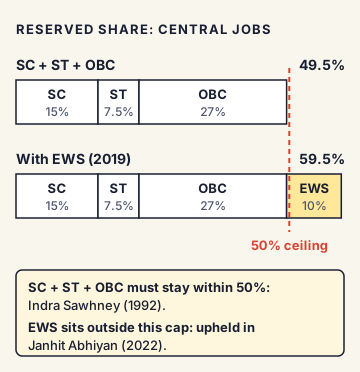
How does the ceiling work today? A simple picture
In central government jobs, SCs get 15%, STs 7.5% and OBCs 27%: a total of 49.5%. EWS adds 10% more, taking the total to 59.5%. This is allowed because of the separate EWS ruling. But when a State tries to raise SC, ST or OBC shares so that their total crosses 50%, courts usually strike it down unless the State proves extraordinary circumstances.
Commonly confused concepts
- Indra Sawhney vs Champakam Dorairajan (1951): Champakam Dorairajan struck down caste-based seats in Madras colleges, which led to the First Amendment (1951) adding Article 15(4). Indra Sawhney (1992) dealt with OBC reservation in jobs.
- Creamy layer vs EWS: Creamy layer removes the well-off from OBC benefits. EWS gives reservation to the poor among those not covered by SC, ST or OBC reservation.
- Vertical vs horizontal reservation: Vertical reservation (SC, ST, OBC, EWS) is counted for the 50% cap. Horizontal reservation (women, persons with disabilities, ex-servicemen) runs across these categories, so it does not add to the cap.
- Article 16(4) vs Article 16(4A): 16(4) allows reservation in appointments for backward classes; 16(4A) allows reservation in promotions only for SCs and STs.
Issues, criticism and the way forward
- Is 50% a fixed rule? Critics say the Constitution does not mention 50%, and that States with large backward populations need more. Supporters say the ceiling protects equal opportunity and prevents reservation becoming a tool for vote-seeking.
- The EWS shift: After Janhit Abhiyan, many argue that the 50% ceiling has become uneven: it limits backward classes but not EWS.
- Ninth Schedule route: Placing reservation laws in the Ninth Schedule is seen by some as a way around the courts.
- Data: Reliable caste-wise data is needed to show "extraordinary circumstances". Many States have begun their own caste surveys for this reason.
- Way forward: Regular data collection, updating backward class lists, removing groups that have moved ahead, and wider sub-categorisation so that benefits reach the most backward.
Concepts to Know
- Other Backward Classes (OBCs): Groups that are socially and educationally backward but are not SCs or STs.
- Office Memorandum: An official order issued by a government department, without passing a new law.
- Creamy layer: The better-off section within OBCs, identified by income and the status of parents, who are kept out of reservation benefits.
- Ninth Schedule: A list of laws in the Constitution, added by the First Amendment (1951) through Article 31B, meant to protect them from being challenged for violating Fundamental Rights.
- Constitution Bench: A bench of five or more Supreme Court judges that decides important questions about the meaning of the Constitution.
- Mandal Commission: set up 1 January 1979; report 1980; OBCs about 52% of population; recommended 27%
- Office Memorandum for 27% OBC reservation: 13 August 1990
- Indra Sawhney judgment: 16 November 1992; nine judges; 6:3 majority
- Rulings: 27% upheld; creamy layer excluded; 50% ceiling (except extraordinary situations); no reservation in promotions; 10% economic-only quota struck down
- NCBC: set up 1993 (constitutional status in 2018 through the 102nd Amendment, Article 338B)
- 77th Amendment (1995): Article 16(4A); 81st Amendment (2000): Article 16(4B)
- 76th Amendment (1994): Tamil Nadu's 69% law put in the Ninth Schedule
- Maratha case (Jaishri Laxmanrao Patil): 5 May 2021; EWS case (Janhit Abhiyan): 7 November 2022, 3:2
- Local bodies: 50% ceiling applies (K. Krishna Murthy, 2010); OBC "triple test" (Vikas Kishanrao Gawali, 4 March 2021)
- State hikes struck down by High Courts: Bihar 65% (Patna High Court, 20 June 2024); Karnataka 56% (Karnataka High Court, 12 October 2026)
- 13 Oct 2026Added High Court rulings striking down Bihar's 65% (June 2024) and Karnataka's 56% (October 2026) quota hikes under the 50% ceiling.
- 10 Oct 2026Added how the 50% ceiling applies to panchayat and municipal seats, including the 2021 "triple test" for OBC reservation there.
● Tracked since February 18, 2026 · last seen October 13, 2026 · updates as the daily brief publishes