Special Leave Petition (Article 136)
A Special Leave Petition (SLP) is a request to the Supreme Court asking for permission ("leave") to appeal against a judgment of any court or tribunal in India. It comes from Article 136 of the Constitution. The Supreme Court has full discretion: it may hear the appeal, or it may refuse without giving reasons. It is the most common way cases reach the Supreme Court.
Why does it exist?
Ordinary appeals go up step by step: from a lower court to a High Court, and to the Supreme Court only in certain cases. But sometimes a High Court or tribunal may make a serious legal mistake, or cause great injustice, in a case where no regular appeal lies. Article 136 is a safety valve. It lets the country's highest court correct such errors, wherever they happen.
Where does it come from?
Article 136(1) says that the Supreme Court may, in its discretion, grant special leave to appeal from any judgment, decree, determination, sentence or order, in any case, passed by any court or tribunal in India. The words "notwithstanding anything in this Chapter" mean this power works in addition to the regular appeal routes.
How is it different from regular appeals?
The Constitution gives regular appeals to the Supreme Court in fixed cases:
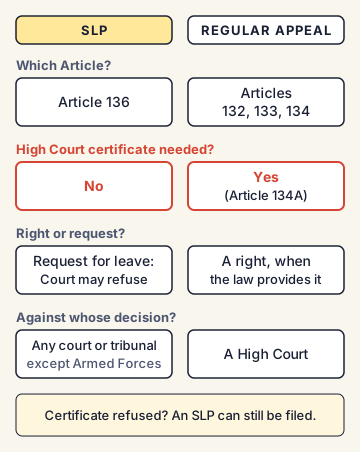
- Article 132: Appeals in cases that involve a substantial question about the interpretation of the Constitution.
- Article 133: Civil appeals that involve a substantial question of law of general importance.
- Article 134: Criminal appeals, for example where a High Court has sentenced a person to death after reversing an acquittal.
- Article 134A: The High Court decides whether to give the certificate needed for an appeal under Articles 132 to 134.
These need a certificate from the High Court. An SLP does not. Even if the High Court refuses a certificate, a person can still file an SLP.
How does it work, step by step?
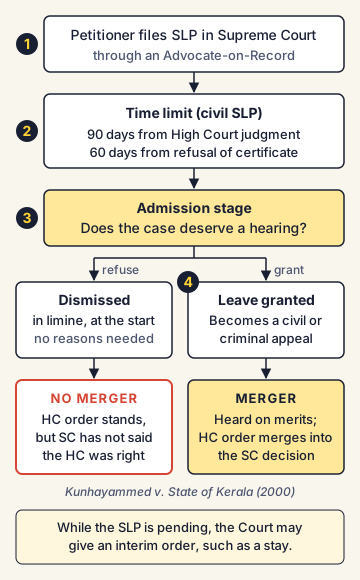
- The person who lost (the petitioner) files an SLP in the Supreme Court, through an Advocate-on-Record.
- Time limit: Under the Supreme Court Rules, 2013, a civil SLP should usually be filed within 90 days from the High Court's judgment, or 60 days from the date the High Court refuses a certificate. The Court can excuse delay for good reasons.
- Admission stage: The Court first decides whether the case deserves a hearing. It may issue notice to the other side, or it may dismiss the SLP at the start (called dismissal in limine).
- Leave granted: If the Court grants leave, the SLP becomes a regular civil or criminal appeal, and the case is heard on its merits.
- While the SLP is pending, the Court may give an interim order, such as a stay on the High Court's judgment.
What did the Supreme Court say about using this power?
- Pritam Singh v. The State (1950): The power is to be used sparingly and only in exceptional cases: where there is grave injustice or a serious question of law.
- Kunhayammed v. State of Kerala (2000): If the Supreme Court dismisses an SLP without reasons, the High Court's order does not merge into the Supreme Court's order. It only means the Court did not want to hear the appeal; it is not a ruling that the High Court was right. If leave is granted and the appeal is decided, the High Court's order merges into the Supreme Court's decision (the doctrine of merger).
Limits on the power
Article 136(2) says the power does not apply to judgments of any court or tribunal set up under laws relating to the Armed Forces (such as courts-martial). Otherwise, the power is very wide: it covers civil, criminal, tax, labour, election and service matters, from courts as well as tribunals.
Commonly confused concepts
- SLP vs Appeal: An appeal is a right when the law provides it. An SLP is only a request for permission; the Court may refuse.
- SLP vs Writ petition (Article 32): A writ petition under Article 32 is filed directly in the Supreme Court to protect Fundamental Rights. An SLP challenges a decision already given by another court or tribunal.
- SLP vs Review petition (Article 137): A review petition asks the Supreme Court to re-look at its own judgment for a clear error. An SLP challenges another court's judgment.
- Curative petition: A last remedy after a review petition fails, created by the Court in Rupa Ashok Hurra v. Ashok Hurra (2002) to prevent gross miscarriage of justice.
Issues, criticism and the way forward
- Too many SLPs: A large part of the Supreme Court's workload is SLPs, many on routine matters. Critics say this turns the Court into an ordinary appeal court and leaves less time for big constitutional questions.
- Unequal access: Filing in Delhi is costly. People with money can reach the Supreme Court much more easily than poor litigants.
- Way forward: Suggestions include stricter screening at the admission stage, and splitting the Court into a Constitution Bench in Delhi plus regional "cassation" benches (in Delhi, Chennai/Hyderabad, Kolkata and Mumbai) for routine appeals, as proposed by the Law Commission's 229th Report (2009).
Concepts to Know
- Leave: Permission from a court to do something, here to bring an appeal.
- Advocate-on-Record: A lawyer who has passed a special Supreme Court exam and is allowed to file cases there.
- Dismissed in limine: Rejected at the very first stage, without a full hearing.
- Interim order: A temporary order given while a case is still going on, such as a stay.
- Cassation bench: A bench that only hears ordinary appeals and corrects legal errors in lower court decisions, leaving big constitutional questions to a separate bench.
- Tribunal: A special body, like a court, set up to decide disputes in a particular field, such as tax, service or environment.
- Article 136(1): Supreme Court's discretionary power to grant special leave to appeal from any court or tribunal in India
- Article 136(2): Armed Forces courts and tribunals excluded
- Articles 132, 133, 134: regular appeals with a High Court certificate; Article 134A: certificate procedure
- Time limit (civil SLP): 90 days from the judgment; 60 days from refusal of certificate (Supreme Court Rules, 2013)
- Pritam Singh v. The State (1950): use sparingly, in exceptional cases
- Kunhayammed v. State of Kerala (2000): dismissal of SLP without reasons does not cause merger
- Curative petition: Rupa Ashok Hurra v. Ashok Hurra (2002)
● Tracked since July 13, 2026 · last seen October 03, 2026 · updates as the daily brief publishes