Ninth Schedule
Laws Shielded from Court Challenge
The Ninth Schedule is a list of laws attached to the Constitution. Laws placed in it are protected by Article 31B from being struck down on the ground that they violate Fundamental Rights. It was created so that important land reform laws could not be cancelled by courts. Today it has 284 laws, but since 2007 its protection is no longer complete: laws added after 24 April 1973 can still be tested against the basic structure of the Constitution.
Why was it created?
Soon after independence, States passed laws to abolish the zamindari system and to give land to tillers. Landlords challenged these laws in courts, saying they violated their Fundamental Right to property and to equality. Some High Courts struck down these laws. The government feared that land reform, a key promise of the freedom movement, would fail. So it created a "safe locker" in the Constitution: any law kept inside it could not be challenged for violating Fundamental Rights.
Where did it come from?
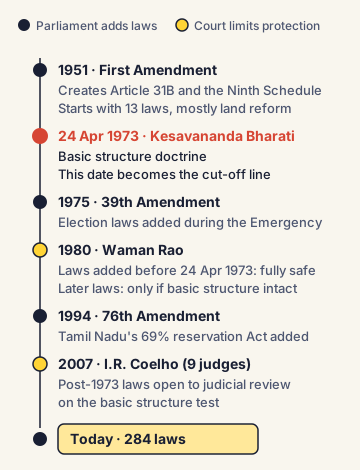
- First Amendment, 1951: Added Article 31A (saving laws on acquisition of estates), Article 31B and the Ninth Schedule. It started with 13 laws, almost all on land reform.
- Over the years, Parliament added many more laws through further constitutional amendments, including laws on land ceilings, nationalisation, essential commodities and reservation. Some additions during the Emergency (the 39th Amendment, 1975, for example) even covered election-related laws, which led to criticism that the Schedule was being misused.
- 76th Amendment, 1994: Placed Tamil Nadu's 1993 reservation Act, which provides 69% reservation, in the Ninth Schedule. This let it stand above the 50% ceiling of Indra Sawhney.
- Today the Schedule contains 284 entries.
What does Article 31B say?
In simple words: none of the laws listed in the Ninth Schedule shall be treated as void, or ever to have become void, on the ground that it takes away or cuts down any Fundamental Right. This applies in spite of any judgment, decree or order of any court to the contrary. The legislature that made the law can still change or repeal it.
How is a law put into the Ninth Schedule?
Only Parliament can add a law, and only through a constitutional amendment under Article 368, passed by a special majority (a majority of the total membership of each House, and two-thirds of members present and voting). A State cannot put its own law in the Ninth Schedule; it must request the Centre, which must then move an amendment in Parliament.
This is why, from time to time, States like Karnataka have said they would seek Ninth Schedule protection for higher reservation, but this needs Parliament's approval.
How did the courts limit it?
- Kesavananda Bharati v. State of Kerala (24 April 1973): A 13-judge bench held that Parliament can amend any part of the Constitution but cannot destroy its basic structure.
- Waman Rao v. Union of India (decided 1980, reported 1981): Laws placed in the Ninth Schedule before 24 April 1973 remain fully protected. Laws added on or after that date are protected only if they do not damage the basic structure.
- I.R. Coelho v. State of Tamil Nadu (11 January 2007): A nine-judge bench confirmed that laws added to the Ninth Schedule after 24 April 1973 are open to judicial review. If such a law violates Fundamental Rights in a way that destroys the basic structure (for example, the core of Articles 14, 15, 19 and 21), courts can strike it down. Also, if a Ninth Schedule law has already been upheld by a court earlier, that decision stands.
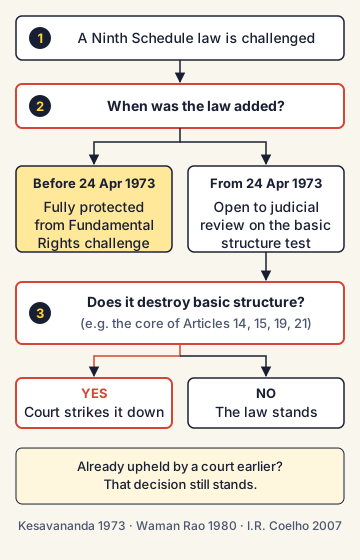
So, in short: the Ninth Schedule is now a shield, but not a full wall.
Commonly confused concepts
- Ninth Schedule vs Tenth Schedule: The Ninth Schedule protects listed laws from Fundamental Rights challenges. The Tenth Schedule is the anti-defection law (52nd Amendment, 1985).
- Article 31A vs Article 31B vs Article 31C: 31A protects specific kinds of laws (like acquisition of estates) from Articles 14 and 19. 31B protects the laws listed in the Ninth Schedule. 31C (25th Amendment, 1971) protects laws giving effect to certain Directive Principles (Article 39(b) and (c)) from Articles 14 and 19.
- Before vs after 24 April 1973: Laws added before this date have full protection; laws added on or after it can be reviewed for the basic structure.
- Ninth Schedule vs Schedules on languages or tribal areas: The Eighth Schedule lists 22 official languages; the Fifth and Sixth Schedules deal with administration of Scheduled and Tribal Areas. These are unrelated to court protection.
Issues, criticism and the way forward
- Misuse: The Schedule was meant for land reform, but over time many unrelated laws were added, which critics see as a way to escape judicial review.
- Reservation above 50%: Tamil Nadu's 69% shows how the Schedule can be used to cross the 50% ceiling. Other States now ask for the same, raising concerns about equality and about uneven treatment between States.
- Coelho's balance: Supporters say Coelho restored the courts' role in protecting the basic structure. Others argue it creates uncertainty because every post-1973 entry can be challenged.
- Way forward: Experts have suggested reviewing the 284 laws, removing those that no longer serve a purpose, and using the Schedule only for genuine social reform laws with clear data and reasoning.
Concepts to Know
- Schedule (of the Constitution): A list or table attached to the Constitution that gives details for some Articles. The Constitution now has 12 Schedules.
- Judicial review: The power of courts to check whether a law or government action follows the Constitution, and to strike it down if it does not.
- Zamindari system: A land system in British India where landlords (zamindars) collected rent from farmers and paid a share to the government. It was abolished after independence.
- Void: Having no legal force, as if the law never existed.
- Special majority: A higher level of support than a simple majority, needed for constitutional amendments under Article 368.
- Created by the First Amendment Act, 1951, along with Articles 31A and 31B; originally 13 laws
- Currently 284 laws
- Laws are added only by constitutional amendment under Article 368 (special majority)
- Kesavananda Bharati: 24 April 1973 (basic structure doctrine)
- Waman Rao (1980/81): post-24 April 1973 entries protected only if they do not damage the basic structure
- I.R. Coelho (2007, nine judges): post-1973 Ninth Schedule laws open to judicial review on the basic structure test
- Tamil Nadu's 69% reservation Act (1993) placed in the Ninth Schedule by the 76th Amendment, 1994
● Tracked since March 13, 2026 · last seen October 12, 2026 · updates as the daily brief publishes