103rd Constitutional Amendment Act, 2019
EWS Reservation
The 103rd Constitutional Amendment Act, 2019 allows up to 10% reservation in government jobs and in admissions to educational institutions for Economically Weaker Sections (EWS) of citizens. These are poor people who are not covered by any existing reservation, that is, they are not SCs, STs or OBCs. This was the first time India allowed reservation on the basis of economic condition alone, instead of social and educational backwardness.
Why was it brought?
Reservation in India was built on the idea of social backwardness: communities that faced caste discrimination and exclusion. But poverty also exists among communities that are not socially backward. A poor student from a non-reserved community competes in the open category with no support. The government's stated aim was to help such economically weak people get a fair share in education and government jobs.
Where did it come from?
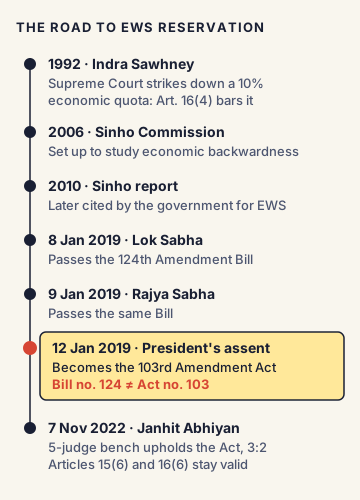
- In Indra Sawhney (1992), the Supreme Court had struck down a 1991 order giving 10% reservation to economically backward people among the forward castes. The Court said Article 16(4) did not allow reservation on economic criteria alone.
- The Major General (retd.) S.R. Sinho Commission, set up in 2006, studied economic backwardness among the general category and submitted its report in 2010. The government later cited this report in support of the EWS quota. (Critics note that the report itself said economic criteria alone could not identify a backward class for reservation without a constitutional change.)
- In January 2019, Parliament passed the Constitution (124th Amendment) Bill (Lok Sabha on 8 January, Rajya Sabha on 9 January). It received the President's assent on 12 January 2019 and became the Constitution (One Hundred and Third Amendment) Act, 2019.
What did the amendment change?
- Article 15(6): allows the State to make special provisions, including up to 10% reservation in admissions to educational institutions (including private institutions, aided or unaided, but not minority institutions), for EWS.
- Article 16(6): allows the State to reserve up to 10% of appointments or posts for EWS.
- Article 46 (a Directive Principle asking the State to promote the educational and economic interests of weaker sections) was used as the basis; the amendment's explanation says "economically weaker sections" will be notified by the State on the basis of family income and other indicators of economic disadvantage.
- The 10% is "in addition to" existing reservations. So in central jobs, total reservation became 49.5% (15% SC + 7.5% ST + 27% OBC) plus 10% EWS = 59.5%.
Who qualifies? (Central government criteria)
These rules are set by government orders, not the Constitution. A person qualifies for EWS in central jobs and institutions if:
- They are not covered by SC, ST or OBC reservation, and
- Their family income from all sources is below ₹8 lakh a year, and
- The family does not own any of these: 5 acres or more of agricultural land; a residential flat of 1,000 square feet or more; a residential plot of 100 square yards or more in notified municipalities; or 200 square yards or more in other areas.
"Family" here means the applicant, parents, siblings below 18 years, spouse and children below 18 years. States may set their own criteria for State jobs.
What did the Supreme Court say? Janhit Abhiyan v. Union of India (2022) On 7 November 2022, a five-judge Constitution Bench upheld the 103rd Amendment by a 3:2 majority.
- Majority (Justices Dinesh Maheshwari, Bela M. Trivedi, J.B. Pardiwala): Economic criteria can be a valid basis for reservation. Excluding SCs, STs and OBCs from EWS is fair because they already have their own reservation. The 50% ceiling is not absolute and applies to reservations under Articles 15(4) and 16(4), not to this new separate category. The amendment does not violate the basic structure. Justice Pardiwala also said reservation should not continue indefinitely.
- Minority (Justice S. Ravindra Bhat, with Chief Justice U.U. Lalit agreeing): Economic reservation as such is allowed, but excluding the poor among SCs, STs and OBCs from EWS is discrimination that violates the equality code and the basic structure. They also warned that breaching the 50% ceiling could lead to further breaches.
How does it work in practice? A simple picture
Imagine 100 government posts in a central department:
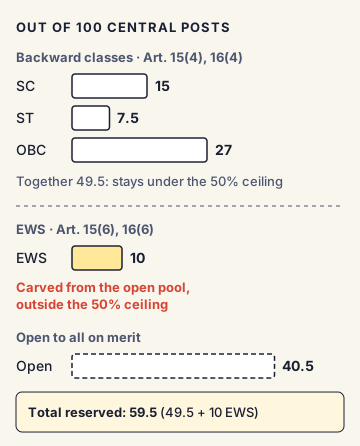
- 15 go to SCs, 7 or 8 to STs (7.5%), 27 to OBCs (non-creamy layer), 10 to EWS.
- About 40 remain open to everyone on merit.
- An SC, ST or OBC candidate can compete for the open seats, but cannot claim an EWS seat.
EWS and the 50% ceiling: commonly confused concepts
- Vertical vs horizontal reservation: Vertical reservation is for social groups (SC, ST, OBC, EWS) and adds up across categories. Horizontal reservation (for women, persons with disabilities, ex-servicemen) cuts across these groups and is adjusted inside each of them. The 50% ceiling concerns vertical reservation.
- EWS vs OBC creamy layer: Both use an ₹8 lakh income limit, but for opposite purposes. For OBCs, crossing ₹8 lakh pushes a person out of reservation (creamy layer). For EWS, staying below ₹8 lakh brings a person into it. The two calculations also differ in what income counts.
- EWS (Articles 15(6), 16(6)) vs RTE 25% seats: The Right to Education Act's Section 12(1)(c) reserves 25% of entry-level seats in private schools for children from weaker sections and disadvantaged groups. This is a separate statutory rule and has nothing to do with the 103rd Amendment.
- Does EWS break the 50% rule for backward classes? No. As the Karnataka High Court explained, even after Janhit Abhiyan, the 50% limit still applies to reservation for backward classes under Articles 15(4) and 16(4). The EWS 10% sits outside that limit, carved from the open pool.
Issues, criticism and the way forward
- Income limit too high: Critics say ₹8 lakh a year covers the vast majority of families in the country, so EWS may not reach the truly poor. A government-appointed review committee (report in January 2022) recommended keeping the ₹8 lakh limit, subject to periodic revision.
- Exclusion of poor SC/ST/OBC: The minority judgment saw this as against equality; supporters say these groups already have larger quotas of their own.
- Data: No caste-wise or income-wise survey was done before fixing 10%. Critics ask how the number was chosen; the government pointed to the Sinho Commission and its general data on poverty.
- Pressure on the 50% ceiling: After EWS, many States have argued that if 60% total is allowed at the Centre, they should also be allowed to cross 50% for backward classes. Courts, as in Karnataka and Bihar, have so far said no.
- Way forward: Periodic review of the income and asset limits, regional adjustment for living costs, and better data on who actually benefits.
Concepts to Know
- Constitution Bench: A bench of at least five Supreme Court judges, needed for cases involving important questions about the meaning of the Constitution (Article 145(3)).
- Directive Principles of State Policy: Guidelines in Part IV of the Constitution that the government should follow while making laws, though courts cannot enforce them directly. Article 46 is one of them.
- Creamy layer: The better-off members of OBCs, who are excluded from OBC reservation so that benefits reach the poorer members.
- Basic structure: Core features of the Constitution that even Parliament cannot destroy through an amendment.
- Open (general) category: Seats or posts that anyone can win on merit, without any reservation.
- 103rd Amendment Act, 2019: inserted Articles 15(6) and 16(6); up to 10% EWS reservation
- Passed as the 124th Amendment Bill; Lok Sabha 8 January 2019, Rajya Sabha 9 January 2019; assent 12 January 2019
- Applies to people not covered by SC, ST or OBC reservation; includes private educational institutions but not minority institutions
- Central criteria: family income below ₹8 lakh; no 5 acres or more of farm land; no flat of 1,000 sq ft or more; plot limits of 100 sq yards (notified municipalities) and 200 sq yards (other areas)
- Janhit Abhiyan v. Union of India, 7 November 2022: upheld 3:2 (majority: Maheshwari, Trivedi, Pardiwala; minority: Bhat, CJI Lalit)
- Sinho Commission: set up 2006, report 2010
- Central reservation after EWS: 15% SC + 7.5% ST + 27% OBC + 10% EWS = 59.5%
● Tracked since April 17, 2026 · last seen October 12, 2026 · updates as the daily brief publishes