Constitution (Scheduled Castes) Order, 1950
Updated 16 Oct 2026: Added the October 2026 Supreme Court ruling that converts cannot carry old caste status into a backward class list, and the Balakrishnan Commission's June 2026 deadline.
The Constitution (Scheduled Castes) Order, 1950 is the official list that decides which castes count as Scheduled Castes (SCs) in each state. Only people from the castes named in this list can get SC benefits, such as reserved seats in jobs, colleges, Parliament and assemblies. The President issued it in 1950 under Article 341 of the Constitution.
Its most debated part is paragraph 3, which says that a person who follows a religion other than Hinduism, Sikhism or Buddhism cannot be a member of a Scheduled Caste.
Why does the Constitution need such a list?
The Constitution gives special protection to communities that suffered untouchability for centuries. But the Constitution itself does not name these communities. Somebody has to say clearly, state by state, who exactly is covered. Without one official list, every office could decide on its own, and there would be confusion, fake claims and unfairness. The Order is that single, official list.
How does Article 341 work?
Article 341 sets up a simple two-step system:
- Article 341(1): The President, by a public notification, names the castes, races or tribes (or parts of them) that will be Scheduled Castes for a state or Union Territory. For a state, the President first consults the Governor.
- Article 341(2): After that first notification, only Parliament, by passing a law, can add a caste to the list or remove one. Neither the President nor a state government can change it alone.
So the list is "frozen" after it is first issued. Think of it like a school's admission register that only the school board can edit, not the class teacher. Article 366(24) of the Constitution then says that "Scheduled Castes" means the castes deemed to be SCs under Article 341.
What exactly does paragraph 3 say?
In its present form, paragraph 3 says: no person who professes (openly follows) a religion different from the Hindu, the Sikh or the Buddhist religion shall be deemed to be a member of a Scheduled Caste. The idea behind it was that untouchability was a practice inside the Hindu social order. So, in the government's view, the special protection was linked to that social order.
How did paragraph 3 change over time?
- 1950: The original paragraph 3 allowed only Hindus to be Scheduled Castes.
- 1956: It was amended to include Sikhs. The Kaka Kalelkar Commission (the first Backward Classes Commission, report in 1955) helped push this change.
- 1990: The Constitution (Scheduled Castes) Orders (Amendment) Act, 1990 added Buddhists. The words "or Sikh" were replaced with "the Sikh or the Buddhist". This followed the report of a High-Powered Panel on Minorities, SCs and STs (1983). Many Dalits had become Buddhists, especially after Dr B.R. Ambedkar's conversion in 1956.
Christians and Muslims are still outside the SC list
A Dalit who becomes a Christian or a Muslim loses SC status. This is why the terms "Dalit Christian" and "Dalit Muslim" are used in public debate. These groups may still get reservation as Other Backward Classes (OBCs) if their community is on an OBC list, but not as SCs. A convert cannot carry their old caste into the new religion's OBC list, though.
They get OBC benefits only if they truly belong to a backward community that is listed in their new religion (see the October 2026 judgment below).
What happens on conversion and reconversion?
The courts have built a clear set of rules around paragraph 3:
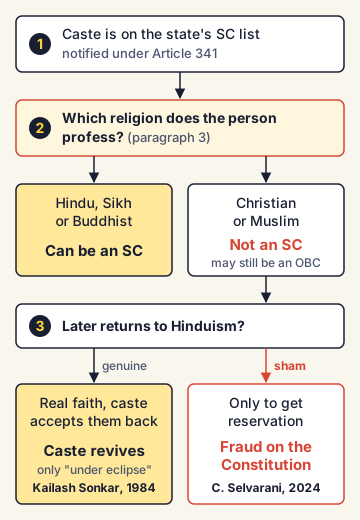
- Conversion out: If a Scheduled Caste person adopts Christianity or Islam, they stop being an SC for legal purposes. In Chinthada Anand v. State of Andhra Pradesh (24 March 2026), the Supreme Court held that a pastor who had practised Christianity for over a decade could not use the SC/ST (Prevention of Atrocities) Act, 1989, because he was no longer an SC.
- No carrying old status into a new backward class list: On 15 October 2026, the Supreme Court (Justices Prashant Kumar Mishra and Shree Chandrashekhar) dismissed Tamil Nadu's appeal and upheld a Madras High Court ruling of June 2026. Tamil Nadu's order of March 2024 let converts to Islam from SC and backward Hindu castes get "Backward Class (Muslim)" certificates. The Court said conversion alone does not make a person a member of a notified backward Muslim community. Backwardness suffered in the old social order cannot simply be carried forward into the new one. The Court also repeated that a convert to Islam loses SC status and cannot claim job reservation under Article 16(4) (the clause that allows reserved government posts for backward classes) on that basis.
- Reconversion: In Kailash Sonkar v. Maya Devi (1984), the Supreme Court said that a person's caste goes "under eclipse" (hidden, not destroyed) on conversion. If the person returns to Hinduism and the caste community accepts them back, the caste can revive. Here, a reconverted woman was allowed to contest from a reserved seat. In its October 2026 judgment, the Court added that the old caste does not revive automatically: an official must check the facts of each case.
- Fake conversion: In C. Selvarani v. Special Secretary-cum-District Collector (November 2024), the Supreme Court said that converting, or claiming to reconvert, only to get reservation without real belief is a "fraud on the Constitution". A woman who was baptised and went to church regularly could not claim to be a Hindu SC for a job.
- Validity of the rule: In Soosai v. Union of India (1985), a Dalit Christian cobbler from Madras challenged paragraph 3. The Supreme Court upheld it, saying he had not shown with proper data that Dalit Christians face the same level of disadvantage as Hindu Dalits.
What about Scheduled Tribes?
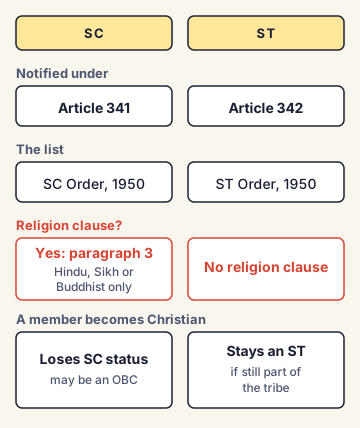
Scheduled Tribes are listed under a different article, Article 342, through the Constitution (Scheduled Tribes) Order, 1950. That Order has no religion clause. So a tribal person who becomes a Christian generally stays a Scheduled Tribe, as long as they remain part of the tribe. This is a common exam trap.
India's position today
As of October 2026, paragraph 3 remains unchanged. In October 2022, the Union government set up a three-member commission headed by former Chief Justice of India K.G. Balakrishnan under the Commissions of Inquiry Act, 1952. Its job is to examine whether SC status should be given to people who historically belonged to SCs but converted to religions other than Hinduism, Sikhism and Buddhism.
Its deadline has been extended more than once, most recently to 10 June 2026. As of October 2026, its report has not been made public. Petitions challenging paragraph 3 have also been pending in the Supreme Court for many years.
Commonly confused concepts
- Scheduled Caste vs Scheduled Tribe: SCs are notified under Article 341 and the SC Order has a religion bar. STs are notified under Article 342 and the ST Order has no religion bar.
- Scheduled Caste vs Other Backward Class (OBC): SC status is about historical untouchability and is decided by the Article 341 list. OBC status is about social and educational backwardness, decided by central and state OBC lists, and it can include communities of any religion. A Dalit Christian may be an OBC but not an SC.
- Article 341(1) vs 341(2): The President issues the first list; only Parliament, by law, can change it later.
- Kailash Sonkar vs Selvarani: Kailash Sonkar allows caste to revive after a genuine reconversion accepted by the community. Selvarani blocks sham conversion done only for benefits.
Issues, criticism and the way forward
- The equality argument: Critics argue that caste discrimination does not end when a person changes religion. They say Dalit Christians and Dalit Muslims often face the same social exclusion, so excluding them may conflict with Articles 14 and 15 (equality and non-discrimination). The Ranganath Misra Commission (National Commission for Religious and Linguistic Minorities, report in 2007) recommended deleting paragraph 3 so that SC status is fully delinked from religion.
- The government's position: The Union government has argued in court that untouchability was a feature of the Hindu social order, and that Christianity and Islam do not recognise caste. It has also said that existing SCs could lose their share if new groups are added without proper study.
- Data gap: In Soosai (1985), the Court asked for solid data. Supporters of inclusion say this data now exists; opponents say it is not settled. This is why the Balakrishnan Commission's report is awaited.
- Way forward: Experts suggest a fresh, data-based study of how much discrimination converts face, a decision by Parliament (since Article 341(2) gives Parliament the power), and strong checks against fake or purely benefit-driven conversions.
Concepts to Know
- Untouchability: The old practice of treating some castes as "impure" and keeping them away from temples, wells, schools and social life. Article 17 of the Constitution abolishes it and makes its practice a punishable offence.
- Notification: An official announcement published in the government's Gazette. A rule or list becomes official from the date of its notification.
- Professes a religion: Openly follows and practises a religion as one's own faith.
- Doctrine of eclipse (in caste cases): The idea that a person's caste is only hidden, not wiped out, while they follow another religion, and can return if they genuinely return to the old faith and are accepted by the caste.
- Commission of Inquiry: A body set up by the government under the Commissions of Inquiry Act, 1952 to study an issue and give a report. Its report is advice, not law.
- Notified backward class community: A community that the government has officially placed on its list of backward classes. Only members of a listed community can claim backward class reservation.
- Article 341: President notifies SCs (after consulting the Governor for a state); only Parliament can change the list by law (Article 341(2))
- Article 342: Scheduled Tribes; Constitution (Scheduled Tribes) Order, 1950 has no religion clause
- Article 366(24): defines Scheduled Castes by reference to Article 341
- Paragraph 3 of the SC Order: only Hindus, Sikhs and Buddhists can be SCs
- Sikhs added in 1956; Buddhists added by the Constitution (Scheduled Castes) Orders (Amendment) Act, 1990
- Soosai v. Union of India (1985): paragraph 3 upheld for want of data
- Kailash Sonkar v. Maya Devi (1984): caste can revive on genuine reconversion with community acceptance
- C. Selvarani (2024): conversion only for reservation is a "fraud on the Constitution"
- Chinthada Anand v. State of Andhra Pradesh (24 March 2026): Christian convert cannot use the SC/ST Atrocities Act
- Supreme Court, 15 October 2026 (Tamil Nadu appeal): conversion to Islam alone does not give backward class status; pre-conversion caste status cannot be carried into the new religion's backward class list
- Ranganath Misra Commission (2007): recommended deleting paragraph 3
- K.G. Balakrishnan Commission: set up October 2022 to examine SC status for converts; deadline last extended to 10 June 2026
- 16 Oct 2026Added the October 2026 Supreme Court ruling that converts cannot carry old caste status into a backward class list, and the Balakrishnan Commission's June 2026 deadline.
● Tracked since March 19, 2026 · last seen October 15, 2026 · updates as the daily brief publishes