Reservation Policy in Tamil Nadu
The 69% Model
Tamil Nadu reserves 69% of seats in state government jobs and state educational institutions for backward groups. This is much higher than the general 50% limit that the Supreme Court set in 1992. The state can keep it because its reservation law was placed in the Ninth Schedule of the Constitution, which gives laws strong protection from court challenges. The 69% is split among Backward Classes, Most Backward Classes, Scheduled Castes and Scheduled Tribes.
Why does Tamil Nadu have such high reservation?
The region has a long history of the non-Brahmin movement. In the early 1900s, a small upper-caste group held most government jobs and college seats, even though it was a tiny share of the population. Leaders of the Justice Party and later the Dravidian movement argued that this imbalance must be corrected. So the state treated reservation as a tool of social justice much earlier than most of India.
Where did it come from? A timeline
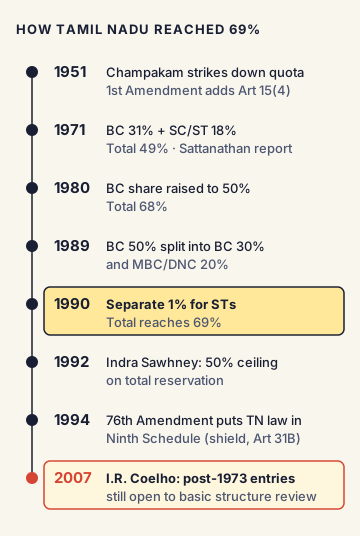
- 1921 and 1927: The Madras Presidency issued "Communal Government Orders". These set aside shares of government posts for different communities. The 1927 order gave non-Brahmin Hindus 44%, and Brahmins, Muslims, and Christians and Anglo-Indians 16% each, with 8% for SCs.
- 1950–51: The courts struck down the communal order in State of Madras v. Champakam Dorairajan (1951). In response, Parliament passed the First Amendment (1951), which added Article 15(4) to allow special provisions for backward classes in education.
- 1971: After the Sattanathan Commission (report in 1970), the BC share was raised from 25% to 31% and the SC/ST share from 16% to 18%. Total: 49%.
- 1980: The BC share was raised to 50%, taking the total to 68%.
- 1989: The 50% BC share was split into 30% for Backward Classes and 20% for Most Backward Classes (MBC) and Denotified Communities.
- 1990: A separate 1% was given to Scheduled Tribes. Total: 69%.
How did 69% survive the 50% ceiling?
In Indra Sawhney v. Union of India (1992), the Supreme Court said total reservation should normally not cross 50%. Tamil Nadu then passed the Tamil Nadu Backward Classes, Scheduled Castes and Scheduled Tribes (Reservation of Seats in Educational Institutions and of Appointments or Posts in the Services under the State) Act, 1993 (Tamil Nadu Act 45 of 1994).
Parliament then passed the 76th Constitutional Amendment Act, 1994, which put this Act into the Ninth Schedule as entry 257A. Under Article 31B, laws in the Ninth Schedule cannot be struck down just because they conflict with Fundamental Rights. Think of the Ninth Schedule like a protective cover around a law.
But the cover is not complete
In I.R. Coelho v. State of Tamil Nadu (2007), a nine-judge bench held that laws put into the Ninth Schedule after 24 April 1973 can still be reviewed if they damage the basic structure of the Constitution. Since the 76th Amendment came in 1994, Tamil Nadu's 69% law can still be tested on this ground. Petitions challenging it have been pending in the Supreme Court.
How is the 69% divided today?
As per the Tamil Nadu government's citizen charter:
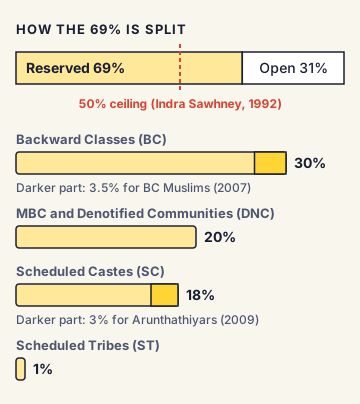
- Backward Classes (BC): 30%, of which BC (general) is 26.5% and BC Muslims 3.5%
- Most Backward Classes and Denotified Communities (MBC/DNC): 20%
- Scheduled Castes (SC): 18%, of which 3% is set apart for Arunthathiyars (since 2009)
- Scheduled Tribes (ST): 1%
- Open competition (general): 31%
The BC Muslim quota
The Tamil Nadu Backward Class Christians and Backward Class Muslims Act, 2007 (Act 33 of 2007) set aside 3.5% each for BC Christians and BC Muslims, out of the 30% BC share, from 15 September 2007. In 2008, the separate Christian quota was withdrawn (Tamil Nadu Act 51 of 2008), after Christian groups said they did better in the general BC pool.
The BC Muslim quota of 3.5% continues. It covers seven notified Muslim communities: Ansar, Dekkani Muslims, Dubekula, Labbais (including Rowthar and Marakayar), Mapilla, Sheik and Syed.
Internal reservation and its limits
A "quota within a quota" is called internal reservation. Courts have allowed it, but only with proper data. In 2021, Tamil Nadu gave 10.5% inside the 20% MBC quota to the Vanniyar community. On 31 March 2022, the Supreme Court (Justices L. Nageswara Rao and B.R. Gavai) struck this down. It said caste can be a basis for internal reservation, but it cannot be the only basis, and the state had used old, unreliable data.
Commonly confused concepts
- 50% ceiling vs EWS: The 50% ceiling from Indra Sawhney applies to caste-based reservation. The 10% EWS (Economically Weaker Sections) quota from the 103rd Amendment (2019) was upheld in Janhit Abhiyan (2022) as a separate category.
- BC vs MBC: Both are backward groups in Tamil Nadu, but MBCs are judged to be more backward and have their own 20% share, so they do not compete with relatively better-off BCs.
- Ninth Schedule protection vs basic structure review: Article 31B protects a law from Fundamental Rights challenges, but after I.R. Coelho (2007), post-1973 entries can still be tested against the basic structure.
Issues, criticism and the way forward
- Data: Critics point out that Tamil Nadu has no recent caste census to show exactly how many people belong to each group, so the shares are hard to test. Supporters say a large majority of the state's people belong to backward groups, which justifies the high share.
- Merit and the open category: Some argue that only 31% of seats remain open, which can hurt candidates outside the reserved groups. Others reply that reservation has widened access to education and jobs, and that Tamil Nadu has strong human development results.
- Fairness inside groups: Larger or better-off castes may take most of the benefits within a category. Internal reservation is one answer, but the Vanniyar case shows it needs solid data.
- Way forward: Experts suggest regular, data-based reviews by the State Backward Classes Commission, transparent caste data, and a final ruling by the Supreme Court on the pending 69% cases.
Concepts to Know
- Ninth Schedule: A list in the Constitution, added by the First Amendment (1951). Laws placed here get protection under Article 31B from being struck down for violating Fundamental Rights.
- Basic structure: The core features of the Constitution (like democracy, secularism and judicial review) that even Parliament cannot destroy through an amendment. The idea comes from Kesavananda Bharati (1973).
- Denotified Communities: Groups that were labelled "criminal tribes" under a colonial law of 1871. That label was removed ("denotified") in 1952.
- Community certificate: A government document, usually issued by a Tahsildar, that states which caste or community a person belongs to. It is needed to claim reservation.
- Total reservation: 69% (BC 30, MBC/DNC 20, SC 18, ST 1)
- BC Muslims: 3.5% out of the BC 30%, since 15 September 2007 (Act 33 of 2007)
- BC Christian 3.5% sub-quota withdrawn in 2008 (Act 51 of 2008)
- Arunthathiyars: 3% within the SC 18% (2009)
- 1993 Act = Tamil Nadu Act 45 of 1994; put in the Ninth Schedule by the 76th Amendment, 1994 (entry 257A)
- I.R. Coelho (2007): post-24 April 1973 Ninth Schedule laws open to basic structure review
- Vanniyar 10.5% internal quota struck down on 31 March 2022
● Tracked since October 15, 2026 · last seen October 15, 2026 · updates as the daily brief publishes