National Commission for Scheduled Castes (NCSC)
Article 338
The National Commission for Scheduled Castes (NCSC) is a constitutional body set up under Article 338 of the Constitution. Its job is to watch over the safeguards given to Scheduled Castes (SCs), look into their complaints, and advise the government on their development. Because it is created by the Constitution itself, it cannot be abolished by an ordinary law. Its sister body for tribes is the National Commission for Scheduled Tribes (NCST) under Article 338A.
Why does it exist?
The Constitution gives SCs many protections: reservation in jobs and education, reserved seats in legislatures, protection against untouchability (Article 17) and laws like the SC/ST (Prevention of Atrocities) Act, 1989. Protections on paper are not enough. Someone must check whether they are actually being followed, and must listen when an SC person or community is denied their rights.
The NCSC is that watchdog. You can think of it like a referee who watches the game and can stop play, summon players and report problems to the authorities.
Where did it come from?
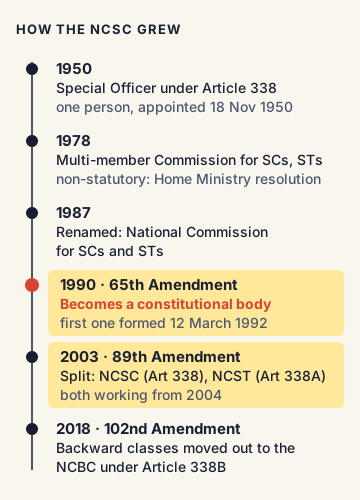
- 1950: The original Article 338 created a Special Officer, later called the Commissioner for Scheduled Castes and Scheduled Tribes, appointed on 18 November 1950. This was a one-person office.
- 1978: By a Home Ministry resolution of 21 July 1978, the government set up a non-statutory (not created by law) multi-member Commission for SCs and STs. Its first chairman was Bhola Paswan Shastri.
- 1987: It was renamed the National Commission for SCs and STs.
- 1990: The 65th Constitutional Amendment turned it into a constitutional body, the National Commission for SCs and STs. The first such Commission was formed on 12 March 1992, and the old Commissioner's office was abolished.
- 2003: The 89th Constitutional Amendment split it into two: the NCSC (Article 338) and the NCST (new Article 338A). Both began working in 2004.
- 2018: The 102nd Amendment removed the NCSC's role in looking into complaints of backward classes, because a new National Commission for Backward Classes (Article 338B) was given constitutional status.
Who is in it?
The NCSC has:
- A Chairperson
- A Vice-Chairperson
- Three other Members
They are appointed by the President by warrant under his hand and seal (a formal signed and sealed order). Their conditions of service and tenure are decided by the President through rules; in practice the term is three years.
What does it do? (Article 338(5))
- Investigate and monitor all matters relating to the safeguards for SCs under the Constitution and other laws, and judge how well they work.
- Inquire into specific complaints about denial of rights and safeguards of SCs.
- Advise on the planning process for the social and economic development of SCs, and assess their progress at the Union and State levels.
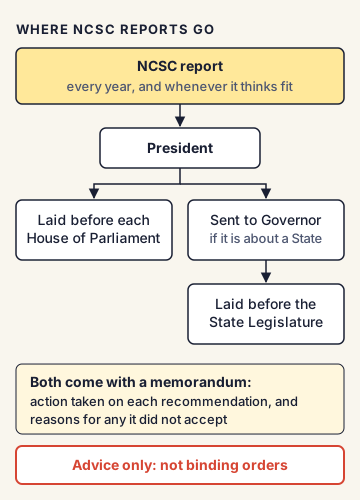
- Report to the President every year, and at other times it thinks fit, on the working of the safeguards.
- Recommend measures that the Union or States should take for the protection and welfare of SCs.
What powers does it have? (Article 338(8)) When investigating or inquiring into a complaint, the Commission has all the powers of a civil court trying a suit. It can:
- Summon any person and examine them on oath
- Order any document to be found and produced
- Take evidence on affidavits
- Ask for any public record from any court or office
- Issue commissions to examine witnesses and documents
Must the government consult it? (Article 338(9)) Yes. Article 338(9) says the Union and every State Government shall consult the Commission on all major policy matters affecting Scheduled Castes. Article 338A(9) has the same rule for the NCST and Scheduled Tribes. Changing the share of reservation for SCs or STs is clearly a major policy matter. Courts can treat a failure to consult as a serious defect in a decision.
What happens to its reports?
The President places the reports before each House of Parliament, along with a memorandum explaining the action taken on its recommendations and the reasons if any recommendation is not accepted. If a report concerns a State, it is also sent to the Governor, who places it before the State Legislature with a similar memorandum.
Commonly confused concepts
- NCSC (Article 338) vs NCST (Article 338A) vs NCBC (Article 338B): Same basic design (chairperson, vice-chairperson, three members; civil court powers), but for SCs, STs and socially and educationally backward classes respectively. The NCST was split from the NCSC by the 89th Amendment (2003); the NCBC got constitutional status by the 102nd Amendment (2018).
- NCSC vs National Commission for Safai Karamcharis: The Safai Karamcharis commission is a statutory body (originally set up under a 1993 Act and later continued by government resolution) for sanitation workers. It is not a constitutional body.
- Constitutional vs statutory body: A constitutional body (like NCSC) is created by the Constitution and can be changed only by a constitutional amendment. A statutory body (like the National Human Rights Commission) is created by an ordinary Act of Parliament.
- Advisory, not binding: The NCSC's recommendations are not binding orders. Its strength lies in investigation, reporting to Parliament and the compulsory consultation rule.
Issues, criticism and the way forward
- Recommendations not binding: Governments can ignore its advice, so its influence depends on public and parliamentary attention.
- Delayed reports: Annual reports have often been laid before Parliament years late, which weakens accountability.
- Vacancies and staff shortage: Posts in the Commission have at times remained vacant, and its regional offices are thinly staffed for handling complaints from across the country.
- Consultation often skipped: As the Karnataka case shows, governments sometimes take major decisions affecting SCs without consulting the Commission.
- Way forward: Experts suggest time limits for placing reports before Parliament, filling vacancies on time, better funding and staff, and making the consultation step a clear, recorded part of every major policy decision on SCs.
Concepts to Know
- Constitutional body: An institution set up directly by the Constitution, such as the Election Commission or the NCSC.
- Safeguards: Protections given by the Constitution and laws to a weaker group, like reservation or laws against atrocities.
- Affidavit: A written statement that a person swears is true, which can be used as evidence.
- Memorandum of action taken: A note from the government explaining what it has done about each recommendation, and why it did not accept some.
- Article 338: NCSC; Article 338A: NCST; Article 338B: NCBC
- 65th Amendment, 1990: multi-member constitutional National Commission for SCs and STs (first constituted 12 March 1992)
- 89th Amendment, 2003: split into NCSC and NCST (working from 2004)
- 102nd Amendment, 2018: NCBC created under Article 338B; backward classes removed from Article 338(10)
- Composition: Chairperson, Vice-Chairperson, three Members; appointed by the President by warrant under hand and seal
- Article 338(8): powers of a civil court while investigating or inquiring
- Article 338(9): Union and State governments must consult the NCSC on all major policy matters affecting SCs
- Reports go to the President, who lays them before Parliament with an action-taken memorandum
- First Special Officer (Commissioner for SCs and STs) appointed on 18 November 1950; non-statutory Commission formed in 1978
● Tracked since May 19, 2026 · last seen October 12, 2026 · updates as the daily brief publishes