Articles 330 and 332
Reservation of Seats for SCs and STs in Legislatures
Articles 330 and 332 of the Constitution reserve seats for Scheduled Castes (SCs) and Scheduled Tribes (STs) in the Lok Sabha and in the Legislative Assemblies of the States. In these reserved seats, only an SC (or ST) person can stand as a candidate, but all voters of the constituency, from every community, vote. The number of reserved seats in each State is fixed in proportion to the SC and ST population of that State. This is the one place where the Constitution clearly uses population as the measure for reservation.
Why does it exist?
Communities that faced untouchability and social exclusion for centuries had almost no voice in law-making bodies. In open elections, dominant groups could win most seats, and the concerns of SCs and STs might never reach the House. Reserved seats guarantee that these communities have members of their own in every legislature, roughly equal to their share of the population. Think of it like a school committee where some places are kept for students from every section, so no section is left without a voice.
Where did it come from?
- In August 1932, the British government's Communal Award gave the "Depressed Classes" (as SCs were then called) separate electorates, meaning only Depressed Class voters would elect Depressed Class members.
- Mahatma Gandhi opposed separate electorates and began a fast in Yerwada jail. The result was the Poona Pact of 24 September 1932 between Gandhi and Dr B.R. Ambedkar. It replaced separate electorates with joint electorates plus reserved seats, and increased the number of seats for the Depressed Classes (usually given as 148 in provincial legislatures).
- The Government of India Act, 1935 followed this model.
- The Constituent Assembly also rejected separate electorates and kept joint electorates with reserved seats, now written into Articles 330 and 332.
What do the Articles say?
- Article 330: Seats are reserved in the Lok Sabha for SCs and for STs. (STs in the autonomous districts of Assam are covered separately.) Under clause (2), the number of seats reserved in a State must bear, "as nearly as may be", the same proportion to that State's total seats as the State's SC (or ST) population bears to its total population.
- Article 332: The same rule for State Legislative Assemblies. Clause (3) applies the same population proportion.
- Article 334: These reservations are temporary and must end after a fixed period, unless extended. It started at 10 years and has been extended many times.
- Articles 341 and 342: The President (and Parliament by law) decides which communities are SCs and STs in each State. Only people from these lists can contest reserved seats.
- Articles 330A and 332A: Added by the 106th Amendment, 2023 (Nari Shakti Vandan Adhiniyam). One-third of seats will be reserved for women, including one-third of the SC and ST reserved seats. This comes into effect after the next census and delimitation.
How does it work in practice?
- The census gives the SC and ST population of each State.
- A Delimitation Commission (set up under a law of Parliament) calculates how many seats in each State must be reserved, and picks which constituencies will be reserved.
- ST seats are usually chosen where the share of ST people is highest. SC seats are chosen where SC share is relatively high, spread across the State.
- On election day, every voter in the reserved constituency votes. Only the candidates must be SC or ST.
- An SC or ST person can also contest an unreserved (general) seat.
Under the 84th Amendment (2001) and 87th Amendment (2003), seat numbers are frozen and reserved seats are based on the 2001 Census until the figures of the first census after 2026 are published. After the 2008 delimitation, the Lok Sabha has 84 seats reserved for SCs and 47 for STs out of 543.
How long will it last? (Article 334)
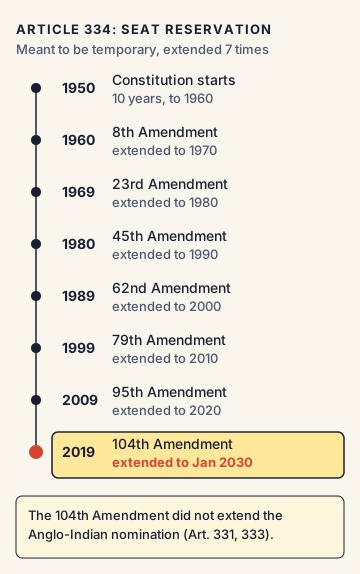
The original Constitution allowed reserved seats for 10 years. Parliament extended the period by the 8th (1960), 23rd (1969), 45th (1980), 62nd (1989), 79th (1999), 95th (2009) and 104th (2019) Amendments. The 104th Amendment, 2019 extended SC and ST seat reservation to 80 years from the start of the Constitution, that is, until January 2030. It did not extend the nomination of two Anglo-Indian members to the Lok Sabha, so that provision ended.
Political reservation vs job reservation: the key difference
Students often mix these up. The Constitution treats them differently:
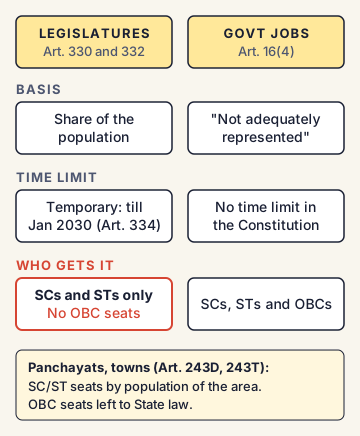
- Seats in legislatures (Articles 330, 332): proportional to population; temporary (Article 334); only for SCs and STs (no OBC reservation in Parliament or Assemblies).
- Government jobs (Article 16(4)): based on "not adequately represented", not population; no time limit in the Constitution; available for SCs, STs and OBCs; subject to the 50% ceiling from Indra Sawhney (1992).
- Panchayats and municipalities (Articles 243D and 243T): SC and ST seats are proportional to population of the area; OBC reservation is left to State law. In K. Krishna Murthy v. Union of India (2010), the Supreme Court held that local body reservation is different from job and education reservation, but OBC reservation there must pass a "triple test", which includes a 50% overall cap.
Commonly confused concepts
- Reserved seat vs separate electorate: In a reserved seat, everyone votes but only an SC/ST candidate can contest. In a separate electorate, only voters of that community vote. India uses reserved seats; separate electorates were rejected in the Poona Pact.
- Article 330 vs Article 331: Article 330 is SC/ST reservation in the Lok Sabha. Article 331 allowed the President to nominate two Anglo-Indians to the Lok Sabha; this ended in January 2020.
- Article 332 vs Article 333: Article 332 is SC/ST reservation in State Assemblies. Article 333 allowed Governors to nominate an Anglo-Indian member; this also ended after the 104th Amendment.
- Rajya Sabha: There is no SC/ST reservation in the Rajya Sabha or in State Legislative Councils.
Issues, criticism and the way forward
- Proxy representation: Critics argue that because all voters elect the member, reserved-seat members may depend on dominant groups and party leaders, and may not always speak strongly for their own community. Supporters say joint electorates prevent social division.
- No rotation: Reserved constituencies stay the same until the next delimitation, so general candidates in those areas can never contest, and SC/ST candidates are often limited to those seats.
- Old census data: Seats are still based on the 2001 Census. Population shares have changed since then.
- Repeated extensions: Reservation was meant to be temporary, but it has been extended seven times. Some argue for a review of results; others say social exclusion continues and the safeguard is still needed.
- Way forward: Experts suggest using fresh census data at the next delimitation, studying how reserved-seat members perform, and strengthening internal party democracy so that SC/ST leaders get real decision-making roles.
Concepts to Know
- Electorate: The group of people who are allowed to vote in an election.
- Constituency: The area whose voters elect one member to the Lok Sabha or a State Assembly.
- Delimitation: Fixing the number of seats and drawing the boundaries of constituencies, done by a Delimitation Commission after a census.
- Depressed Classes: The old term used in British India for the communities now called Scheduled Castes.
- Basic structure: Core features of the Constitution (like equality, democracy and judicial review) that even Parliament cannot destroy through an amendment, as decided in Kesavananda Bharati (1973).
- Article 330: SC/ST seats in Lok Sabha; Article 332: SC/ST seats in State Assemblies; both proportional to population
- Article 334: time limit; extended by the 104th Amendment, 2019 until January 2030
- Lok Sabha: 84 SC and 47 ST reserved seats out of 543 (Delimitation 2008, based on 2001 Census)
- Poona Pact: 24 September 1932; joint electorates with reserved seats replaced the separate electorates of the Communal Award (August 1932)
- Articles 330A and 332A (106th Amendment, 2023): one-third seats for women, including within SC/ST seats
- Anglo-Indian nomination (Articles 331 and 333) ended in January 2020
- No SC/ST reservation in Rajya Sabha or Legislative Councils
- K. Krishna Murthy v. Union of India (2010): local body reservation is distinct; OBC reservation in local bodies needs the triple test
● Tracked since April 15, 2026 · last seen October 12, 2026 · updates as the daily brief publishes