Nagoya Protocol on Access and Benefit-Sharing (ABS)
Updated 4 Nov 2026: Added Article 4(4) on specialised benefit-sharing treaties, and how the WHO's PIP Framework and planned PABS system relate to the Protocol.
The Nagoya Protocol is an international agreement about a simple question: if a company or scientist takes a plant, animal or microbe from one country and earns money from it, does that country get a share? The Protocol says yes. The user must take permission first, and must agree to share the benefits fairly. It is a supplementary agreement to the Convention on Biological Diversity (CBD), adopted in Nagoya, Japan, on 29 October 2010, and in force since 12 October 2014.
Why does it exist?
Many medicines, cosmetics, seeds and food products come from living things found in nature. A large share of this natural wealth sits in developing countries in the tropics, like India, Brazil or Indonesia. But for a long time, firms in rich countries collected these resources, made products, patented them and kept all the profit. The countries and communities that had protected these resources for centuries got nothing. This is called biopiracy. The Nagoya Protocol exists to stop this and make the deal fair.
A simple comparison: think of a village with a mango orchard. Earlier, a trader could walk in, take the best mango variety, sell a new juice made from it worldwide, and never pay the village. Under the Nagoya Protocol, the trader must ask the village first, sign an agreement, and share some of the earnings.
Where did it come from?
The idea starts with the CBD itself.
- The CBD (1992) made "fair and equitable sharing of benefits" its third objective. Its Article 15 said countries have sovereign rights over their genetic resources, so access needs the providing country's prior informed consent. But it gave no detailed rules.
- In 2002, the CBD adopted the Bonn Guidelines on access and benefit-sharing. These were only voluntary, so many countries ignored them.
- The same year, the World Summit on Sustainable Development in Johannesburg called for an international regime on benefit-sharing.
- After years of talks, the Nagoya Protocol was adopted at COP10 in Nagoya in 2010. It came into force on 12 October 2014, 90 days after the 50th country ratified it.
The two key ideas: PIC and MAT
The whole Protocol stands on two short terms. Learn them well:
- Prior Informed Consent (PIC): Before taking a genetic resource, the user must get permission from the provider country's government. "Informed" means the user must honestly explain what they will do with it.
- Mutually Agreed Terms (MAT): The user and the provider sign a contract. It sets out how the benefits will be shared, for example money, royalties, joint research or training.
How does it work, step by step?
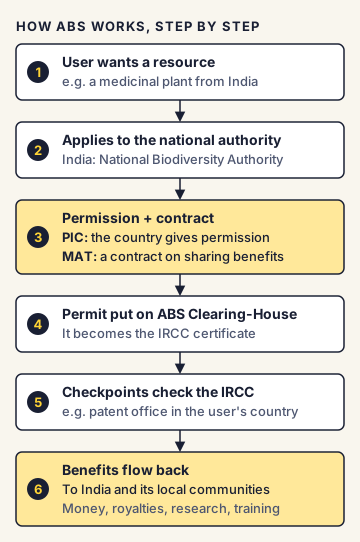
- A researcher or company wants to use, say, a medicinal plant from India.
- They apply to India's competent national authority (in India, the National Biodiversity Authority).
- The authority gives permission (PIC) and both sides sign a contract (MAT) on sharing benefits.
- The permit is uploaded to a global online database, the ABS Clearing-House. Once there, it becomes an Internationally Recognised Certificate of Compliance (IRCC).
- When the user later applies for a patent, funding or market approval in its home country, officials at "checkpoints" can check this certificate.
- If the product earns money, benefits flow back to the provider country and to the local communities who held the resource or knowledge.
The key parts UPSC may ask about
- Article 1: The objective is fair and equitable sharing of benefits from the use of genetic resources, which helps conserve biodiversity.
- Article 2: Defines "utilisation of genetic resources" as research and development on their genetic or biochemical makeup, including through biotechnology. It also covers derivatives: natural biochemical compounds made by a living thing (like a plant oil or toxin), even if they contain no genes.
- Article 4: Explains how the Protocol fits with other treaties. Under Article 4(4), a special international agreement on access and benefit-sharing (called a specialised ABS instrument) can apply in place of the Protocol. It must fit the goals of the CBD and the Protocol. It then replaces the Protocol only for the countries in that agreement, and only for the genetic resource it covers.
- Article 5: Benefit-sharing on mutually agreed terms. Benefits can be monetary (fees, royalties) or non-monetary (sharing research results, technology, training).
- Article 6: Access to genetic resources needs prior informed consent of the providing country.
- Article 7: Access to traditional knowledge linked to genetic resources needs the consent of the Indigenous and local communities who hold it.
- Article 8: Special considerations. Countries should make access simpler for non-commercial research and act fast in health emergencies. It also mentions the importance of genetic resources for food and agriculture.
- Article 10: Parties will consider a global multilateral benefit-sharing mechanism for cases that cross borders or where consent cannot be granted or obtained.
- Article 14: Sets up the ABS Clearing-House, the online information platform.
- Articles 15 and 16: Each country must make sure that resources and traditional knowledge used within its borders were accessed legally in the provider country. This is the "user country" duty.
- Article 17: Monitoring through checkpoints and the IRCC.
- Articles 19 and 20: Encourage model contract clauses and codes of conduct.
What is the Article 10 mechanism, and why is it hard?
The normal system works one-to-one: one user, one provider country, one contract. But some cases do not fit. A plant may grow across five countries, so who gives consent? Or a sample may have been collected decades ago with no record of its origin. Article 10 asks countries to consider a global pot where benefits from such cases can go, to be used for conservation everywhere.
Countries have discussed it since 2010 but have never agreed on whether it is needed or how it should work. It is one of the items COP17 left for COP18.
What does an IRCC contain?
Article 17 says the certificate must show, when not confidential: the issuing authority, the date, the provider, a unique identifier, the person or company given consent, the resource covered, confirmation that PIC was obtained and MAT were set, and whether the use is commercial or non-commercial.
India's position and Indian examples
- India signed the Protocol on 11 May 2011 and ratified it on 9 October 2012. It became binding for India on 12 October 2014, the day it entered into force.
- India implements it through the Biological Diversity Act, 2002, which has a three-tier structure: the National Biodiversity Authority (NBA) in Chennai, State Biodiversity Boards (SBBs) and Biodiversity Management Committees (BMCs) at the local body level. BMCs keep People's Biodiversity Registers, which record local resources and knowledge.
- Under the Act, foreign persons and companies need NBA approval to access Indian biological resources, and anyone seeking a patent based on Indian biological resources or knowledge needs NBA approval.
- India is the world's biggest issuer of IRCCs. As per Environment Ministry data released in March 2026, India had issued 3,561 of the 6,311 IRCCs worldwide (about 56%), far ahead of France (964) and Spain (320).
- The Biological Diversity (Amendment) Act, 2023 exempted registered AYUSH practitioners and users of codified traditional knowledge (such as texts of Ayurveda, Siddha and Unani) from benefit-sharing, and decriminalised offences under the Act.
- A classic Indian example of why ABS matters is the neem and turmeric patent cases of the 1990s. Patents were granted abroad on uses that Indian households had known for centuries. India got them revoked by showing this was traditional knowledge.
Commonly confused concepts
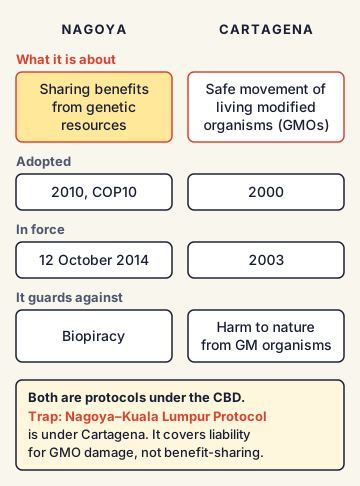
- Nagoya Protocol vs Cartagena Protocol: Nagoya (2010) is about sharing benefits from genetic resources. Cartagena (2000, in force 2003) is about the safe movement of living modified organisms (genetically modified organisms) across borders. Both are under the CBD.
- Nagoya Protocol vs Nagoya–Kuala Lumpur Supplementary Protocol: The supplementary protocol (also 2010) is under the Cartagena Protocol. It deals with liability and compensation for damage caused by living modified organisms. It is not about benefit-sharing.
- Nagoya Protocol vs Aichi Biodiversity Targets: Both came from COP10 in Nagoya-Aichi in 2010. The Aichi Targets were 20 global goals for 2011–2020 (Target 16 asked for the Nagoya Protocol to be in force by 2015). The Protocol is a binding legal treaty.
- Nagoya Protocol vs ITPGRFA: The International Treaty on Plant Genetic Resources for Food and Agriculture (2001, under the Food and Agriculture Organization) runs its own multilateral system for 64 major food and fodder crops. Users get standard access and pay into a shared fund. The Nagoya Protocol's Article 10 mechanism is a separate, still-unbuilt idea.
- Nagoya Protocol vs the Cali Fund: The Cali Fund (agreed at COP16 in 2024, set up under the CBD) collects money from companies that use Digital Sequence Information (DSI), which is genetic data stored online. The Nagoya Protocol was written for physical samples. Whether DSI falls under it was a long fight, so the CBD built a separate system for DSI.
- Nagoya Protocol vs the WHO's PIP Framework and PABS system: Nagoya is a general system that mostly works country by country. The World Health Organization's Pandemic Influenza Preparedness (PIP) Framework is a special many-country system for one purpose: sharing flu viruses that could cause a pandemic, along with access to vaccines. The Pathogen Access and Benefit-Sharing (PABS) system is a planned system for pathogens (germs such as viruses) that could cause a pandemic. It comes from the WHO Pandemic Agreement, adopted in May 2025. As of September 2026, its annex (the attached rulebook) was still being negotiated. The WHO says both could count as specialised ABS instruments under Article 4(4), with PABS counting only once it is running. That is the WHO's view, not a decision of the Nagoya Parties, and those Parties have recorded different views on such instruments.
Issues, criticism and the way forward
- Digital data loophole: Today, scientists often download a genetic sequence from an online database instead of collecting a sample. The Protocol does not clearly cover this. The Cali Fund tries to fill the gap, but contributions are voluntary.
- Weak user-country checks: Many rich user countries have few or weak checkpoints. So a resource taken illegally may still be patented or sold there.
- Paperwork for research: Scientists complain that permits slow down basic research, disease surveillance and sharing of samples, such as virus samples in a pandemic.
- Small benefits reach communities: Even where benefits are shared, very little money reaches the Indigenous and local communities who protected the resource.
- Big players outside: The United States, home to many biotech firms, is not a Party to the CBD, so it is not bound by the Protocol.
- Way forward: Experts suggest simple, fast permits for non-commercial research, stronger checkpoints in user countries, a clear decision on the Article 10 mechanism, linking the Protocol with the Cali Fund for DSI, and strong BMCs and People's Biodiversity Registers so benefits reach communities.
Concepts to Know
- Genetic resources: Any plant, animal or microbe material that contains genes and has real or possible value, for example a seed, a leaf, a soil microbe or a snake venom sample.
- Traditional knowledge: Knowledge that communities have built over generations, such as which plant heals a wound. It often guides scientists to useful resources.
- Biopiracy: Taking a country's biological resources or traditional knowledge, and profiting from them through patents or products, without permission or fair payment.
- Ratification: The formal step by which a country agrees to be legally bound by a treaty it has signed.
- Patent: A legal right that lets only the inventor make and sell an invention for a set number of years (usually 20).
- Checkpoint: An office, such as a patent office or a research funding agency, that checks whether the user of a genetic resource has a valid permit.
- Royalty: A regular payment made to the owner of something for the right to use it, often a percentage of sales.
- Full name: Nagoya Protocol on Access to Genetic Resources and the Fair and Equitable Sharing of Benefits Arising from their Utilization to the CBD
- Adopted: 29 October 2010 at COP10, Nagoya, Japan; in force: 12 October 2014 (90 days after the 50th ratification)
- About 142 Parties (as of 2025, including the European Union)
- Core ideas: Prior Informed Consent (PIC) and Mutually Agreed Terms (MAT)
- Article 4(4): specialised ABS instruments can apply in place of the Protocol; Article 7: consent of communities for traditional knowledge; Article 10: global multilateral benefit-sharing mechanism; Article 14: ABS Clearing-House; Article 17: checkpoints and IRCC
- Predecessor: Bonn Guidelines (2002), voluntary
- India: signed 11 May 2011, ratified 9 October 2012; implemented via the Biological Diversity Act, 2002 and the NBA (Chennai)
- India issued about 56% of all IRCCs worldwide (3,561 of 6,311, as per March 2026 data)
- 4 Nov 2026Added Article 4(4) on specialised benefit-sharing treaties, and how the WHO's PIP Framework and planned PABS system relate to the Protocol.
● Tracked since March 18, 2026 · last seen November 02, 2026 · updates as the daily brief publishes