WHO Pandemic Agreement
The World's Treaty for the Next Pandemic
The WHO Pandemic Agreement is an international treaty meant to help the world prevent, prepare for and respond to future pandemics better than it did during COVID-19. A pandemic is a disease outbreak that spreads across many countries and continents. The Agreement's main promise is fairness: when the next pandemic comes, vaccines, medicines and tests should reach poor countries too, not only rich ones.
It was adopted by the World Health Assembly in May 2025, but one key part, the PABS annex, is still being negotiated.
Why was it needed?
During COVID-19, rich countries bought up most of the early vaccines. Many poor countries, especially in Africa, waited months for their first doses. Countries also blocked exports of masks and medicines, and information about the virus was not always shared quickly. This unfairness is often called "vaccine nationalism" or "vaccine apartheid". Experts agreed that the old rules did not prevent this.
Countries that share a virus sample with the world should also get a fair share of the vaccines made from it. The Agreement tries to build that deal into international law.
Where did it come from?
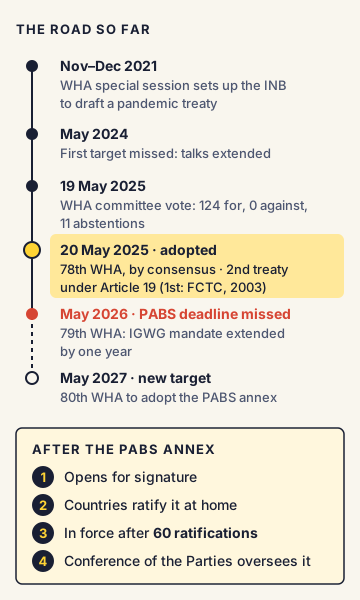
- November–December 2021: At only the second special session in its history, the World Health Assembly (WHA), WHO's top decision-making body of all member countries, set up an Intergovernmental Negotiating Body (INB) to draft a pandemic treaty.
- The first target was May 2024, but countries could not agree in time, so talks were extended.
- 19 May 2025: A committee of the WHA approved the text by 124 votes in favour, 0 against and 11 abstentions.
- 20 May 2025: The 78th World Health Assembly adopted the Pandemic Agreement by consensus. It was only the second treaty ever negotiated under Article 19 of the WHO Constitution. The first was the WHO Framework Convention on Tobacco Control (FCTC), adopted in 2003 and in force since 2005.
- The WHA set up an Intergovernmental Working Group (IGWG) to negotiate the PABS annex, with a first target of the 79th WHA in May 2026.
- May 2026: Talks failed to finish. The IGWG's mandate was extended by a year, with the 80th WHA in May 2027 as the new target. A special session could be called earlier if a deal is reached sooner.
How will it work once complete?
- The PABS annex is finished and adopted by the WHA.
- The Agreement opens for signature. Countries then ratify it through their own national processes.
- It enters into force after 60 countries ratify it.
- A Conference of the Parties (COP), a regular meeting of all member countries, oversees how it is followed.
The key parts and facts
- Prevention and One Health: Countries commit to stopping outbreaks at the source, including diseases that jump from animals to people. One Health is the idea that human health, animal health and the environment are linked and must be managed together.
- PABS system (Article 12): Countries share samples and genetic data of dangerous pathogens quickly through WHO. In return, the benefits (vaccines, medicines, tests) are shared fairly.
- The 20% promise: Manufacturers that join the PABS system would give WHO rapid access to 20% of their real-time production of vaccines, medicines and tests during a pandemic, for distribution based on public health risk and need, especially to developing countries.
- Technology transfer: Countries agree to encourage the sharing of know-how so that more countries, including developing ones, can make vaccines and medicines locally. This is to be on "mutually agreed" terms, not forced.
- Global Supply Chain and Logistics Network (GSCL): A system to make sure health products reach where they are needed fairly and quickly.
- Coordinating Financial Mechanism: A system to arrange money for pandemic preparedness, especially for poorer countries.
- Sovereignty clause: The Agreement clearly states that nothing in it gives WHO the power to order any country to change its laws, or to impose lockdowns, travel bans or vaccine mandates. These stay national decisions.
What is the fight over the PABS annex?
The deal is simple in idea but hard in detail.
- The Africa Group and the Group for Equity (a bloc of developing countries; Indonesia has spoken for it) want legally binding contracts that force companies to share products at affordable prices and within set timelines.
- Several developed countries, mainly in Europe, and the drug industry argue that strict rules could slow research and discourage investment. They prefer more voluntary arrangements.
- A hybrid model with both mandatory and voluntary tracks was proposed in 2026 but did not win enough support.
India's position and Indian examples
- India backed the Pandemic Agreement and pushed for strong equity, a workable PABS system, and technology transfer, in line with its long-standing support for developing-country access to medicines.
- India is a major vaccine maker, often called the "pharmacy of the world". During COVID-19, it supplied vaccines abroad under the Vaccine Maitri initiative. So India stands on both sides of the debate: it supports access for poor countries and has a large manufacturing industry that would supply products.
- India has also argued, together with South Africa, at the WTO for waivers on patents (TRIPS rules) for COVID-19 products, which shows its consistent stand on access.
Commonly confused concepts
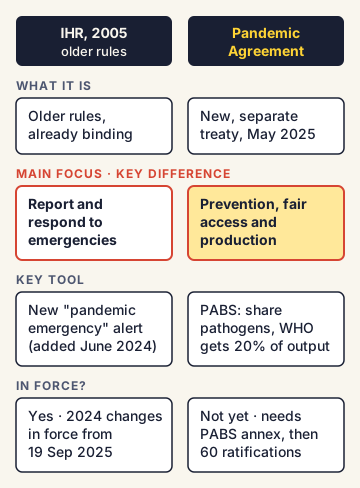
- Pandemic Agreement vs International Health Regulations (IHR), 2005: The IHR is an older, already binding set of rules on how countries report and respond to health emergencies, such as notifying WHO of outbreaks. The IHR was amended in June 2024 to add a new, higher alert level called a "pandemic emergency"; these changes entered into force on 19 September 2025. The Pandemic Agreement is a separate, new treaty focused on prevention, fair access and production. It needs 60 ratifications to enter into force.
- PHEIC vs Pandemic emergency: A PHEIC (Public Health Emergency of International Concern) is WHO's alert for a serious outbreak that may spread across borders, like the 2026 Ebola outbreak. A pandemic emergency is a higher level, for a PHEIC that has spread or is likely to spread widely across many regions and overwhelm health systems.
- Pandemic vs Epidemic vs Endemic: An epidemic is a sudden rise in cases in one area. A pandemic is an epidemic spread across many countries or continents. An endemic disease is always present at a steady level in a region (like malaria in parts of India).
- PABS vs Nagoya Protocol: The Nagoya Protocol (2010) covers benefit-sharing for all genetic resources under biodiversity law, with country-by-country permissions. PABS is a special, faster multilateral system for dangerous pathogens, because in a pandemic there is no time for slow bilateral permissions.
- PABS vs PIP Framework: The Pandemic Influenza Preparedness (PIP) Framework (2011) is an older WHO system for sharing flu viruses with pandemic potential and their benefits. PABS would cover all pathogens with pandemic potential.
Issues, criticism and the way forward
- Delay: Without the PABS annex, the whole treaty is frozen. Each year of delay means the world faces outbreaks like the 2026 Ebola epidemic without the new rules.
- Weak commitments: Critics say key promises, such as technology transfer, are voluntary ("mutually agreed"), so they may not change company behaviour.
- Absence of major players: The United States did not take part in the final vote and formally left WHO on 22 January 2026. A treaty without a major vaccine-producing country is weaker.
- Sovereignty concerns: Some groups claim the treaty will give WHO power over countries. The text explicitly denies this, but such fears can slow ratification.
- Way forward: Experts and the Independent Panel for Pandemic Preparedness and Response urge countries to finish PABS quickly, strengthen IHR implementation, and invest in surveillance and local manufacturing in the meantime.
Concepts to Know
- World Health Assembly (WHA): The yearly meeting of all WHO member countries in Geneva. It is WHO's highest decision-making body.
- Annex: An extra section attached to a treaty that holds detailed rules. It is a full part of the treaty.
- Ratification: The step by which a country formally agrees to be legally bound by a treaty, after signing it, through its own internal process.
- Pathogen: Any germ that causes disease, such as a virus, bacterium or fungus.
- Genetic sequence data: The "code" of a virus written as a string of letters. Scientists can use it to design tests and vaccines even without a physical sample.
- Abstention: When a country neither votes for nor against a proposal.
- INB set up at a WHA special session, November–December 2021
- Committee vote: 19 May 2025 (124 in favour, 0 objections, 11 abstentions); adopted by the 78th WHA on 20 May 2025
- Second treaty under Article 19 of the WHO Constitution (first: FCTC, adopted 2003, in force 2005)
- Enters into force after 60 ratifications; opens for signature only after the PABS annex is adopted
- PABS: Article 12; manufacturers to give WHO rapid access to 20% of real-time pandemic production
- PABS deadline missed in May 2026; new target: 80th WHA, May 2027
- IHR amendments adopted June 2024 ("pandemic emergency" level); in force 19 September 2025
- United States left WHO on 22 January 2026
● Tracked since November 02, 2026 · last seen November 02, 2026 · updates as the daily brief publishes