Ebola Virus Disease (EVD)
Ebola disease is a severe and often deadly illness in humans, caused by a group of viruses called orthoebolaviruses. It spreads between people through direct contact with the blood or body fluids of someone who is sick or has died from it. On average, about half of the people who catch it die, though this has ranged from 25% to 90% in past outbreaks. Most outbreaks have happened in Central and West Africa.
Why does it matter so much?
Ebola is not airborne like flu or COVID-19, so it does not spread as easily. But it is extremely deadly, it spreads fast in places with weak health systems, and it often kills health workers. Large outbreaks can overwhelm hospitals, shut down economies and cross borders through travel. That is why WHO has declared several Ebola outbreaks to be global emergencies.
Where did it come from?
Ebola was first identified in 1976, in two outbreaks at almost the same time:
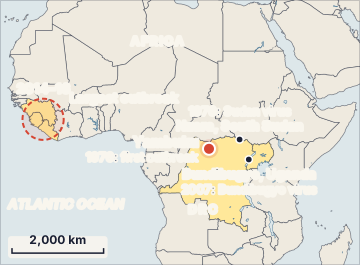
- One in Yambuku, in what is now the Democratic Republic of the Congo (DRC), near the Ebola River, which gave the disease its name.
- The other in Nzara, in what is now South Sudan, caused by a different virus (Sudan virus).
Major outbreaks since then:
- 2014–2016, West Africa (mainly Guinea, Liberia and Sierra Leone): the largest Ebola outbreak in history, with more than 28,600 cases and over 11,000 deaths. WHO declared it a PHEIC in 2014.
- 2018–2020, DRC (North Kivu and Ituri): the second-largest at that time, also declared a PHEIC in 2019.
- 2026, DRC and Uganda: an outbreak caused by Bundibugyo virus, declared on 15 May 2026 and made a PHEIC on 17 May 2026.
The virus family
Ebola viruses belong to the genus Orthoebolavirus in the family Filoviridae (filoviruses, named for their long, thread-like shape under a microscope). Six species are known. Three cause large human outbreaks:
- Ebola virus (earlier called Zaire ebolavirus): causes Ebola virus disease (EVD); the most common and best studied.
- Sudan virus: causes Sudan virus disease (SVD).
- Bundibugyo virus: causes Bundibugyo virus disease (BVD). It was first found in Bundibugyo district, Uganda, in 2007. Before 2026, the only other known outbreak was in the DRC in 2012 (59 cases, 34 deaths).
How does it spread, step by step?
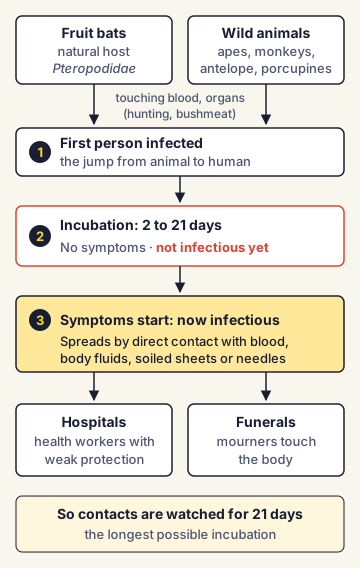
- From animals: The natural host is thought to be fruit bats of the family Pteropodidae. Humans first get infected by touching the blood, organs or body fluids of infected animals such as fruit bats, chimpanzees, gorillas, monkeys, forest antelope or porcupines, often while hunting or handling bushmeat.
- Between people: Through direct contact (through broken skin or the eyes, nose or mouth) with the blood or body fluids (vomit, stool, urine, saliva, semen) of a sick or dead person, or with objects like bedsheets or needles soiled with these fluids.
- Hospitals and funerals: Health workers get infected when protective measures are weak. Burials where mourners touch the body can spread it widely.
- Not before symptoms: A person is not infectious until symptoms start. The incubation period (time from infection to first symptoms) is 2 to 21 days. That is why contacts are watched for 21 days.
Symptoms and diagnosis
It starts suddenly with fever, tiredness, muscle pain, headache and sore throat. Later come vomiting, diarrhoea, stomach pain, rash, and damage to the kidneys and liver. Bleeding happens in some patients, usually late, and is less common than people think. Early Ebola looks like malaria or typhoid, so it is confirmed by lab tests such as RT-PCR (a test that detects the virus's genetic material).
Vaccines and treatment
- Ebola virus (Zaire type) only: There are two approved vaccines. Ervebo (by Merck), approved in 2019 by both the European regulator and the US FDA, is the one WHO recommends for outbreak response. Zabdeno/Mvabea (by Janssen) is the other. Two monoclonal antibody medicines, mAb114 (ansuvimab) and REGN-EB3 (Inmazeb), are recommended by WHO for treatment.
- Sudan and Bundibugyo viruses: There is no approved vaccine or specific medicine. Candidates are being tested. Patients get supportive care: fluids, keeping blood pressure and body salts stable, and treating other infections. Early supportive care greatly improves survival.
How is an outbreak controlled?
The standard tools are: quick detection and lab testing; contact tracing (finding everyone a patient touched and checking them for 21 days); isolating and caring for patients; strict infection control in hospitals; safe and dignified burials; vaccination where a vaccine exists (ring vaccination of contacts and their contacts); and community engagement so people trust health workers.
India's position and Indian examples
India has never had a local Ebola outbreak. During the 2014–2016 epidemic, India screened travellers at airports, set up isolation wards, and contributed money and supplies to the response in West Africa. Testing for such dangerous viruses in India is done at high-security labs such as the ICMR-National Institute of Virology (NIV), Pune, which has a BSL-4 (highest biosafety level) laboratory.
Commonly confused concepts
- Ebola vs Marburg: Both are filoviruses that cause severe haemorrhagic fever and spread through body fluids. But they are different viruses. Marburg virus was first identified in 1967 in Germany (Marburg) and Serbia (Belgrade), linked to monkeys from Uganda. Ebola vaccines do not protect against Marburg.
- Ebola vs Nipah: Nipah is also carried by fruit bats, but it belongs to a different family (Paramyxoviridae) and mainly affects the brain and lungs. Nipah outbreaks have occurred in India (Kerala, West Bengal) and Bangladesh. Ebola has not occurred in India.
- Ebola vs Lassa fever: Lassa fever, found in West Africa, is an arenavirus spread mainly by rats (Mastomys rats), not bats. It is usually less deadly.
- Ebola virus vs Ebola disease: "Ebola disease" is the umbrella term for illness caused by any orthoebolavirus. "Ebola virus disease (EVD)" strictly means illness caused by the Ebola virus (Zaire type). Disease from Bundibugyo virus is "BVD".
- Haemorrhagic fever does not always mean heavy bleeding: Many Ebola patients never bleed visibly. The main killers are fluid loss and organ failure.
Issues, criticism and the way forward
- Vaccine gap: Vaccines exist only for the Zaire-type Ebola virus. Outbreaks of Sudan or Bundibugyo virus, like the 2026 one, start with no approved vaccine or medicine. Experts call for "ready-to-test" candidate vaccines for every major virus species.
- Conflict zones: Eastern DRC has armed conflict and millions of displaced people. Violence blocks contact tracing, sample transport and vaccination.
- Trust and stigma: Fear of hospitals and of unfamiliar burial rules makes some families hide the sick. Survivors face stigma. Community engagement is essential.
- Global fairness: In past outbreaks, samples from Africa helped develop vaccines and drugs that were costly or late to reach Africa. This is exactly the problem the PABS system in the WHO Pandemic Agreement is meant to fix.
- Survivor care: The virus can hide in parts of the body such as the eyes, testes and brain, and in semen for up to 15 months after recovery. Survivors need follow-up care to prevent new chains of infection.
Concepts to Know
- Zoonotic disease: A disease that jumps from animals to humans, like Ebola, Nipah, rabies or bird flu.
- Case fatality rate (CFR): Out of every 100 confirmed patients, how many die. A CFR of 50% means half of them die.
- Monoclonal antibodies: Lab-made copies of the body's own defence proteins (antibodies), designed to stick to one specific part of a virus and stop it.
- Ring vaccination: Vaccinating the contacts of a patient, and the contacts of those contacts, to build a protective "ring" around each case.
- BSL-4 laboratory: A lab with the highest safety level, used to handle the most dangerous germs, with sealed rooms and full-body protective suits.
- Public Health Emergency of International Concern (PHEIC): WHO's formal alert, under the International Health Regulations, that an outbreak is serious, unusual, and may spread to other countries, needing a coordinated global response.
- First identified: 1976 (Yambuku, DRC, near the Ebola River; and Nzara, South Sudan)
- Family Filoviridae, genus Orthoebolavirus; 6 species, 3 cause large outbreaks (Ebola, Sudan, Bundibugyo viruses)
- Natural host: fruit bats (family Pteropodidae)
- Incubation: 2–21 days; not infectious before symptoms; contacts followed for 21 days
- Average CFR about 50% (range 25–90%)
- Vaccines (Zaire-type only): Ervebo (2019), Zabdeno/Mvabea; treatments: ansuvimab (mAb114), Inmazeb (REGN-EB3)
- No approved vaccine or medicine for Bundibugyo or Sudan virus disease
- West Africa 2014–2016: largest outbreak (over 28,600 cases, over 11,000 deaths)
- 2026 DRC-Uganda Bundibugyo outbreak: declared 15 May 2026; PHEIC 17 May 2026
● Tracked since May 18, 2026 · last seen November 02, 2026 · updates as the daily brief publishes