Convention on Biological Diversity (CBD)
The Convention on Biological Diversity, or CBD, is the main world treaty for protecting the variety of life on Earth. It was signed at the Earth Summit in Rio de Janeiro in 1992 and came into force on 29 December 1993. It has three goals: protect biodiversity, use it in a way that it lasts (sustainable use), and share fairly the benefits that come from using genetic resources. Almost every country in the world has joined it, and India is a full member.
What is biodiversity, and why does it need a treaty?
Biodiversity means the variety of all living things: plants, animals, fungi and tiny microbes. It covers three levels: variety of genes within a species, variety of species, and variety of ecosystems (forests, wetlands, coral reefs). Humans depend on this variety for food, medicines, clean water, fertile soil and pollination of crops. Nature does not stop at borders. A migrating bird or a river fish crosses many countries. So no single country can protect biodiversity alone, and countries need common rules.
Why was the CBD created?
By the 1980s, forests were being cut fast and species were disappearing at a worrying speed. Earlier treaties protected only some things: CITES (1973) controlled trade in endangered species, and Ramsar (1971) protected wetlands. There was no single treaty for all of life. There was also a fight between rich and poor countries. Most biodiversity is in developing countries like India, Brazil and Indonesia.
But rich countries' companies took plants and genes from them, made medicines and seeds, and earned huge profits without sharing anything. The CBD was made to fix both problems.
Where did it come from?
The United Nations Environment Programme (UNEP) began work on a biodiversity treaty in 1988. The final text was agreed in Nairobi in May 1992. It was opened for signature at the UN Conference on Environment and Development (the "Earth Summit") in Rio de Janeiro on 5 June 1992. The same summit also gave birth to the climate treaty (UNFCCC) and, later, the desertification treaty (UNCCD).
These three are called the Rio Conventions. The CBD came into force on 29 December 1993, 90 days after the 30th country ratified it. That is why 29 December was first celebrated as biodiversity day; the date was later moved to 22 May, the day the text was agreed in 1992.
The three objectives (Article 1)
- Conservation of biological diversity: protecting species and ecosystems.
- Sustainable use of its components: using forests, fish and plants in a way that they do not run out.
- Fair and equitable sharing of benefits arising from the use of genetic resources. This is called Access and Benefit-Sharing (ABS).
A big shift: sovereign rights
Before the CBD, many people treated genetic resources as the "common heritage of mankind", free for anyone to take. The CBD changed this. It says countries have sovereign rights over their own biological resources (Article 15). This means a foreign company must get the country's permission before taking its plants or genes, and must share the benefits on terms both sides agree.
Think of it like a farmer's mango orchard: you cannot just walk in, pick the mangoes and sell them; you need the owner's permission and must pay a fair share.
Key articles UPSC may ask about
- Article 6: every country must make a National Biodiversity Strategy and Action Plan (NBSAP), its own plan for protecting biodiversity.
- Article 8: in-situ conservation (protecting species in their natural home, such as national parks). Article 8(j) asks countries to respect and protect the traditional knowledge of indigenous and local communities.
- Article 9: ex-situ conservation (protecting species outside their natural home, such as zoos, botanical gardens and seed banks).
- Article 14: environmental impact assessment for projects that may harm biodiversity.
- Article 15: access to genetic resources, based on prior informed consent and mutually agreed terms.
- Article 19(3): asks countries to consider a protocol on the safe handling of living modified organisms. This led to the Cartagena Protocol.
- Articles 20 and 21: rich countries give new and additional money to help developing countries. The Global Environment Facility (GEF) works as the financial mechanism.
How does it work? The bodies of the CBD
- Conference of the Parties (COP): the top decision-making body. All member countries ("Parties") meet, now usually every two years. COP1 was held in Nassau, Bahamas, in 1994.
- Secretariat: based in Montreal, Canada, and administered by UNEP. It is headed by an Executive Secretary.
- SBSTTA (Subsidiary Body on Scientific, Technical and Technological Advice): gives scientific advice to the COP.
- Subsidiary Body on Implementation (SBI): checks how well countries are carrying out their promises.
- Permanent Subsidiary Body on Article 8(j): set up at COP16 (2024) to give indigenous peoples and local communities a stronger voice.
The protocols: extra agreements under the CBD
The CBD is a "framework" treaty. It sets broad goals, and more detailed rules come through protocols:
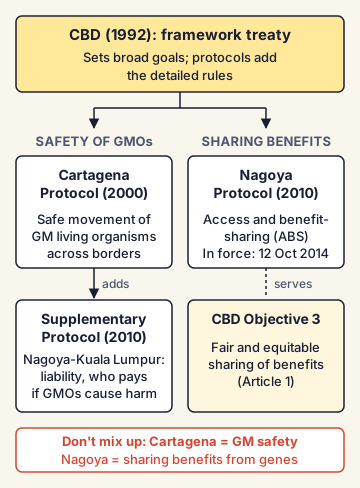
- Cartagena Protocol on Biosafety (2000): safe movement of genetically modified living organisms across borders.
- Nagoya-Kuala Lumpur Supplementary Protocol (2010): liability and redress (who pays) if such organisms cause damage.
- Nagoya Protocol on Access and Benefit-Sharing (2010): detailed rules on how genetic resources are accessed and benefits shared. In force since 12 October 2014.
The global targets, decade by decade
The CBD sets global targets through its COPs:
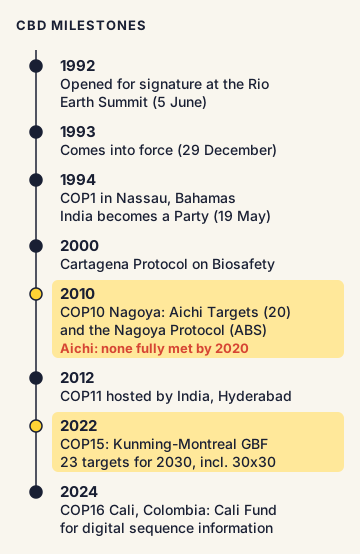
- 2002: the "2010 Biodiversity Target" to significantly reduce the rate of loss. It was not met.
- 2010 (COP10, Nagoya, Japan): the Aichi Biodiversity Targets, 20 targets for 2011–2020. None was fully met by 2020, as the fifth Global Biodiversity Outlook report found.
- 2022 (COP15, Kunming–Montreal): the Kunming-Montreal Global Biodiversity Framework, with 4 goals for 2050 and 23 targets for 2030, including "30x30" (protecting 30% of land and sea by 2030).
- 2024 (COP16, Cali, Colombia; resumed in Rome in 2025): created the Cali Fund, where companies that use digital sequence information (genetic data stored on computers) should pay a share of profits. Half of it is meant for indigenous peoples and local communities.
- 2026 (COP17, Yerevan, Armenia): the first global review of the 2022 framework.
Who is in, and who is not?
The CBD has 196 Parties (195 countries plus the European Union). The United States signed it in 1993 but has never ratified it. So it is the most notable country that is not a Party.
India's position and Indian examples
India is one of the world's 17 "megadiverse" countries, with about 7–8% of the world's recorded species on just 2.4% of the world's land. India ratified the CBD on 18 February 1994 and became a Party on 19 May 1994. To carry out its promises, India passed the Biological Diversity Act, 2002. This law set up a three-tier system: the National Biodiversity Authority (NBA) in Chennai, State Biodiversity Boards and local Biodiversity Management Committees with People's Biodiversity Registers.
The Act was amended in 2023. India hosted COP11 in Hyderabad in 2012. India is a Party to all three protocols. It submitted an updated NBSAP with 23 national targets in line with the 2022 framework at COP16 in 2024. India often fights "biopiracy", for example the successful challenges to foreign patents on turmeric and neem, which used India's traditional knowledge.
Commonly confused concepts
- CBD vs CITES: CBD covers all biodiversity and benefit-sharing. CITES (1973) only controls international trade in endangered wild animals and plants.
- CBD vs UNFCCC: both were born at the 1992 Rio Earth Summit, but the UNFCCC is about climate change. Its COPs are separate and held every year. The CBD's secretariat is in Montreal; the UNFCCC's is in Bonn.
- CBD vs IUCN: the CBD is a treaty between governments. IUCN is an international organisation (with governments and NGOs as members) that publishes the Red List of threatened species. It is not a treaty.
- Cartagena vs Nagoya Protocol: Cartagena is about the safety of genetically modified organisms. Nagoya is about sharing benefits from genetic resources.
- Aichi Targets vs KMGBF: Aichi had 20 targets for 2011–2020; KMGBF has 23 targets for 2030.
- In-situ vs ex-situ: in-situ means protection in the natural home (a tiger reserve); ex-situ means outside it (a zoo or a seed bank).
Issues, criticism and the way forward
- Weak enforcement: the CBD has no penalty for countries that miss targets. All Aichi targets were missed, and the 2022 targets are also off track.
- Money gap: developing countries say rich countries have not given enough money. The world spends far less on protecting nature than on subsidies that harm it.
- Absence of the United States: a major economy and biotech power stays outside the treaty.
- Benefit-sharing is slow: genetic data now moves as digital code over the internet, which makes tracking difficult. The Cali Fund is an attempt to solve this, but company payments are voluntary in practice.
- Rights of local people: critics say conservation has sometimes pushed out tribal and forest communities. The new body on Article 8(j) aims to address this.
- Way forward: experts suggest regular national reporting and review (like the climate system's stocktake), more finance from both public and private sources, removing harmful subsidies and putting biodiversity into all sectors like farming, mining and infrastructure ("mainstreaming").
Concepts to Know
- Ratify: when a country formally agrees to be legally bound by a treaty it has signed. Signing shows intent; ratifying makes it binding.
- Party: a country (or a group like the EU) that has ratified or joined a treaty.
- Genetic resources: plants, animals or microbes that carry useful genes, for example a wild rice plant with a gene for drought tolerance.
- Biopiracy: taking a country's biological resources or traditional knowledge and making profit from them (for example by getting a patent) without permission or sharing benefits.
- Framework convention: a treaty that sets broad goals and structures, with detailed rules added later through protocols.
- Megadiverse country: one of 17 countries that together hold most of the world's species. India is one of them.
- Global Environment Facility (GEF): a fund set up in 1991 that gives money to developing countries for environmental projects under several treaties.
- Opened for signature: 5 June 1992, Rio Earth Summit; in force: 29 December 1993
- 3 objectives: conservation, sustainable use, fair and equitable benefit-sharing (Article 1)
- Secretariat: Montreal, Canada; financial mechanism: GEF
- 196 Parties; the USA has signed but not ratified
- India: ratified 18 February 1994, Party since 19 May 1994; Biological Diversity Act, 2002 (NBA, Chennai); hosted COP11, Hyderabad, 2012
- Protocols: Cartagena (2000), Nagoya–Kuala Lumpur Supplementary (2010), Nagoya ABS (2010, in force 2014)
- International Day for Biological Diversity: 22 May
- Targets: Aichi (2010, 20 targets) → KMGBF (2022, 23 targets)
● Tracked since August 13, 2026 · last seen October 19, 2026 · updates as the daily brief publishes