Vienna Convention on the Law of Treaties (VCLT), 1969
The Vienna Convention on the Law of Treaties (VCLT) is the "rulebook for treaties". It is an international agreement that sets out how countries make treaties, how treaties are read and understood, when they become invalid, and when a country may end or pause one. It was adopted in Vienna in 1969 and came into force in 1980.
It contains the famous rule that promises must be kept (pacta sunt servanda) and its narrow exception for big, unforeseen changes (rebus sic stantibus). Even countries that have not joined it, like India, generally follow its main rules, because most of them are accepted as customary international law.
Why does it exist?
Countries sign thousands of treaties on trade, borders, water, tax and defence. Without common rules, every disagreement about what a treaty means, or whether a country can walk away from it, would turn into a fight. The VCLT gives every country the same basic answers. Think of it like the Indian Contract Act, 1872 for ordinary agreements: it does not tell you what to agree, but it tells you how agreements work.
Where did it come from?
Rules about treaties grew over centuries as unwritten custom. The International Law Commission (ILC), a body of legal experts set up by the UN General Assembly, spent years writing these customs down as draft articles. A UN conference held in Vienna in 1968 and 1969 finalised the text.
- Adopted on 22 May 1969; opened for signature on 23 May 1969.
- Entered into force on 27 January 1980, thirty days after the 35th country ratified or joined it (Article 84).
- As of May 2026, about 119 states are parties.
- India is not a party, but in practice it follows the Convention's main rules, and they are widely treated as customary law binding on all states.
- A separate 1986 Vienna Convention covers treaties involving international organisations.
What does it say? The key rules
- What is a treaty (Article 2): an international agreement between states, in writing, and governed by international law. The name does not matter: "convention", "agreement" or "protocol" can all be treaties.
- Pacta sunt servanda (Article 26): "agreements must be kept". Every treaty in force binds its parties and must be carried out in good faith.
- Internal law is no excuse (Article 27): a country cannot use its own domestic law as a reason for not following a treaty.
- No looking backwards (Article 4): the Convention itself applies only to treaties made after it came into force for the states concerned. But its customary rules still apply to older treaties.
- How to interpret a treaty (Articles 31 to 33): read the words in good faith, in their ordinary meaning, in context, and in light of the treaty's object and purpose.
- Jus cogens (Article 53): a treaty is void if it conflicts with a peremptory norm, a basic rule that no country may set aside, such as the ban on genocide or slavery.
- Leaving a treaty with no exit clause (Article 56): not allowed unless the parties intended to allow it, or it is implied by the nature of the treaty. Even then, at least 12 months' notice is needed.
When can a treaty be ended or suspended?
The VCLT allows it only on a few narrow grounds:
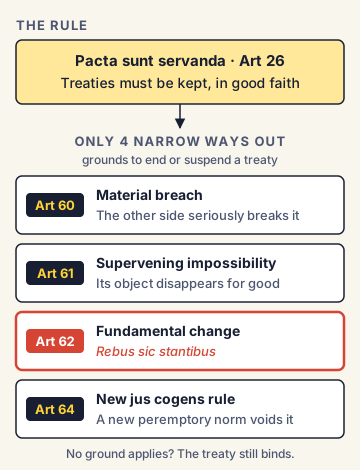
- Material breach (Article 60): if one side seriously breaks a bilateral treaty, the other may end or suspend it.
- Supervening impossibility (Article 61): if something essential for the treaty permanently disappears (for example, an island that sinks or a river that dries up for good). If the impossibility is only temporary, the treaty can only be suspended.
- Fundamental change of circumstances (Article 62): the rebus sic stantibus rule, explained below.
- New jus cogens rule (Article 64): an older treaty that conflicts with a new peremptory norm ends.
Rebus sic stantibus: the doctrine in detail
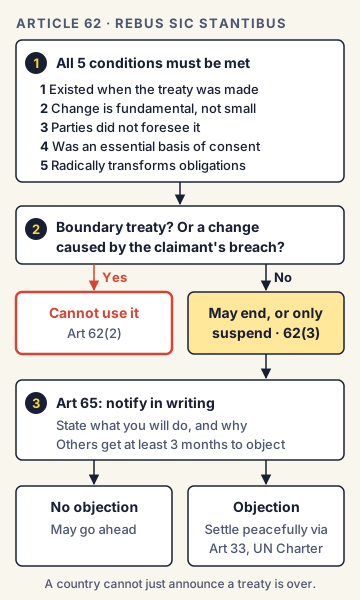
The Latin phrase means "things standing thus". The idea is that every agreement is made assuming certain basic facts. If those facts change completely, the agreement may no longer be fair to keep. But Article 62 is written in a negative way: a change "may not be invoked" unless all its conditions are met. This shows it is meant to be a rare exception. The conditions are:
- The change is in circumstances that existed when the treaty was made.
- The change is fundamental, not small.
- The parties did not foresee it.
- Those circumstances were an essential basis of the parties' consent to the treaty.
- The change radically transforms the obligations still to be carried out.
Article 62(2) adds two exceptions where the doctrine can never be used:
- if the treaty establishes a boundary (so border treaties stay stable); or
- if the change was caused by a breach by the country claiming it. You cannot break something and then say "things have changed".
Under Article 62(3), a country that can use the doctrine to end a treaty may instead choose only to suspend it.
The procedure (Article 65)
A country cannot just announce that a treaty is over. It must notify the other parties in writing, stating what it wants to do and why. If no one objects within a period of at least three months (except in cases of special urgency), it may go ahead. If someone objects, the parties must look for a peaceful solution through the methods in Article 33 of the UN Charter, such as negotiation, mediation, arbitration or a court.
How have courts used it?
International courts have accepted the doctrine in principle but have almost never let a country use it.
- Fisheries Jurisdiction case (UK v. Iceland, 1973): the International Court of Justice (ICJ) accepted that a fundamental change can, under certain conditions, allow a treaty to be ended, but only if it radically changes the obligations.
- Gabčíkovo-Nagymaros case (Hungary/Slovakia, 1997): Hungary argued that political changes, the end of communism, and new environmental knowledge allowed it to quit a dam treaty. The ICJ rejected this. It said the changes did not radically transform the obligations, and that the doctrine applies only in exceptional cases because treaties must be stable. It also said Articles 65 to 67 largely reflect customary law.
India's position and Indian examples
- India follows the VCLT's main rules in its treaty practice even though it is not a party.
- In the Indus Waters Treaty dispute, India has cited fundamental changes in circumstances since 1960 in seeking modification of the treaty. Pakistan disputes this, and a Court of Arbitration rejected those grounds in August 2026; India does not recognise that court.
- Inside India, the same idea of "changed circumstances" is sometimes raised in disputes between states. For example, the Supreme Court has been asked to decide whether the 1886 Mullaperiyar lease is still valid "in the changed circumstances". But disputes between Indian states are governed by the Constitution and Indian laws, not by the VCLT. The doctrine is used there only as a legal idea or argument, not as a binding rule.
Commonly confused concepts
- Pacta sunt servanda vs rebus sic stantibus: The first is the rule (keep your promises). The second is a narrow exception (unless things have changed fundamentally and unforeseeably).
- Fundamental change (Article 62) vs impossibility (Article 61): Under Article 62, the treaty can still be carried out but has become radically different. Under Article 61, it physically cannot be carried out.
- Termination vs suspension: Termination ends the treaty for good. Suspension pauses it, and it can be revived later. "Abeyance" is not a term used in the VCLT; it is closest to suspension.
- Material breach (Article 60) vs fundamental change (Article 62): A breach is about the other side's wrongdoing. A fundamental change is about the world changing, with no one necessarily at fault.
- VCLT 1969 vs Vienna Convention on Diplomatic Relations 1961: The 1961 convention deals with embassies and diplomats' immunity. The 1969 convention deals with treaties.
Issues, criticism and the way forward
- Stability vs fairness. If the doctrine were easy to use, any country could escape a treaty it no longer liked, and no one would trust treaties. If it is too hard to use, countries may stay stuck in deals that have become deeply unfair. Courts have so far chosen stability.
- Unilateral action. Critics argue that countries sometimes invoke "changed circumstances" without following the Article 65 procedure, which weakens the rule of law.
- Climate change. Many water and fishing treaties assumed stable river flows and climate. Experts suggest that new treaties should include review clauses, flexible sharing formulas for dry years, and regular joint reviews, so that countries need not fall back on rebus sic stantibus at all.
- India's non-membership. Some experts suggest India should join the VCLT to strengthen its voice in treaty disputes. Others say India already follows its customary rules and gains little by formally joining.
Concepts to Know
- Treaty: A written agreement between countries that is binding under international law. It can be called a convention, agreement, covenant or protocol.
- Customary international law: Rules that countries follow because they have long accepted them as binding, even if they are not written in a treaty they have signed.
- Ratification: The formal step by which a country confirms that it agrees to be bound by a treaty it has signed.
- Good faith: Acting honestly and fairly, without trying to cheat the other side or defeat the purpose of the agreement.
- Peremptory norm (jus cogens): A basic rule of international law that no treaty can override, such as the ban on genocide, slavery or torture.
- International Court of Justice (ICJ): The main court of the United Nations, at The Hague, which settles legal disputes between countries.
- Adopted 22 May 1969, opened for signature 23 May 1969; in force 27 January 1980 (after 35 ratifications, Article 84)
- About 119 states parties (May 2026); India is not a party but follows its customary rules
- Article 26: pacta sunt servanda; Article 27: internal law no excuse; Article 53: jus cogens
- Article 56: no exit clause means no withdrawal unless intended or implied; 12 months' notice
- Grounds to end/suspend: Article 60 (material breach), 61 (supervening impossibility), 62 (fundamental change), 64 (new jus cogens)
- Article 62(2): cannot be used for boundary treaties, or when the change results from the invoking party's own breach
- Article 65: written notice, at least 3 months for objections; disputes go to Article 33 UN Charter methods
- ICJ cases: Fisheries Jurisdiction (1973), Gabčíkovo-Nagymaros (1997)
● Tracked since August 31, 2026 · last seen October 07, 2026 · updates as the daily brief publishes