UN Secretary-General's Panel on Critical Energy Transition Minerals
The UN Secretary-General's Panel on Critical Energy Transition Minerals is a group set up by UN Secretary-General António Guterres in April 2024 to agree on common rules of good behaviour for the minerals that clean energy needs. Its job was to make sure that mining and trading these minerals is fair, protects people and nature, and benefits the countries where the minerals are found.
In September 2024, it gave the world seven Guiding Principles and five Actionable Recommendations. These are voluntary: they guide countries and companies but do not legally bind anyone.
Why does it exist?
Solar panels, wind turbines, electric vehicle batteries and power lines need large amounts of minerals such as copper, lithium, nickel, cobalt and rare earth elements. According to the International Energy Agency (IEA), mineral demand for clean energy could grow about three and a half times by 2030 on the path to net zero by 2050.
Many of these minerals lie in developing countries in Africa, Latin America and Asia. Africa alone holds over one-fifth of the world's reserves of a dozen metals needed for the energy transition. In the past, many such countries only dug up raw ore and sent it abroad cheaply, while the jobs and profits of processing and manufacturing went elsewhere.
Mining also often brought pollution, forced removal of local and Indigenous communities, child labour and corruption. Guterres summed up the worry in two lines: "A world powered by renewables is a world hungry for critical minerals" and "The race to net zero cannot trample over the poor."
Where did it come from?
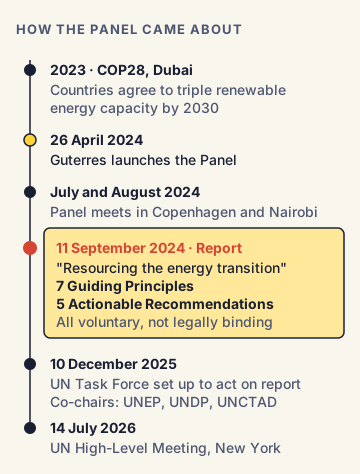
- 2023: At COP28 in Dubai, countries agreed to triple renewable energy capacity by 2030. This made the mineral question urgent, because tripling renewables needs far more minerals.
- 26 April 2024: Guterres launched the Panel. Resource-rich developing countries had asked for urgent action so that they, and their communities, would benefit from the minerals found on their land.
- July and August 2024: The Panel met in person in Copenhagen (8–9 July) and Nairobi (20–21 August).
- 11 September 2024: The Panel released its report, titled "Resourcing the energy transition", ahead of the UN General Assembly's high-level week and COP29.
- 10 December 2025: A UN Task Force on Critical Energy Transition Minerals was launched to turn the report into action.
- 14 July 2026: A UN High-Level Meeting on Critical Energy Transition Minerals was held at UN Headquarters in New York.
Who was on the Panel?
It was co-chaired by Ambassador Nozipho Joyce Mxakato-Diseko of South Africa and Ditte Juul Jørgensen, Director-General for Energy at the European Commission. It brought together governments, international bodies, industry and civil society. Its 22 member countries were Australia, Botswana, Brazil, Canada, Chile, China, Colombia, the Democratic Republic of the Congo, Egypt, India, Indonesia, Japan, Kazakhstan, Namibia, Nigeria, South Africa, the UAE, the UK, the US, Viet Nam, Zambia and Zimbabwe.
The African Union and the European Union were also members. So both mineral-rich countries and big mineral-buying countries sat at the same table.
The seven Guiding Principles
You can think of these as a code of conduct for the whole journey of a mineral, from the mine to the factory to recycling.
- Human rights must be at the centre of every mineral value chain.
- The planet's environment, ecosystems and biodiversity must be protected.
- Justice and fairness must be the foundation.
- Development must be promoted through benefit-sharing, local value addition and economic diversification.
- Investment, finance and trade must be responsible and fair.
- Transparency, accountability and anti-corruption are needed for good governance.
- Multilateral cooperation must drive global action and support peace and security.
The Panel said all seven carry equal weight and must be advanced together.
The five Actionable Recommendations
These turn the principles into concrete steps.
- Set up a High-Level Expert Advisory Group to speed up benefit-sharing, local value addition, economic diversification and fair trade, investment, finance and tax rules.
- Build a global traceability, transparency and accountability framework covering the whole chain from mining to recycling. The Panel said it must not be used as a one-sided trade barrier.
- Create a Global Mining Legacy Fund to clean up abandoned mines and strengthen money guarantees for closing and restoring mines.
- Launch an initiative to help artisanal and small-scale miners become a force for development, environmental care and human rights.
- Set fair targets and timelines for material efficiency and circularity (using less material and recycling more) across the full life of these minerals.
How is it being put into practice?
The UN Task Force launched in December 2025 is chaired jointly by the UN Environment Programme (UNEP), the UN Development Programme (UNDP) and the UN Conference on Trade and Development (UNCTAD). It has five technical work areas that match the recommendations: value addition, traceability, a global mining legacy fund, artisanal and small-scale mining, and circularity and material efficiency.
It also offers help to individual countries that want to apply the principles. Separately, at the UN Environment Assembly (UNEA-7) in Nairobi in December 2025, countries adopted a resolution proposed by Colombia on minerals and metals. It asks UNEP to collect views and hold dialogues, but it does not create binding global rules. Colombia had wanted talks towards a treaty, but some countries opposed this.
India's position and Indian examples
India was a member of the Panel. India sits on both sides of this issue. It is a big buyer of critical minerals for its solar, battery and electric vehicle plans, and it has its own mining areas, many of them in tribal and forest regions of states like Jharkhand, Odisha and Chhattisgarh.
- Benefit-sharing at home: Section 9B, added to the Mines and Minerals (Development and Regulation) Act, 1957 by the 2015 amendment, lets states set up District Mineral Foundations (DMFs). These are non-profit trusts funded by mining companies, which spend money on people and areas hurt by mining. The Pradhan Mantri Khanij Kshetra Kalyan Yojana (PMKKKY), framed in September 2015 and revised in January 2024, guides how DMF money is spent.
- Value addition: India wants to process minerals at home, not just import finished products. The National Critical Mineral Mission (2025) and a scheme supporting critical mineral processing plants (approved November 2026) aim at this.
- Recycling: The Battery Waste Management Rules, 2022 and the Critical Mineral Recycling Incentive Scheme (2025) push recovery of minerals from old batteries and electronics, which fits the Panel's circularity recommendation.
- Partnerships: India works with mineral-rich countries through KABIL (Khanij Bidesh India Ltd), and joined the US-led Minerals Security Partnership in June 2023.
Commonly confused concepts
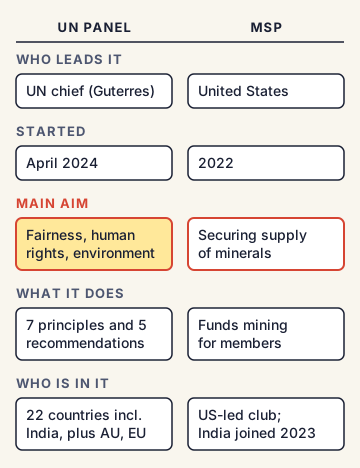
- UN Panel vs Minerals Security Partnership (MSP): The UN Panel is a UN-wide effort about fairness, rights and environment in mineral supply chains, with voluntary principles. The MSP is a US-led club of countries, launched in 2022, focused on securing supplies and funding mining projects for its members.
- UN Panel principles vs OECD Due Diligence Guidance: The OECD Due Diligence Guidance (adopted in 2011) is an older, voluntary five-step method for companies to check that minerals from conflict-affected and high-risk areas do not fund violence or abuse. It began with tin, tantalum, tungsten and gold. The UN Panel's principles are broader, covering all energy transition minerals and adding goals like local value addition and benefit-sharing.
- Voluntary principles vs binding due diligence: The Panel's principles are guidance. "Binding due diligence", which civil society asked for at COP31, would be a legal duty on companies, with penalties if they fail to find and fix harm in their supply chains.
- Critical minerals vs critical energy transition minerals: "Critical minerals" is a country-specific list based on economic need and supply risk (for example, India's list of 30). "Critical energy transition minerals" is the UN's term for the minerals needed specifically for clean energy technology.
Issues, criticism and the way forward
- No legal force: The principles are voluntary. Rights groups argue that without binding rules, abuses will keep rising as mining expands.
- Missing from climate talks: Mining and minerals are not directly part of the UNFCCC negotiating texts, so COP decisions on renewables and electrification say little about where the minerals will come from.
- Divided countries: Some mineral-rich countries want binding global rules and more local processing. Some big producers and buyers prefer to keep control at the national level, as seen when UNEA-7 stopped short of a treaty.
- Trade fears: Developing countries worry that traceability systems run by rich countries could become hidden trade barriers. This is why the Panel said its framework must not be a one-sided trade tool.
- Old mines, new damage: Thousands of abandoned mines still pollute land and water. The proposed Global Mining Legacy Fund aims to fix this, but it still needs money.
- Way forward: Experts suggest making due diligence mandatory, sharing more of the value with producer communities, giving local and Indigenous people a real say (free, prior and informed consent), and cutting the need for new mining through recycling and better design.
Concepts to Know
- Value chain: All the steps a product goes through, from digging the raw mineral, to refining it, to making parts, to the final product, and finally to recycling.
- Value addition: Doing more processing inside the country (for example, refining ore into battery-grade lithium) so that more jobs and money stay there.
- Benefit-sharing: Making sure local communities and the producing country get a fair share of the money earned from minerals taken from their land.
- Traceability: Being able to track where a mineral came from at every step, like a parcel tracking number, so buyers know it was mined fairly.
- Due diligence: Careful checking by a company to find, prevent and fix harm to people or nature in its operations and supply chain.
- Artisanal and small-scale mining: Mining done by individuals or small groups with simple tools, often informal and poorly regulated. Millions of people depend on it, especially for cobalt and gold.
- Circularity: Using materials again and again through reuse and recycling, instead of the "dig, use, throw" model.
- Free, prior and informed consent: The right of Indigenous peoples to say yes or no to a project on their land, before it starts, with full information.
- Launched by UN Secretary-General António Guterres on 26 April 2024
- Co-chairs: Nozipho Joyce Mxakato-Diseko (South Africa) and Ditte Juul Jørgensen (European Commission)
- 22 member countries, including India, plus the African Union, the European Union and non-state members
- Report "Resourcing the energy transition": released 11 September 2024
- Outputs: 7 Guiding Principles and 5 Actionable Recommendations (voluntary)
- Recommendations: High-Level Expert Advisory Group; global traceability framework; Global Mining Legacy Fund; artisanal and small-scale mining initiative; material efficiency and circularity targets
- UN Task Force on Critical Energy Transition Minerals: launched 10 December 2025; co-chaired by UNEP, UNDP and UNCTAD
- UNEA-7 (December 2025): Colombia's minerals and metals resolution adopted; calls for dialogues, not binding rules
- UN High-Level Meeting on Critical Energy Transition Minerals: 14 July 2026, New York
- IEA: clean energy mineral demand could grow about 3.5 times by 2030 on a net zero path
● Tracked since November 13, 2026 · last seen November 13, 2026 · updates as the daily brief publishes