Electrification of Final Energy Demand
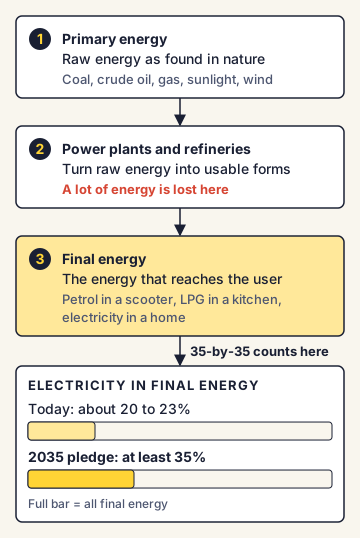
Electrification means using electricity, instead of burning coal, oil, gas or wood, to do everyday work like moving vehicles, cooking food, heating water and running factories. When a city replaces diesel buses with electric buses, or a farmer swaps a diesel pump for a solar-powered electric pump, that is electrification. The share of electricity in the total energy that people and businesses finally use is a key measure of how far a country has moved towards clean energy. Today, electricity meets only about one-fifth of the world's final energy needs.
First, what is "final energy"?
Energy is counted at two stages. Primary energy is energy in its raw form as found in nature: coal in the mine, crude oil, natural gas, sunlight, wind. Final energy is the energy that actually reaches the user: petrol in your scooter, LPG in your kitchen, electricity in your home. Between the two, a lot is lost in power plants and refineries. The 35-by-35 target is about final energy: out of all the energy finally used, 35% should be electricity.
Why does electrification matter?
There are three big reasons.
- Efficiency: An electric motor turns roughly 80 to 90% of its energy into motion. A petrol or diesel engine wastes most of its fuel as heat. A heat pump (a machine like a reverse air-conditioner that moves heat) can deliver several units of heat for every unit of electricity it uses. So electrification can do the same work with much less total energy.
- Clean power potential: Coal, oil and gas can only be burned. Electricity can be made from the sun, wind, water and nuclear power. Once a bus or a factory runs on electricity, it automatically gets cleaner as the grid gets cleaner.
- Health and security: Electric vehicles have no tailpipe smoke, and electric cooking ends indoor smoke from wood and dung. Countries that import oil and gas, like India, also become less exposed to sudden price jumps and supply shocks.
Where did the idea come from?
Electrification is old: railways and homes were electrified through the 20th century. Its role as a climate tool grew after the Paris Agreement (2015). The International Energy Agency (IEA), an energy policy body of mainly developed countries, made it a central pillar in its "Net Zero by 2050" roadmap (2021). There, electricity's share of final energy rises from about 20% in 2020 to around half by 2050.
Its later outlooks show a path where electricity reaches about one-third by 2035. The COP31 hosts adopted this idea as their headline voluntary target, the 35-by-35 pledge.
How does electrification work, sector by sector?
- Transport: Electric two-wheelers, three-wheelers, cars, buses and trucks, plus electric railways and metros.
- Buildings: Electric or induction cooking, heat pumps, efficient fans and air-conditioners.
- Agriculture: Electric and solar pumps replacing diesel pumps.
- Industry: Electric furnaces, electric boilers and heat pumps for low-temperature heat. Some heavy industries, like steel, may use green hydrogen made with electricity instead.
Some uses are hard to electrify, such as long-distance flights, shipping and very high-temperature industrial heat. These may need other clean fuels.
Electrification is not the same as clean power
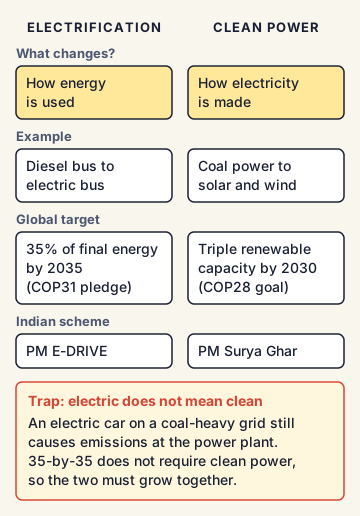
This is the most important point to understand. Electrification only cuts emissions if the electricity itself is clean. An electric car charged from a coal-heavy grid still causes emissions at the power plant, though usually less overall because of higher efficiency. So electrification and clean power must grow together. This is exactly why critics say the 35-by-35 pledge is weak: it does not require the new electricity to be renewable, so countries could meet it by burning more gas or coal.
India's position and Indian examples
- Access first: India completed village electrification in April 2018 under the Deen Dayal Upadhyaya Gram Jyoti Yojana (2014), and pushed household connections under the Saubhagya scheme (2017).
- Clean capacity: India reached 50% of its installed power capacity from non-fossil sources (solar, wind, hydro, nuclear) in June 2025, five years ahead of its 2030 target under its Nationally Determined Contribution (NDC). It aims for 500 GW of non-fossil capacity by 2030 and net zero emissions by 2070.
- Transport: The PM E-DRIVE scheme (2024) supports electric two-wheelers, three-wheelers, buses and charging stations. Indian Railways has electrified almost its entire broad-gauge network.
- Agriculture: PM-KUSUM (2019) helps farmers install solar pumps and solarise existing grid-connected pumps.
- Homes: PM Surya Ghar: Muft Bijli Yojana (2024) supports rooftop solar for one crore households, with up to 300 units of free electricity a month.
- The catch: Coal still produces most of India's electricity, so electrification and grid cleaning must go hand in hand.
Commonly confused concepts
- Electrification vs electricity access: Access means every home has a power connection. Electrification of end-use means replacing fuels with electricity for tasks like transport and cooking. A country can have 100% access but still low electrification.
- Primary energy vs final energy: Primary energy is raw energy in nature. Final energy is what reaches the consumer. Electricity's share looks smaller in primary energy accounting and larger in final energy.
- Installed capacity vs generation: Installed capacity (in GW) is how much power plants can produce at full output. Generation (in units) is what they actually produce. Solar plants have high capacity but lower generation because the sun does not shine all day.
- Electrification target vs renewable target: 35-by-35 is about using electricity. The COP28 goal of tripling renewable capacity by 2030 is about producing electricity cleanly. Both are needed.
Issues, criticism and the way forward
- No clean-power condition: Without a renewable requirement, electrification could lock in more coal and gas power.
- Finance gap: Developing countries pay much higher interest rates on loans than rich countries, so the same solar farm or electric bus costs them more. Analysts call for concessional finance (loans cheaper than market rates) and first-loss guarantees (a lender agrees to absorb the first losses, which makes private investors feel safe).
- Weak grids and utilities: Many developing countries have unreliable supply and loss-making distribution companies (discoms), which cannot handle a big rise in demand without reform.
- Import dependence: Batteries, solar panels and their minerals are concentrated in a few countries, mainly China. Countries need domestic manufacturing and technology transfer.
- Fairness (equity): Developing countries argue that one global target must allow different timelines, in line with the principle of Common but Differentiated Responsibilities.
- Way forward: Pair electrification with clean power and storage, invest in grids, support domestic manufacturing, and redirect public spending to public transport and clean end-use technology.
Concepts to Know
- Final energy demand: The total energy used by consumers (homes, vehicles, farms, factories) after all conversion and transport losses.
- Heat pump: A machine that moves heat from one place to another using electricity, like an air-conditioner running in reverse. It can give out more heat energy than the electricity it uses.
- Leapfrogging: Skipping an older stage of technology and jumping straight to a newer one, like many Indians going straight to mobile phones without ever owning a landline.
- Discom: A distribution company, the body that buys electricity and supplies it to homes and businesses in an area.
- Net zero: A state where a country removes as much greenhouse gas from the air as it releases, so its net addition is zero.
- 35-by-35 pledge: electricity to supply at least 35% of global final energy demand by 2035 (voluntary), proposed by the COP31 Presidency
- Current global share: roughly 20 to 23% of final energy
- IEA Net Zero by 2050 (2021): electricity about half of final energy by 2050, up from about 20% in 2020
- Electric motors: about 80 to 90% efficient; combustion engines lose most energy as heat
- India: 50% non-fossil installed capacity reached June 2025; targets 500 GW non-fossil by 2030 and net zero by 2070
- Indian schemes: DDUGJY (2014), Saubhagya (2017), PM-KUSUM (2019), PM Surya Ghar (2024), PM E-DRIVE (2024)
● Tracked since November 06, 2026 · last seen November 06, 2026 · updates as the daily brief publishes