Just Transition
A Fair Shift to Clean Energy
A just transition means moving from a polluting, fossil fuel based economy to a clean, low-carbon economy in a way that is fair to everyone. "Just" here means fair, not "only". The idea is that workers, families and regions that depend on coal, oil and gas should not be left jobless and poor when the world moves to clean energy. In short, the climate must be protected without leaving anyone behind.
Why does it exist?
Shutting down a coal mine or a coal power plant cuts pollution. But it can also end thousands of jobs in one place. Shopkeepers, transporters and local governments that depend on that mine also suffer. Think of a town built around one big factory: if the factory closes overnight, the whole town collapses. Without planning, the shift to clean energy can create anger and resistance, and governments may then slow down climate action. A just transition plan tries to prevent this by preparing workers and regions in advance.
Where did it come from?
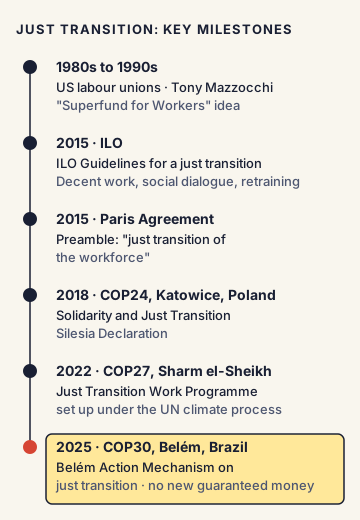
- 1980s to 1990s, US labour unions: The idea began with American trade unions. Tony Mazzocchi, a leader of the Oil, Chemical and Atomic Workers Union, argued that workers who lose jobs because of environmental rules should be supported, retrained and paid, much like soldiers returning from war were helped by the government. He first called it a "Superfund for Workers"; the name later became "just transition".
- 2015, ILO Guidelines: The International Labour Organization (ILO), the UN agency for work and workers, adopted Guidelines for a just transition towards environmentally sustainable economies and societies for all. They call for decent work, social dialogue (talks between government, employers and workers), retraining, social protection and local economic diversification.
- 2015, Paris Agreement: The preamble (the opening part) of the Paris Agreement mentions "a just transition of the workforce and the creation of decent work and quality jobs".
- 2018, Silesia Declaration: At COP24 in Katowice, Poland (a coal region), countries adopted the Solidarity and Just Transition Silesia Declaration.
- 2022, Just Transition Work Programme: At COP27 in Sharm el-Sheikh, Egypt, countries set up a work programme on just transition pathways under the UN climate process.
- 2025, Belém Action Mechanism: At COP30 in Belém, Brazil, countries agreed to set up a mechanism on just transition. It is meant to coordinate help, share good practices and track progress. Critics note that it did not come with new, guaranteed money.
How does it work in practice?
A just transition plan usually has these parts:
- Planning early: Mapping which regions, workers and industries will be hit, and setting dates for closing old plants.
- Skills and jobs: Retraining workers for new jobs, for example in solar installation, battery making or grid maintenance.
- Social protection: Pensions, income support and health cover for workers who cannot easily switch.
- New local economy: Bringing new industries to the affected region so it does not become a ghost town. Old mine land can be reused for solar parks, forests or tourism.
- Fair energy access: Making sure clean energy is affordable for poor households, so they do not pay more for electricity.
- Consultation: Workers, unions, local communities and indigenous people take part in decisions.
Just Energy Transition Partnerships (JETPs)
A JETP is a funding deal between a developing country that depends on coal and a group of rich countries (the "International Partners Group", which has included the G7 countries and the EU). The rich countries promise loans, grants and investment. In return, the developing country commits to faster coal phase-down.
- South Africa was the first, announced at COP26 (Glasgow, 2021), with about US$8.5 billion.
- Indonesia (2022) got a pledge of about US$20 billion, and Vietnam (2022) about US$15.5 billion.
- Senegal (2023) signed a deal of about 2.5 billion euros focused on renewables.
- In early 2025, the United States withdrew from these partnerships. Other partners continued.
Critics point out that most JETP money comes as loans, not grants, which adds to the debt of poor countries.
India's position and Indian examples
India's situation makes a just transition especially hard:
- Coal still generates the majority of India's electricity. Coal mining is concentrated in states such as Jharkhand, Chhattisgarh and Odisha, which also have many poor and tribal communities.
- Millions of people depend on coal directly or indirectly: miners, transporters, informal workers and local governments that earn from mining royalties. Indian Railways also earns a large part of its freight income from carrying coal.
- The District Mineral Foundation (DMF), created under the Mines and Minerals (Development and Regulation) Act in 2015, collects money from mining companies for the welfare of mining-affected areas. Experts suggest it could fund just transition work.
- India's climate goals: 500 GW of non-fossil power capacity by 2030 and net zero emissions by 2070. India reached 50% non-fossil installed capacity in June 2025, five years ahead of its 2030 goal. Its updated climate target for 2035 aims for 60% non-fossil capacity.
- India has not signed a JETP. Its official position is that the transition must follow national circumstances, and that rich countries must provide finance and technology. India speaks of "phase-down" rather than "phase-out" of coal; at COP26 in 2021, India pushed for the wording "phase down" of unabated coal power.
Commonly confused concepts
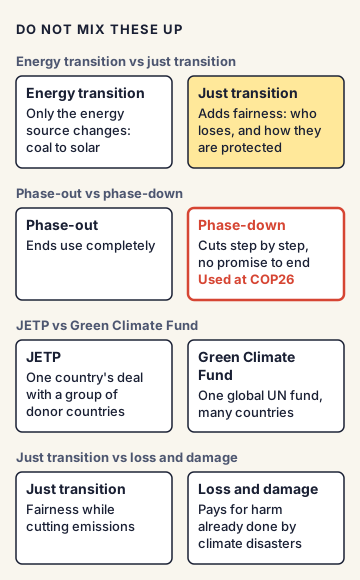
- Just transition vs energy transition: Energy transition is only the change in energy sources (coal to solar). Just transition adds the question of fairness: who wins, who loses, and how losers are protected.
- Phase-out vs phase-down: Phase-out means ending use completely. Phase-down means reducing step by step, without a promise to end fully. The Glasgow Climate Pact (COP26) used "phase-down" for coal.
- JETP vs Green Climate Fund: A JETP is a country-specific deal with a group of donor countries. The Green Climate Fund is a single global fund under the UN climate system that finances projects in many countries.
- Just transition vs Loss and Damage: Just transition is about fairness while cutting emissions. Loss and damage is about paying for harm already caused by climate disasters.
- Mitigation vs adaptation: Mitigation means cutting emissions. Adaptation means adjusting to climate change, such as building flood walls. Just transition is mainly linked to mitigation.
Issues, criticism and the way forward
- Money gap: Developing countries say the finance offered is too small and mostly in the form of loans. Rich countries say private investment must play a larger role.
- Energy security vs climate: Countries such as India say they must meet rising power demand and lift people out of poverty, so they cannot abandon coal quickly. Activists say renewables are now cheap enough to grow much faster.
- Informal workers: Many coal-linked workers in India are informal, with no records. They are hard to reach with pensions or retraining.
- State finances: Coal-rich states depend on mining income. They need new sources of revenue before mines close.
- Fairness between countries: Developing countries argue that rich countries, which polluted the most in the past, must move first and pay more. This links to the principle of Common but Differentiated Responsibilities.
- Way forward: Experts suggest district-level transition plans in coal areas, using DMF funds for new livelihoods, skilling for clean-energy jobs, reusing old mine land for solar parks, and getting grant-based international finance.
Concepts to Know
- Fossil fuels: Coal, oil and natural gas, formed from ancient plants and animals. Burning them releases carbon dioxide, the main gas that warms the planet.
- Renewable energy: Energy from sources that do not run out, such as sunlight, wind and flowing water.
- Net zero: A state where a country removes as much greenhouse gas from the air (through forests or technology) as it releases, so the total added is zero.
- Installed capacity: The maximum electricity all power plants could produce together, measured in gigawatts (GW). It is different from the electricity actually produced.
- Climate finance: Money given or lent to help countries cut emissions or adapt to climate change.
- Social dialogue: Formal talks between government, employers and workers' unions to agree on policies.
- Origin: US labour unions in the 1980s to 1990s (Tony Mazzocchi)
- ILO Guidelines for a just transition: 2015
- Paris Agreement (2015) preamble mentions "just transition of the workforce"
- Solidarity and Just Transition Silesia Declaration: COP24, Katowice, 2018
- Just Transition Work Programme: COP27, Sharm el-Sheikh, 2022
- Belém Action Mechanism on just transition: COP30, Belém, 2025
- JETPs: South Africa (2021, about US$8.5 billion), Indonesia (2022, about US$20 billion), Vietnam (2022, about US$15.5 billion), Senegal (2023, about 2.5 billion euros); US withdrew in 2025
- India: 500 GW non-fossil by 2030; 50% non-fossil installed capacity reached June 2025; net zero by 2070; no JETP signed
● Tracked since April 21, 2026 · last seen October 10, 2026 · updates as the daily brief publishes