Strait of Hormuz
Geography and Strategic Significance
Updated 7 Oct 2026: Added that Dubai's Jebel Ali port lies inside the Persian Gulf, unlike Fujairah and Chabahar outside the strait.
The Strait of Hormuz is a narrow sea passage between Iran in the north and Oman in the south. It connects the Persian Gulf to the Gulf of Oman, which then opens into the Arabian Sea and the Indian Ocean. It is the only sea exit for the oil and gas of most Gulf countries. That is why it is called the world's most important oil "chokepoint": a narrow point where, if traffic is blocked, the whole world feels it.
Where exactly is it?
Picture the Persian Gulf as a long bottle, with the Strait of Hormuz as its narrow neck. On the north side of the neck is Iran, with its port of Bandar Abbas and islands like Qeshm, Hormuz and Larak. On the south side is the Musandam Peninsula. Musandam belongs to Oman, but it is an exclave: it is cut off from the rest of Oman by UAE territory.
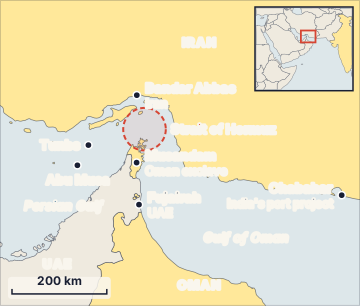
Once a ship passes through the neck, it enters the Gulf of Oman. Ports like Fujairah (UAE) and Chabahar (Iran) lie outside the neck, on the Gulf of Oman side. Big ports like Jebel Ali (Dubai, UAE) lie inside the bottle, on the Persian Gulf, so every ship going to them must pass through Hormuz.
How narrow is it?
- At its narrowest, the strait is about 21 nautical miles wide, that is roughly 39 km.
- Big ships cannot use the whole width, because much of the water is shallow or close to islands.
- Ships use a Traffic Separation Scheme. There is one lane of about 2 miles for ships going in, one lane of about 2 miles for ships coming out, and a buffer zone of about 2 miles between them. Think of it like a divided highway with a median.
- Because the lanes are so narrow and pass close to Iran's coast and islands, a country with missiles, mines and fast boats nearby can threaten every passing ship.
Why does it matter so much?
The countries around the Persian Gulf are among the world's biggest oil and gas producers: Saudi Arabia, Iraq, the UAE, Kuwait, Qatar, Bahrain and Iran. For most of them, the sea route through Hormuz is the main or only way to send oil out.
- In 2025, about 20 million barrels per day of crude oil and oil products passed through the strait. This is roughly one-fifth of the oil the whole world uses in a day.
- Nearly 15 million barrels per day of this was crude oil, about 34% of all crude oil traded across the world by sea and land.
- About 19% of the world's LNG (liquefied natural gas) trade passes through it, mostly from Qatar and the UAE.
- Most of these shipments go to Asia. China, India, Japan and South Korea are the main buyers.
So when the strait is closed, oil prices jump everywhere. Petrol, diesel, cooking gas, fertiliser and transport all become costlier, even in countries far away.
A history of trouble
The strait has been a flashpoint (a place where conflict easily breaks out) for decades.
- 1971: When Britain withdrew from the Gulf, Iran took control of three small islands near the strait: Abu Musa and the Greater and Lesser Tunb. The UAE still claims these islands. The dispute continues today.
- 1984 to 1988, the "Tanker War": During the Iran-Iraq War (1980 to 1988), both countries attacked oil tankers in the Gulf.
- 1987 to 1988: The US Navy ran Operation Earnest Will to escort Kuwaiti tankers. After a US warship hit an Iranian mine, the US launched Operation Praying Mantis on 18 April 1988 against Iranian ships and oil platforms.
- 2019: Several tankers were attacked near the strait. India's Navy started Operation Sankalp in June 2019 to escort Indian-flagged ships in the region.
- 2026: After US and Israeli strikes on Iran began on 28 February 2026, Iran declared the strait closed and cross-strait traffic largely stopped. The United States then imposed a naval blockade on Iranian ports from 13 April 2026. The blockade was lifted under a 17 June 2026 MoU and reimposed on 14 July 2026. As of October 2026, the strait was still largely closed. Iran said it would reopen it only after its conditions under the Islamabad memorandum (MoU, a written agreement) with the US were met.
What does international law say?
The main law of the sea is UNCLOS, the United Nations Convention on the Law of the Sea, 1982.
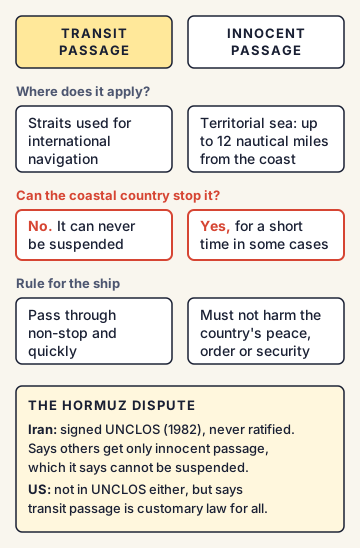
- Part III of UNCLOS gives ships and aircraft the right of transit passage through straits used for international navigation. Transit passage means ships can pass through continuously and quickly, and the coastal country cannot suspend (stop) this right.
- Innocent passage is a weaker right that applies in a country's territorial sea (up to 12 nautical miles from its coast). A ship may pass only if it is not harming the coastal country's peace, good order or security. In some cases the coastal country can temporarily suspend it.
- Iran signed UNCLOS in 1982 but has never ratified it (never made it binding on itself). Iran says transit passage applies only between countries that have joined UNCLOS. It says Hormuz falls under non-suspendable innocent passage for others.
- The United States has also not joined UNCLOS, but it says transit passage is customary international law, meaning a rule all countries must follow because they have followed it for a long time.
Are there ways around it?
Only partly. A few pipelines can carry oil to ports outside the strait:
- East-West Pipeline (Petroline), Saudi Arabia: runs about 1,200 km from Abqaiq near the Gulf coast to Yanbu on the Red Sea. Its capacity is about 7 million barrels per day after expansion.
- Habshan-Fujairah Pipeline, UAE: runs about 400 km to Fujairah on the Gulf of Oman. It carries about 1.5 million barrels per day, with a reported capacity of up to about 1.8 million barrels per day.
- These routes together cannot replace the full 20 million barrels per day. Qatar's LNG has no pipeline bypass at all. Also, oil sent to Yanbu must then pass the Bab-el-Mandeb strait near Yemen, which has its own security risks.
India's position and stakes
- About 50% of India's crude oil imports and about 54% of its LNG imports passed through Hormuz in 2024-25.
- India also gets much of its LPG (cooking gas) from Gulf countries, so a closure hits households directly.
- Millions of Indians live and work in the Gulf countries. Their safety, and the money they send home, depend on peace in the region.
- India's Chabahar port project in Iran lies just outside the strait, on the Gulf of Oman. It is meant to connect India to Afghanistan and Central Asia without passing through Pakistan.
- After the 2026 closure, India quickly shifted to other suppliers. On 11 March 2026, the Petroleum Ministry said about 70% of India's crude imports were coming from routes outside Hormuz, up from about 55% before the crisis. India was then buying crude from about 40 countries.
- To reduce risk, India has been buying more oil from other regions (Russia, the Americas, Africa) and building Strategic Petroleum Reserves: underground oil stores at Visakhapatnam, Mangaluru and Padur that can be used in an emergency.
Commonly confused concepts
- Strait of Hormuz vs Bab-el-Mandeb: Hormuz links the Persian Gulf to the Gulf of Oman (between Iran and Oman). Bab-el-Mandeb links the Red Sea to the Gulf of Aden (between Yemen on one side and Djibouti and Eritrea on the other).
- Strait of Hormuz vs Strait of Malacca: Malacca lies between Malaysia and Indonesia's Sumatra island and links the Indian Ocean to the South China Sea. It is the busiest chokepoint for all kinds of cargo; Hormuz is the most important one for oil.
- Persian Gulf vs Gulf of Oman: The Persian Gulf is inside the strait. The Gulf of Oman is outside it. Fujairah and Chabahar are on the Gulf of Oman, so they can still be used even when Hormuz is shut. Jebel Ali (Dubai) is inside the Persian Gulf, so it is cut off when Hormuz is shut.
- Transit passage vs innocent passage: Transit passage (in straits) cannot be suspended. Innocent passage (in the territorial sea) can be suspended temporarily in some cases.
Issues, criticism and the way forward
- Too much dependence on one route: One narrow strait carries a huge share of world energy. Any conflict there becomes a global price shock.
- Legal grey zone: Because Iran and the US read the law of the sea differently, each side claims the other is acting illegally. This makes a clean legal solution hard.
- Limited bypass capacity: Pipelines help, but they cannot carry everything, and LNG has no alternative route.
- Way forward for India: Experts suggest wider diversification of oil and gas suppliers, larger strategic reserves, faster growth of renewable energy to cut import needs, naval escort missions for Indian ships, and active diplomacy with all sides for freedom of navigation.
Concepts to Know
- Chokepoint: A narrow sea passage that a large amount of shipping must pass through. If it is blocked, trade across the world is disrupted.
- Nautical mile: A unit used at sea. One nautical mile is 1.852 km.
- Exclave: A part of a country that is cut off from the main country by another country's land. Musandam is Oman's exclave.
- LNG (Liquefied Natural Gas): Natural gas cooled to about minus 162°C so that it becomes a liquid. This shrinks it a lot, so it can be carried in special ships.
- Ratify: When a country formally approves a treaty it has signed, so that the treaty becomes legally binding on it. Signing alone is not enough.
- Customary international law: Rules that become binding on all countries because countries have followed them for a long time, believing they must.
- Strategic Petroleum Reserve: A large store of crude oil kept by the government for use during supply shocks or wars.
- Location: between Iran (north) and Oman's Musandam Peninsula (south); connects the Persian Gulf with the Gulf of Oman
- Narrowest width: about 21 nautical miles (about 39 km); shipping lanes about 2 miles each way with a 2-mile buffer
- 2025 flows: about 20 million barrels per day of oil; nearly 15 million barrels per day of crude (about 34% of global crude trade); about 19% of global LNG trade
- India (2024-25): about 50% of crude imports and about 54% of LNG imports passed through Hormuz; by March 2026, about 70% of crude imports came via routes outside Hormuz
- Bypass pipelines: Saudi East-West (Abqaiq to Yanbu, about 7 million barrels per day); UAE Habshan-Fujairah (about 1.5 million barrels per day)
- UNCLOS 1982, Part III: transit passage through international straits; Iran signed but has not ratified UNCLOS
- Disputed islands: Abu Musa and the Greater and Lesser Tunb (taken by Iran in 1971; claimed by the UAE)
- Operation Earnest Will (1987 to 1988), Operation Praying Mantis (18 April 1988), India's Operation Sankalp (2019)
- 7 Oct 2026Added that Dubai's Jebel Ali port lies inside the Persian Gulf, unlike Fujairah and Chabahar outside the strait.
- 4 Oct 2026Added that the strait was still largely closed as of October 2026, and that India sourced about 70% of crude outside Hormuz by March 2026.
● Tracked since June 28, 2026 · last seen October 06, 2026 · updates as the daily brief publishes
Plus 726 earlier mentions since June 28, 2026.