Review Petition (Article 137)
How the Supreme Court Reconsiders Its Own Judgments
A review petition is a request to the Supreme Court to look again at a judgment it has already given. The Constitution gives the Court this power in Article 137. Review is not a second appeal. It is a narrow door, meant only to fix a clear mistake, such as an error that anyone can see on the face of the judgment, or an important fact that could not be shown earlier.
Why does review exist?
The Supreme Court is the highest court in India, so there is no higher court to appeal to. But judges are human and can make mistakes. Without some way to correct them, an obvious error would stay forever and could cause real injustice. Review gives the Court a chance to correct itself. At the same time, the door is kept narrow, because if every losing party could reopen every case, no judgment would ever be final.
What does the Constitution say?
- Article 137: says that, subject to any law made by Parliament or any rules made under Article 145, the Supreme Court has the power to review any judgment or order it has made.
- Article 145(1)(e): lets the Supreme Court, with the President's approval, make rules about the conditions and the procedure for review, including the time limit.
So Article 137 gives the power, and the rules made under Article 145 tell us how to use it. Today these rules are in Order XLVII of the Supreme Court Rules, 2013.
On what grounds can a judgment be reviewed?
The grounds depend on the type of case:
- Civil cases: the grounds are the same as in Order XLVII Rule 1 of the Code of Civil Procedure (CPC), 1908. There are three:
- Discovery of new and important matter or evidence that the party could not find or produce earlier, even after taking due care.
- A mistake or error apparent on the face of the record. This means an obvious error that can be seen without a long argument. If an error can only be shown by a detailed debate, it is not "apparent".
- Any other sufficient reason. Courts read this narrowly, as reasons similar to the first two.
- Criminal cases: review is allowed only on the ground of an error apparent on the face of the record.
How does the procedure work?
Step by step:
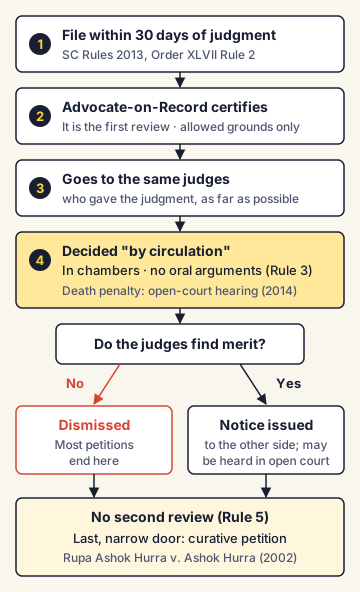
- The party files a review petition within 30 days of the judgment (Order XLVII Rule 2).
- An Advocate-on-Record must certify that it is the first review petition and is based on the allowed grounds.
- As far as possible, it goes to the same judges who gave the judgment.
- Unless the Court orders otherwise, the judges decide it "by circulation" (Rule 3). This means they read the papers in their chambers, without oral arguments in open court. The party may add written arguments.
- Most review petitions are dismissed at this stage. If the judges find merit, they issue notice to the other side and may hear the case in open court.
- Once a review petition is decided, no second review is allowed in the same matter (Rule 5).
A simple way to picture it: an appeal is like asking a senior teacher to re-mark your answer sheet. A review is like asking the same teacher to check whether they made an obvious totalling mistake. You cannot use it to argue that your answer deserved more marks.
Important cases on review
- P.N. Eswara Iyer v. Registrar, Supreme Court (1980): a Constitution Bench upheld the rule that review petitions can be decided by circulation, without oral hearing. In P.T. Mohan v. Registrar (2023), the Court refused to reconsider this.
- Delhi Administration v. Gurdip Singh Uban (2000): the Court said that an application called "clarification", "modification" or "recall", which is really asking for a review, will be treated as a review. A party cannot change the label to get an oral hearing and avoid the review rules. This is often called a disguised review.
- Kamlesh Verma v. Mayawati (2013): the Court summarised the principles of review. Review is not an appeal in disguise, and a petition that only repeats old arguments must be dismissed.
- Mohd. Arif v. Registrar, Supreme Court (2014): a Constitution Bench held, by 4:1, that review petitions in death penalty cases must get a limited oral hearing in open court, because the right to life (Article 21) is at stake.
- Sabarimala review (2019 to 2020): in November 2019, a five-judge bench hearing review petitions against the 2018 Sabarimala judgment referred wider questions on religious freedom to a larger bench. In February 2020, a nine-judge bench held that questions of law can be referred to a larger bench even while hearing a review.
Beyond review: the curative petition
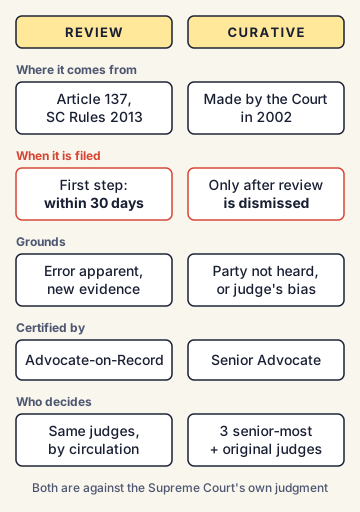
Even after a review is dismissed, a very narrow last remedy exists. In Rupa Ashok Hurra v. Ashok Hurra (2002), a five-judge bench created the curative petition. It is allowed only in rare cases, such as when a party was not heard (a breach of natural justice) or a judge had a possible bias. A Senior Advocate must certify that it meets these grounds. It goes to the three senior-most judges and, if available, the judges who gave the original judgment.
What about High Courts and lower courts?
- Civil cases: High Courts and civil courts can review their judgments under Section 114 and Order XLVII of the CPC, on the same three grounds.
- Criminal cases: once a criminal court signs its final judgment, it cannot review or alter it, except to correct a clerical or arithmetical error (a typing slip or a calculation mistake). This rule was in Section 362 of the CrPC, 1973, and is now in Section 403 of the Bharatiya Nagarik Suraksha Sanhita (BNSS), 2023. The Supreme Court's own criminal review power comes from Article 137, not from this section.
Commonly confused concepts
- Review vs appeal: An appeal goes to a higher court, which can look at the whole case again. A review goes to the same court, and only for a clear error or new evidence.
- Review petition vs curative petition: Review comes first, within 30 days, under Article 137 and the rules. A curative petition comes only after review is dismissed; it was created by the Court in 2002 and is allowed on even narrower grounds.
- Review petition vs clarification (miscellaneous) application: A clarification application asks the Court to explain what its judgment means or how it applies, for example to which people or from which date. It must not ask the Court to change its decision. If it does, it is treated as a disguised review.
- Review petition vs Special Leave Petition (Article 136): An SLP asks the Supreme Court to hear an appeal against a judgment of another court or tribunal. A review is against the Supreme Court's own judgment.
- Review vs reference to a larger bench: A review corrects an error in one case. A reference sends a question of law to a bigger bench, often because two earlier judgments conflict or the question is very important.
- Article 137 vs Article 143: Article 137 is about the Court reviewing its own judgments. Article 143 lets the President ask the Court for its advisory opinion on a question of law or fact.
Issues, criticism and the way forward
- Very few succeed: Most review petitions are dismissed in chambers, often in a one-line order. Supporters say this protects finality. Critics say litigants rarely learn why their petition failed.
- No oral hearing: Lawyers argue that some errors are easier to explain in person. The Court has kept circulation as the rule, with open-court hearings only in death penalty cases or when the bench chooses.
- Disguised reviews and delays: Parties sometimes file "clarification" or "modification" applications to reopen a decided case, which adds to the Court's backlog. The Court has repeatedly warned against this.
- Changing benches: When judges retire, a review may go to a different bench, which can lead to a different view and less certainty.
- Way forward: Suggestions include giving short reasons when dismissing review petitions, clear time-bound listing, and stricter costs for repeated or disguised reviews. These steps aim to balance two goals: correcting real errors and keeping judgments final.
Concepts to Know
- Judgment vs order: A judgment is the court's final decision with reasons. An order can be any direction the court gives, including small procedural ones.
- Circulation: A method where the papers are sent to the judges, who decide the matter in their chambers by reading them, without lawyers arguing in court.
- Chambers vs open court: Chambers are the judges' private rooms. Open court is the public courtroom where lawyers argue and anyone can watch.
- Advocate-on-Record (AOR): A lawyer who has passed a special Supreme Court exam and is allowed to file cases in the Supreme Court.
- Natural justice: Basic rules of fairness: every side must be heard, and no one should judge a case in which they have a personal interest.
- Constitution Bench: A bench of at least five Supreme Court judges, needed for important questions about the meaning of the Constitution (Article 145(3)).
- Finality of judgments: The principle that a decided case must end at some point, so that people can rely on court decisions and plan their lives.
- Article 137: Supreme Court's power to review its own judgments and orders, subject to laws of Parliament and rules under Article 145
- Article 145(1)(e): Court's power to make rules on review conditions and procedure
- Supreme Court Rules, 2013, Order XLVII: 30-day limit (Rule 2); disposal by circulation without oral arguments unless ordered otherwise (Rule 3); no second review in the same matter (Rule 5)
- Civil review grounds: CPC Order XLVII Rule 1 (new evidence, error apparent on the face of the record, other sufficient reason); criminal review: only error apparent on the face of the record
- P.N. Eswara Iyer (1980): circulation upheld; Gurdip Singh Uban (2000): no disguised review through clarification applications; Kamlesh Verma v. Mayawati (2013): principles of review; Mohd. Arif (2014): open-court hearing for death penalty reviews
- Curative petition: Rupa Ashok Hurra v. Ashok Hurra (2002), five-judge bench
- Criminal courts cannot alter a signed judgment except for clerical or arithmetical errors: Section 362 CrPC, now Section 403 BNSS, 2023
● Tracked since November 10, 2026 · last seen November 10, 2026 · updates as the daily brief publishes