Creamy Layer in OBC Reservation
How It Is Decided
Updated 7 Nov 2026: Added the November 2026 Supreme Court order explaining who the Rohith Nathan ruling covers and protecting concluded selections and promotions.
The creamy layer is the better-off section among the Other Backward Classes (OBCs). Members of the creamy layer cannot use OBC reservation in central government jobs and in central educational institutions. The idea is simple: reservation should reach those OBC families who still need help, not those who have already moved up in life. The remaining, still-disadvantaged OBC families are called the non-creamy layer (NCL), and only they get the 27% OBC quota.
Why does the creamy layer exist?
Think of milk. When milk is boiled and cooled, the cream rises to the top. In the same way, inside any backward caste, a few families become rich or powerful. If they keep taking most reserved seats, the poorer families of the same caste never get a chance. The Supreme Court felt that without such a filter, reservation would help the same advanced families again and again, generation after generation.
Where did it come from?
- 1980: The Mandal Commission (Second Backward Classes Commission, chaired by B.P. Mandal) recommended 27% reservation for OBCs.
- 1990: The Centre accepted this for central government jobs through an Office Memorandum.
- 1992: In Indra Sawhney v. Union of India, a nine-judge bench of the Supreme Court upheld the 27% OBC quota but ordered that the creamy layer must be excluded. It asked the government to fix the criteria.
- 1993: An expert committee headed by Justice Ram Nandan Prasad (a retired judge of the Patna High Court) suggested the criteria. The DoPT issued them through an Office Memorandum (OM) dated 8 September 1993. This OM is still the base document today.
How is the creamy layer decided? The 1993 OM's categories
The OM has a list (a schedule) of groups whose children fall in the creamy layer. In simple words:
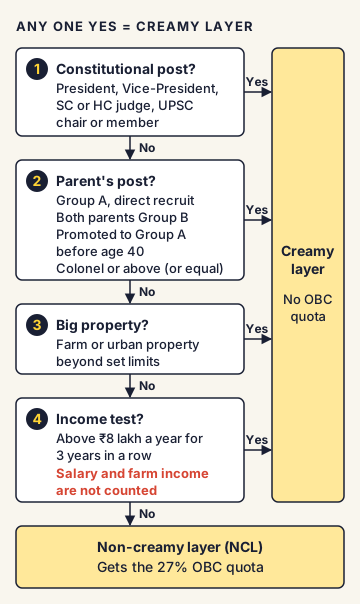
- Constitutional posts: children of people holding high constitutional posts, such as the President, Vice-President, judges of the Supreme Court and High Courts, and chairpersons and members of the UPSC.
- Service category: children of Group A (Class I) officers who were directly recruited, and children of parents who both are Group B (Class II) officers. Children of a parent who reached Group A by promotion before the age of 40 are also in the creamy layer.
- Armed forces: children of officers of the rank of Colonel and above in the Army, and equal ranks in the Navy and Air Force.
- Professionals and business people: doctors, lawyers, traders and so on. For them, the income test below applies.
- Property owners: families owning large farm land or large urban property, beyond set limits.
- Income and wealth test: a family whose gross annual income is above the limit for three years in a row is in the creamy layer.
A key rule inside the income test
The 1993 OM says that income from salaries and from agricultural land is not counted in the income test. Why? Because for salaried government employees, the OM already uses the post (Group A, Group B and so on) to judge status. So a peon's child and an IAS officer's child are separated by the parent's post, not by salary figures. Salary does not get counted twice.
The income limit over time
The income limit has been raised several times:
- ₹1 lakh a year (1993)
- ₹2.5 lakh (2004)
- ₹4.5 lakh (2008)
- ₹6 lakh (2013)
- ₹8 lakh (2017), which is still the limit as of November 2026
The 1993 OM said the limit should be reviewed every three years, but the gaps have been much longer. In 2019, a committee headed by former DoPT Secretary B.P. Sharma was set up to review the criteria.
The PSU and private sector problem
The 1993 OM wanted equal treatment for people working in PSUs, banks, insurance companies, universities and private firms. For this, the government had to decide which of their posts are "equal" to Group A or Group B government posts. This is called equivalence. For many years, equivalence was not fixed for most such bodies. So authorities simply counted the parent's salary. In 2017, the Centre fixed equivalence for posts in central public sector enterprises (CPSEs), treating board-level and managerial posts like Group A [Unverified].
What the Supreme Court said in 2026
In Union of India v. Rohith Nathan (11 March 2026), the Court looked at Civil Services candidates who were refused OBC status because their parents' PSU or private salary crossed ₹8 lakh. The Court held:
- Creamy layer status is about social status, judged by the post and category of the parent. It is not decided by parental salary alone.
- A DoPT letter of 14 October 2004 cannot override the 1993 OM.
- Counting salary for PSU and private sector parents, but not for government employees, was hostile discrimination and broke the right to equality (Article 14).
- Where needed, the government should create supernumerary posts (extra posts created outside the normal count) for wrongly excluded candidates who came before the Court, within six months.
Who does the 2026 ruling cover?
The Centre feared the ruling would disturb old selections, so it asked the Court to explain its reach over time. On 6 November 2026 (2026 INSC 1201), the same bench refused to delay the ruling, but it also protected the past. The ruling works like this:
- Candidates in the case: The judgment decides the rights of those who were before the Court. The six-month period was meant for them, not for a general exercise covering everyone. The government may place eligible candidates in supernumerary posts.
- Past selections: The ruling is not, by itself, a reason to reopen selections or appointments concluded before 11 March 2026. Concluded seniority and promotions also stay as they are.
- Other pending cases: People with similar claims before a court, tribunal or authority will have their cases decided on their own merits. The Court's reading of the 1993 OM and the 2004 letter may be considered.
- From 11 March 2026 onward: All later selections, appointments and allotments against roster points must follow the 1993 OM as the Court read it.
- Civil Services Examination 2025: The result came on 6 March 2026, but services were not yet allocated. So the ruling governs service allocation for OBC candidates of this batch.
- Equivalence and policy: The Centre asked for two years to fix equivalence. The Court set no deadline, because this work belongs to the government and Parliament. The government stays free to make its own creamy layer policy, within the Constitution and the Court's principles.
The constitutional base
Reservation for backward classes rests on these provisions:
- Article 15(4): lets the State make special provisions for socially and educationally backward classes, SCs and STs.
- Article 15(5): added by the 93rd Amendment (2005); allows reservation in educational institutions, including private ones (except minority institutions).
- Article 16(4): allows reservation in public jobs for backward classes not adequately represented in State services.
- Article 338B: gives constitutional status to the National Commission for Backward Classes (NCBC), added by the 102nd Amendment (2018).
- Article 342A(3): added by the 105th Amendment (2021); gives states back the power to prepare their own lists of backward classes.
Other important cases
- Indra Sawhney II (2000): the Court struck down Kerala's refusal to identify a creamy layer. It said ignoring the creamy layer breaks equality.
- Ashoka Kumar Thakur v. Union of India (2008): upheld 27% OBC reservation in central educational institutions, with the creamy layer excluded.
- Jarnail Singh v. Lachhmi Narain Gupta (2018): said the creamy layer idea can apply to SCs and STs in promotions.
- State of Punjab v. Davinder Singh (2024): a seven-judge bench allowed states to sub-classify SCs. Four judges said the creamy layer should also apply to SCs and STs, but this view was not part of the binding decision. The Union Cabinet said in August 2024 that there is no creamy layer for SCs and STs under the Constitution.
Commonly confused concepts
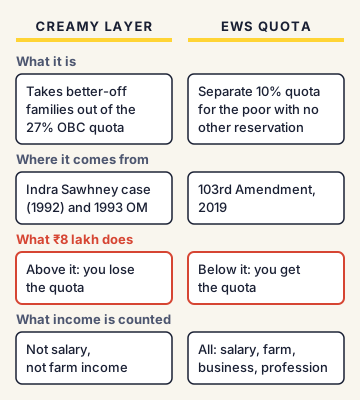
- Creamy layer vs Economically Weaker Sections (EWS): The creamy layer removes richer people from within the OBC quota. The EWS quota (10%, 103rd Amendment, 2019) is a separate quota for poor people from groups that get no other reservation. Both use ₹8 lakh as an income figure, but they work very differently.
- Creamy layer vs income certificate: Being "non-creamy layer" is not just about low income. A low-earning child of a Group A officer is still in the creamy layer, because the test looks at the parent's post.
- Creamy layer vs sub-categorisation: The creamy layer takes out the well-off. Sub-categorisation divides the quota among OBC sub-groups so that dominant castes do not take all seats. The Rohini Commission (set up in 2017 under Article 340; report submitted in 2023) studied OBC sub-categorisation.
- OBC vs SC/ST: The creamy layer applies to OBCs. It does not apply to SC/ST reservation in jobs at entry level.
Issues, criticism and the way forward
- Old income limit: ₹8 lakh has not changed since 2017, while prices and salaries have risen. Parliamentary committees have asked for regular revision.
- Equivalence gap: Without clear equivalence for PSU, bank and private posts, officers fall back on salary, which causes unequal treatment. The 2026 judgment makes fixing equivalence urgent. As of November 2026, no court deadline exists for this work.
- Uncertainty for candidates: Changing rules after an exam result creates confusion about who gets which service. This is exactly why the question of retrospective application arose.
- Should salary count at all? Some argue that a high salary clearly shows a family has moved up, so it should count. Others argue that caste disadvantage is social, not only about income, so the parent's post is a better test.
- Way forward: Regular revision of the limit, clear equivalence rules for all sectors, and a single, transparent online system for certificates have been suggested by committees and experts.
Concepts to Know
- Other Backward Classes (OBCs): Communities that are socially and educationally backward but are not Scheduled Castes or Scheduled Tribes. They get 27% reservation in central jobs and central educational institutions.
- Office Memorandum (OM): An official order issued by a government department to explain or set rules. It is not a law passed by Parliament.
- Non-creamy layer (NCL) certificate: A certificate from the authorities that says a candidate's family is not in the creamy layer, so the candidate can use the OBC quota.
- Group A / Group B posts: Levels of government jobs. Group A is the top level (for example, IAS and IPS officers). Group B is the next level.
- Supernumerary post: An extra post created over and above the normal number, so that a person can be fitted in without removing anyone else.
- Hostile discrimination: Treating two similar groups differently without a fair reason. This breaks Article 14.
- Prospective and retrospective application: A prospective rule applies only from now on. A retrospective rule also reaches back to past cases.
- Roster point: A roster is a fixed list that says which vacancy goes to which category (General, OBC, SC, ST and so on). A roster point is one place on that list.
- Creamy layer exclusion ordered in Indra Sawhney v. Union of India (1992), nine-judge bench
- Criteria: DoPT Office Memorandum dated 8 September 1993, based on the Justice Ram Nandan Prasad committee
- Income limit: ₹1 lakh (1993) → ₹2.5 lakh (2004) → ₹4.5 lakh (2008) → ₹6 lakh (2013) → ₹8 lakh (2017)
- Income test: income above the limit for 3 consecutive years; salary and agricultural income excluded
- Armed forces: Colonel and above; services: direct Group A, both parents Group B, or promotion to Group A before age 40
- Union of India v. Rohith Nathan (11 March 2026): Justices P.S. Narasimha and R. Mahadevan; salary alone cannot decide creamy layer; 2004 DoPT letter cannot override the 1993 OM
- Clarification order (6 November 2026, 2026 INSC 1201): concluded selections, seniority and promotions not reopened; selections after 11 March 2026 and CSE 2025 service allocation follow the ruling; no deadline set for equivalence
- Constitutional base: Articles 15(4), 15(5), 16(4), 338B (NCBC), 342A
- EWS quota: 10%, 103rd Amendment Act, 2019 (separate from the OBC creamy layer)
- 7 Nov 2026Added the November 2026 Supreme Court order explaining who the Rohith Nathan ruling covers and protecting concluded selections and promotions.
● Tracked since November 06, 2026 · last seen November 07, 2026 · updates as the daily brief publishes