Doctrine of Precedent and Article 141
How Supreme Court Rulings Bind
When the Supreme Court decides a legal question, that answer becomes the law for the whole country. Every other court in India must follow it in similar cases. This rule is called the doctrine of precedent, and Article 141 of the Constitution gives it force. It keeps the law certain: the same question should get the same answer, whether it is heard in Kerala or in Kashmir.
Why do we need precedent?
Imagine if every judge could decide the same legal question in a different way. A person in one district would win a case that a person in the next district loses, on the very same facts. Nobody could plan their life or business, because nobody would know what the law is. Precedent solves this. Once a higher court settles a question, lower courts follow it, and people can predict the outcome. It also saves time, because courts do not have to argue the same point again and again.
Where did it come from?
The idea comes from English common law, where it is called stare decisis. This is a Latin phrase that means "to stand by things decided". British India followed it, and the Privy Council in London was the final court for India. When India made its Constitution, it wrote the rule directly into the text. Article 141 says: "The law declared by the Supreme Court shall be binding on all courts within the territory of India." So in India, precedent is not just a habit of judges. It is a constitutional command.
What does Article 141 actually bind?
Not every word in a judgment is binding. Students must learn three terms here:
- Ratio decidendi (the "reason for the decision"): the legal principle the court needed in order to decide the case. Only this part is the "law declared" under Article 141.
- Obiter dicta ("things said by the way"): comments a judge makes that were not needed to decide the case. In Secunderabad Club v. CIT (2023), the Supreme Court said its own obiter dicta are binding on all other courts, but only persuasive for the Supreme Court itself.
- The final order: who wins and what must be done. This binds the parties in that case, but it is not a precedent by itself.
The Supreme Court has repeated that a judgment is an authority only for what it actually decides. You cannot pull out a single line and treat it as law, and you cannot stretch it to things it never discussed.
Which orders are not precedents?
This part is very important for today's news.
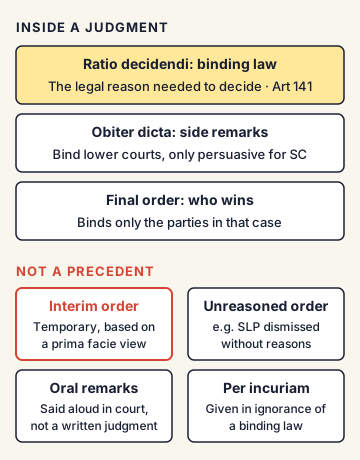
- Interim orders: An interim order is a temporary order passed while a case is still going on. It usually rests on a first look at the facts (called a prima facie view), not on a full hearing. In State of Assam v. Barak Upatyaka D.U. Karmachari Sanstha (2009), the Supreme Court said an interim order that does not finally decide an issue cannot be a precedent.
- Orders without reasons: A short order that only disposes of a case, without explaining the law, does not declare law. For example, in Kunhayammed v. State of Kerala (2000), the court explained that simply dismissing a Special Leave Petition without reasons does not declare any law under Article 141.
- Oral remarks in court: What judges say aloud during a hearing is not a judgment. Only the written, reasoned judgment declares law.
- Per incuriam decisions: A decision given "in ignorance" of a binding law or an earlier larger-bench ruling loses its binding force on that point.
How does the hierarchy work?
Think of it like a staircase: a decision binds everyone standing below it.
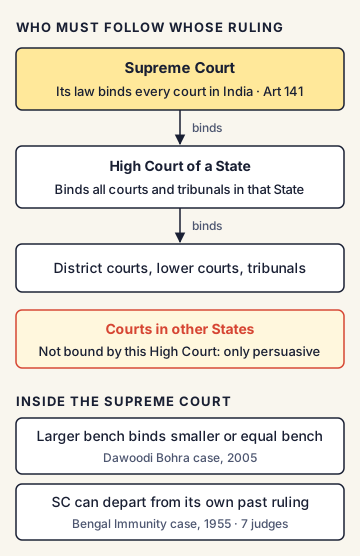
- The Supreme Court binds all High Courts, tribunals and lower courts (Article 141). Article 144 also says all civil and judicial authorities in India must act in aid of the Supreme Court.
- A High Court's decision binds all courts and tribunals under it in that State. A High Court decision is only persuasive in other States.
- Inside the Supreme Court, bench size matters. In Central Board of Dawoodi Bohra Community v. State of Maharashtra (2005), a Constitution Bench held that a larger bench binds any later bench of smaller or equal size. A smaller bench that doubts a larger bench's view cannot overrule it. It can only ask the Chief Justice to send the matter to a larger bench.
- Article 145(3) says a case involving a substantial question about the meaning of the Constitution must be heard by at least five judges. Such a bench is called a Constitution Bench.
Can the Supreme Court change its own view?
Yes. Article 141 binds "all courts", and the Supreme Court has read this as meaning courts other than itself. In Bengal Immunity Co. v. State of Bihar (1955), a seven-judge bench held that the Supreme Court can depart from its own earlier decision if it is convinced the decision was wrong and harmful to the public.
A famous example: Kesavananda Bharati (1973), a 13-judge bench, overruled I.C. Golaknath (1967), an 11-judge bench, on Parliament's power to amend Fundamental Rights. In Golaknath, the court also used prospective overruling: its new rule applied only to the future, so older amendments stayed valid.
Tools that sit next to Article 141
- Article 137: the Supreme Court can review its own judgment.
- Curative petition: created in Rupa Ashok Hurra v. Ashok Hurra (2002), as a last remedy after a review fails, to prevent gross miscarriage of justice.
- Article 142: lets the Supreme Court pass any order needed to do "complete justice" in a case. Such orders are tailored to that case; they are not the same as declaring a general law under Article 141.
India's position and examples
Indian courts use precedent every day. Lawyers cite earlier judgments, and a lower court that ignores a binding Supreme Court ruling can have its order set aside on appeal. In election matters, for example, the Supreme Court's 1995 ruling in Lal Babu Hussein on fair hearings before deleting voters is still cited in voter-list cases decades later, because its ratio has never been overruled.
Commonly confused concepts
- Precedent vs res judicata: Precedent binds other courts on a legal principle. Res judicata (Section 11, Code of Civil Procedure, 1908) stops the same parties from fighting the same dispute again after it is finally decided.
- Article 141 vs Article 142: Article 141 makes the law declared by the Supreme Court binding. Article 142 is a power to do complete justice in a particular case.
- Ratio vs obiter: Ratio is the necessary legal reason and is binding. Obiter is a side remark; it binds lower courts in India but does not bind the Supreme Court.
- Interim order vs final judgment: An interim order keeps things stable while a case is pending and is not a precedent. A final judgment decides the issue and its ratio becomes precedent.
- Overruling vs reversing: Overruling means a later case says an earlier, different case was wrongly decided. Reversing means an appeal court changes the result of the same case.
Issues, criticism and the way forward
- Too many small benches: Most Supreme Court cases are heard by benches of two or three judges. This can create conflicting rulings between equal-sized benches, leaving lower courts unsure which to follow.
- Constitution Benches are rare: Experts point out that important constitutional questions are sometimes decided by small benches, even though Article 145(3) asks for at least five judges.
- Interim orders that last for years: When an interim arrangement stays in place for a long time, people start treating it like settled law, even though it is not. Critics say this blurs the line between temporary and final decisions.
- Way forward: Suggestions include listing more Constitution Benches, clearly marking which part of a judgment is the ratio, and deciding long-pending legal questions quickly so interim orders do not do the work of final judgments.
Concepts to Know
- Bench: The group of judges who hear a case together. A "two-judge bench" has two judges; a "Constitution Bench" has at least five.
- Prima facie: "At first look". A prima facie view is a judge's early opinion before hearing all the evidence.
- Special Leave Petition (SLP): A request to the Supreme Court under Article 136 to allow an appeal against any order of a lower court or tribunal. The court may accept or refuse it.
- Common law: A system, started in England, where judges' decisions build up the law over time alongside laws passed by the legislature.
- Persuasive (not binding): A court may take a persuasive decision into account and may agree with it, but it does not have to follow it.
- Article 141: law declared by the Supreme Court is binding on all courts within the territory of India
- Article 144: all civil and judicial authorities must act in aid of the Supreme Court
- Article 145(3): at least five judges for a substantial question of constitutional interpretation (Constitution Bench)
- Article 137: review of its own judgments; Article 142: complete justice
- Bengal Immunity Co. v. State of Bihar (1955, seven judges): Supreme Court can depart from its own earlier decisions
- Central Board of Dawoodi Bohra Community (2005): larger bench binds smaller or equal benches
- State of Assam v. Barak Upatyaka D.U. Karmachari Sanstha (2009): an interim order is not a precedent
- Kunhayammed v. State of Kerala (2000): SLP dismissal without reasons declares no law
- Rupa Ashok Hurra (2002): curative petition
- Golaknath (1967): prospective overruling; overruled by Kesavananda Bharati (1973)
● Tracked since October 28, 2026 · last seen October 28, 2026 · updates as the daily brief publishes