REDD+
Reducing Emissions from Deforestation and Forest Degradation
REDD+ is a system created under the UN climate treaty that pays developing countries for keeping their forests standing. When forests are cut or damaged, the carbon stored in trees goes into the air as carbon dioxide and heats the planet. REDD+ says: if a country can prove it has cut such emissions, or added more carbon to its forests, it should be rewarded with money.
In simple words, it puts a price on a living forest so that it becomes more valuable standing than cut down.
Why does REDD+ exist?
Cutting and damaging forests is one of the big sources of greenhouse gases, mostly in tropical countries. But for a poor farmer or a poor government, clearing a forest for cattle, soybeans, palm oil or mining brings money today. Protecting the forest brings benefits to the whole world, such as a cooler climate, but no money to the people who protect it.
Economists call this a market failure. REDD+ tries to fix it by sending money from richer countries and investors to forest countries that reduce forest loss.
Where did REDD+ come from?
The idea grew step by step at the yearly UN climate conferences, called COPs (Conference of the Parties):
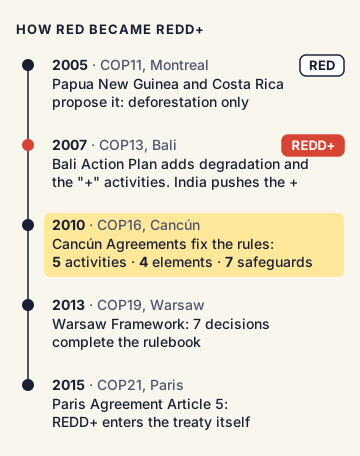
- COP11, Montreal (2005): Papua New Guinea and Costa Rica, on behalf of the Coalition for Rainforest Nations, asked that emissions from deforestation be put on the agenda. The idea was first called "RED" (only deforestation).
- COP13, Bali (2007): The Bali Action Plan recognised the role of reducing emissions from deforestation and forest degradation in developing countries. This added the second "D". It also mentioned conservation, sustainable forest management and the enhancement of forest carbon stocks: these extra activities are the "+" in REDD+. India pushed strongly for this "plus" part.
- COP16, Cancún (2010): The Cancún Agreements (Decision 1/CP.16) laid down the five REDD+ activities, the four things a country must have in place, and seven safeguards.
- COP19, Warsaw (2013): Seven decisions, together called the Warsaw Framework for REDD+, completed the rulebook, including how results are measured and how payments are made.
- COP21, Paris (2015): Article 5 of the Paris Agreement asks countries to conserve and enhance forests as carbon sinks (Article 5.1) and encourages them to carry out and support REDD+, including results-based payments (Article 5.2). This gave REDD+ a place inside the treaty itself.
What are the five REDD+ activities?
A country can earn credit for any of these:
- Reducing emissions from deforestation (forest land turned into farms, roads or towns).
- Reducing emissions from forest degradation (the forest stays but becomes thinner or weaker, for example from selective logging or repeated fires).
- Conservation of forest carbon stocks (protecting forests that are still healthy).
- Sustainable management of forests (using forests without reducing their long-term health).
- Enhancement of forest carbon stocks (growing more trees, restoring damaged forests).
The first two are the "REDD". The last three are the "+".
How does REDD+ work, step by step?
It runs in three phases:
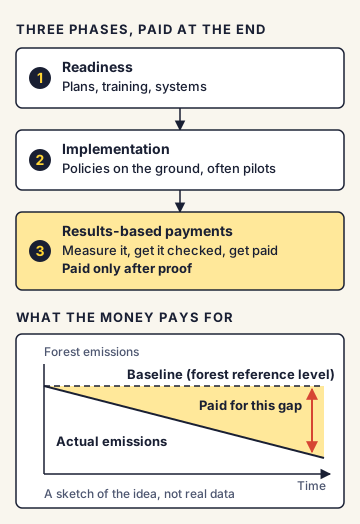
- Readiness: The country makes plans, trains people and builds systems.
- Implementation: It puts its policies into action on the ground, often with pilot projects.
- Results-based payments: It measures how much emission it actually avoided, gets this checked, and is then paid for those verified results.
Think of it like a scholarship paid only after the exam result comes out. The country first sets a baseline, then proves it did better, and only then gets paid.
The four things a country must have (the Cancún elements)
- A national strategy or action plan that names the causes of forest loss and the policies to tackle them.
- A forest reference level: the baseline, or the "normal" level of forest emissions, against which future performance is compared.
- A national forest monitoring system to measure forest cover and carbon, usually with satellites plus ground surveys.
- A safeguard information system that reports how the safeguards are being respected.
What are the Cancún safeguards?
These are seven safeguards meant to make sure REDD+ does not harm people or nature. Among other things, they require respect for the knowledge and rights of Indigenous peoples and local communities, their full and effective participation, transparent forest governance, and no conversion of natural forests into plantations. They also ask countries to address the risk that forest cutting simply shifts elsewhere (called leakage) or comes back later (reversal).
Who pays and who helps?
- UN-REDD Programme: launched in September 2008 by three UN bodies, FAO, UNDP and UNEP, in response to the Bali decision. It gives technical help to partner countries. Norway is its largest donor.
- Forest Carbon Partnership Facility (FCPF): set up by the World Bank to help countries get ready for REDD+ and to pay for results.
- Green Climate Fund (GCF): the main fund under the UN climate system; it has run a pilot programme for REDD+ results-based payments.
- LEAF Coalition: announced in 2021, a group of governments (including the US, UK and Norway) and companies that aimed to mobilise at least US$1 billion to pay for verified forest results at the scale of a whole country or state.
India's position and Indian examples
India was one of the main voices behind the "+" in REDD+. At Bali in 2007, India argued that countries which had protected and grown their forests, and not only those cutting them, should also be rewarded. The reason is simple: India's forest cover has been broadly stable or growing for decades, so a scheme that paid only for "less cutting" would give India almost nothing.
- National REDD+ Strategy: released by the Ministry of Environment, Forest and Climate Change (MoEFCC) on 30 August 2018 and submitted to the UNFCCC. It was drafted by the Indian Council of Forestry Research and Education (ICFRE), Dehradun. It proposes a National Governing Council for REDD+ and a National Designated Entity in MoEFCC to deal with the UNFCCC and the states.
- Forest Survey of India (FSI), Dehradun, was given the job of working out India's forest reference level. ICFRE prepared the safeguards information system, which India submitted to the UNFCCC.
- India's forest-carbon goal sits inside its NDC: to create an additional carbon sink of 2.5 to 3 billion tonnes of CO2 equivalent by 2030 through more forest and tree cover.
- As of the India State of Forest Report (ISFR) 2023, total forest and tree cover was 25.17% of India's area (forest cover 21.76%, tree cover 3.41%), and forest carbon stock was about 7,285.5 million tonnes.
- Indian schemes that support REDD+ type goals include the Green India Mission (one of the eight missions under the National Action Plan on Climate Change, 2008) and CAMPA funds (money paid when forest land is diverted, used for afforestation).
Commonly confused concepts
- REDD vs REDD+: REDD covers only cutting (deforestation) and thinning (degradation). REDD+ adds conservation, sustainable management and enhancement of carbon stocks.
- REDD+ vs carbon offsets in voluntary markets: REDD+ under the UNFCCC is a government-level system with official rules (Warsaw Framework). Many "forest carbon credits" sold to companies come from private projects certified by private standards. They are related but not the same thing.
- REDD+ vs the Tropical Forest Forever Facility (TFFF): REDD+ pays for emission reductions compared with a baseline. The TFFF, launched by Brazil at COP30 in November 2025, aims to pay countries for keeping forest area standing each year, checked by satellite, from returns earned on an investment fund.
- Deforestation vs forest degradation: In deforestation the forest disappears and the land use changes. In degradation the land is still forest, but it holds less carbon and life.
- Afforestation vs reforestation: Afforestation means planting trees where there was no forest for a long time. Reforestation means replanting where forest was recently lost.
Issues, criticism and the way forward
- Too little money: Promised payments have been small compared with the profits from clearing land. This is why new money ideas such as the TFFF have come up.
- Hard to measure: Setting a fair baseline is tricky. If a country sets a high baseline, it can be paid for "reductions" that would have happened anyway. Critics call these inflated credits.
- Leakage and permanence: Protecting one forest may just push cutting to another place. A forest saved today may burn or be cleared later.
- Rights of forest people: Some critics fear REDD+ can treat forests only as carbon stores and limit the rights of Indigenous and local communities. Supporters point to the Cancún safeguards and say secure land rights make REDD+ work better.
- Way forward: Experts suggest working at the scale of a whole country or state (jurisdictional REDD+), better satellite monitoring, secure land rights for communities, and larger, predictable finance.
Concepts to Know
- Carbon stock: The total amount of carbon stored in a forest, in trees, roots, dead wood, leaf litter and soil.
- Carbon sink: Anything that takes in more carbon dioxide from the air than it releases, such as a growing forest.
- UNFCCC: The United Nations Framework Convention on Climate Change (1992), the main global treaty on climate change. Its member countries meet every year at the COP.
- NDC (Nationally Determined Contribution): Each country's own climate plan and target under the Paris Agreement.
- Results-based payment: Money paid only after a country proves, with checked data, that it has achieved a result.
- Baseline / reference level: The "normal" amount of emissions that would have happened without action; it is used to measure improvement.
- Leakage: When stopping forest cutting in one place simply moves the cutting to another place.
- RED proposed at COP11, Montreal (2005) by Papua New Guinea and Costa Rica
- Degradation and the "+" activities recognised in the Bali Action Plan, COP13 (2007)
- Cancún Agreements, COP16 (2010): 5 activities, 4 elements, 7 safeguards
- Warsaw Framework for REDD+, COP19 (2013): 7 decisions
- Paris Agreement Article 5 (2015) encourages REDD+ and results-based payments
- UN-REDD Programme: September 2008, by FAO, UNDP and UNEP
- India's National REDD+ Strategy: 30 August 2018, drafted by ICFRE; FSI handles the forest reference level
- ISFR 2023: forest and tree cover 25.17%; carbon stock about 7,285.5 million tonnes
● Tracked since June 12, 2026 · last seen November 06, 2026 · updates as the daily brief publishes