Punjab Reorganisation Act, 1966
The Punjab Reorganisation Act, 1966 is the law passed by Parliament that split the old state of Punjab into two states, Punjab and Haryana, from 1 November 1966. It also made Chandigarh a separate Union Territory and gave the hill areas of Punjab to Himachal Pradesh. Think of it as a family partition deed: it divided the land, the people, the offices, the money and even the dams between the new owners.
Many of today's fights between Punjab, Haryana and Himachal, over Chandigarh, river water and electricity, go back to how this law divided things.
Why was Punjab divided?
After Independence, the old Punjab had both Punjabi-speaking and Hindi-speaking areas. Many people in the Punjabi-speaking areas wanted their own state based on their language. This demand was called the Punjabi Suba movement ("suba" means province). At the same time, the Hindi-speaking areas in the south-east wanted a state of their own. India had already accepted language as a main basis for drawing state borders in 1956. So a split on language lines was seen as the way to settle the demand.
Where did it come from?
The road to the Act moved in clear steps:
- In 1956, under the States Reorganisation Act, the old Punjab was enlarged by merging PEPSU (the Patiala and East Punjab States Union) into it.
- In early 1966, a parliamentary committee headed by Hukam Singh recommended a Punjabi-speaking state, a Hindi-speaking state, and the joining of the hill areas with Himachal Pradesh.
- On 23 April 1966, the Centre set up the Punjab Boundary Commission, headed by Justice J.C. Shah (with S. Dutt and M.M. Philip as members). It was asked to draw the new border using the 1961 Census language data, with the tehsil as the unit.
- The Commission gave its report on 31 May 1966.
- Parliament passed the Act on 18 September 1966 (Act No. 31 of 1966). It came into force on 1 November 1966, which is called the "appointed day".
How does Parliament create a new state?
The Constitution gives this power to Parliament, not to the states.
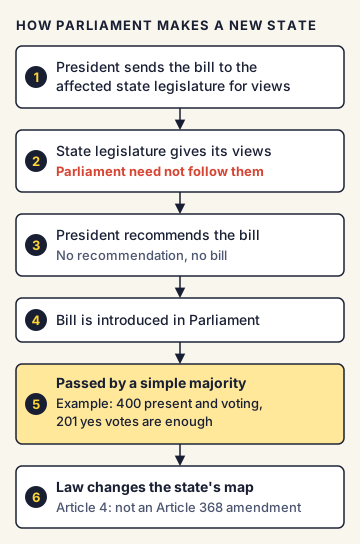
- Article 3 lets Parliament, by law, form a new state, change the area or border of a state, or change its name.
- Such a bill can be introduced only on the recommendation of the President. Before that, the President sends the bill to the legislature of the affected state for its views. Parliament does not have to follow those views.
- Article 4 says such a law is not an amendment of the Constitution under Article 368. So it is passed by a simple majority, like an ordinary law. For example, if 400 members are present and voting, 201 "yes" votes are enough. No special two-thirds majority is needed.
What did the Act give to whom?
- Haryana got the Hindi-speaking south-east: the full districts of Hisar, Rohtak, Gurgaon, Karnal and Mahendragarh, the Ambala, Jagadhri and Naraingarh tehsils, the Jind and Narwana tehsils of Sangrur, and Kalka town with 153 villages of Kharar tehsil. It covered about 44,222 sq km.
- Himachal Pradesh (then a Union Territory) got the hill areas: the full districts of Kangra, Simla (Shimla) and Lahaul and Spiti, the Nalagarh tehsil, Una town with 290 villages of Hoshiarpur, and Dalhousie and Bakloh from Gurdaspur. This was about 27,277 sq km.
- Chandigarh became a separate Union Territory (about 114 sq km). It was made the shared capital of both Punjab and Haryana, as a temporary arrangement that still continues.
- Punjab kept the remaining Punjabi-speaking areas.
Shared institutions that the Act created
The law did not cut every link. Some things were kept common:
- One High Court: Section 29 set up a common High Court for Punjab, Haryana and Chandigarh, the High Court of Punjab and Haryana, at Chandigarh. The Constitution allows this under Article 231, which lets Parliament set up one High Court for two or more states.
- The capital complex: Both state assemblies and secretariats sit in Chandigarh.
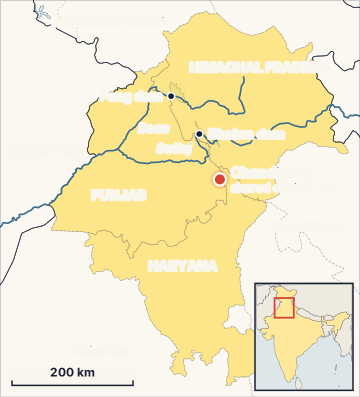
- The rivers and dams: Sections 78 to 80 dealt with the big shared projects on the Sutlej and Beas rivers.
How did the Act share the dams and their power?
This is the part behind most later disputes.
- Section 78 says that the rights and liabilities of the old Punjab in the Bhakra-Nangal Project and the Beas Project pass to the new states. The states were to agree on the shares within two years of 1 November 1966, after talking to the Centre. If they did not agree, the Central Government could decide the shares by order.
- Section 79 set up the Bhakra Management Board to run the Bhakra dam, reservoir and related works. It has a whole-time Chairman and two whole-time members appointed by the Centre, plus representatives of the partner states.
- Section 80 set up the Beas Construction Board to build the Beas Project. Once the Beas works were handed over, the Bhakra Management Board was renamed the Bhakra Beas Management Board (BBMB), with effect from 15 May 1976.
Why did Himachal have a claim?
The Bhakra dam stands on the Sutlej in Bilaspur, and the Pong dam stands on the Beas in Kangra. Both are now in Himachal. Large areas of Himachal land went under water for these reservoirs. When Punjab was split, its hill areas, with a share of the old Punjab's population and land, joined Himachal. Himachal argued that, as a successor to the old Punjab for these areas, it must get a fair share of the power. In 1969 it demanded 7.19%. It became a full state on 25 January 1971.
How did the dispute reach the Supreme Court?
No formal division under Section 78 was ever done for Himachal. Power was shared on an informal basis after 1967, with Himachal getting only a small share. In 1996 Himachal filed an original suit in the Supreme Court. A dispute between states, or between states and the Centre, about legal rights goes straight to the Supreme Court under Article 131.
In September 2011, the Court rejected Himachal's claim to 12% free power but upheld its right to 7.19% of the power that belonged to the old Punjab, with effect from 1 November 1966. Paying the arrears for 45 years then became the long fight that was settled in November 2026.
A landmark case on the Act
In Mangal Singh v. Union of India (1967), the Supreme Court upheld the Act. It held that a law made under Articles 3 and 4 can even reduce the strength of a state's Legislative Assembly below the minimum of 60 members set by Article 170. This is because Article 4 lets such laws make all the "supplemental, incidental and consequential" changes they need.
Commonly confused concepts
- Punjab Reorganisation Act, 1966 vs States Reorganisation Act, 1956: The 1956 Act redrew borders across all of India mainly on language lines and enlarged Punjab by merging PEPSU. The 1966 Act dealt only with Punjab and split it.
- Article 3 vs Article 368: A law under Article 3 changes state borders by simple majority and is not counted as a constitutional amendment (Article 4). Article 368 is the procedure for actually amending the Constitution, which needs a special majority.
- BBMB vs a river water tribunal: The BBMB is a board that runs the dams and power houses every day. A tribunal (like the Ravi and Beas Waters Tribunal of 1986, headed by Justice V. Balakrishna Eradi) decides disputes about how much water each state gets.
- Himachal's 7.19% vs Punjab and Haryana's shares: The 7.19% is Himachal's share of the old Punjab's portion of power. The 2011 judgment fixed Punjab's share at 51.8% and Haryana's at 37.5% of that portion.
Issues, criticism and the way forward
- Chandigarh is still shared. It was meant to be a temporary joint capital, but it remains a Union Territory. Both states claim it. Since 1984, the Governor of Punjab has also served as Chandigarh's Administrator.
- Water sharing remains unsettled. The Sutlej-Yamuna Link (SYL) canal, meant to carry Haryana's share of Ravi-Beas water, is still not complete. In 2004 Punjab passed a law cancelling its water agreements. In 2016 a five-judge bench of the Supreme Court, answering a Presidential Reference under Article 143, held that law unconstitutional.
- Control of the BBMB. States often object when the Centre changes BBMB rules. For example, in 2022 the Centre changed the 1974 rules that had reserved the posts of Member (Power) for Punjab and Member (Irrigation) for Haryana. Punjab and Haryana objected to this.
- The Section 78 deadline did not work. The two-year window for agreement and the Centre's power to decide left many questions open for decades. Experts suggest clearer, time-bound rules for dividing shared assets in any future state split, along with faster dispute resolution.
- Long court delays. Himachal's claim took 30 years in court and 15 more years to put into effect. Cooperative federalism, through talks under bodies like the Northern Zonal Council or mediation by the Attorney General (as in this case), is often suggested as a faster route.
Concepts to Know
- Successor states: The new states that take over the rights, duties, assets and debts of an old state after it is divided. Here, Punjab, Haryana and (for the hill areas) Himachal are successors of the old Punjab.
- Appointed day: The date from which a law starts to apply. For this Act, it was 1 November 1966.
- Tehsil: A smaller unit inside a district, used for land records and administration.
- Original suit: A case that begins directly in the Supreme Court, like a normal civil case, instead of coming to it by appeal from a lower court.
- Million units (MU): A unit of electricity. One unit is one kilowatt-hour (kWh), about the power a 1,000-watt heater uses in one hour. One million units is ten lakh such units.
- Simple majority: More than half of the members present and voting.
- Passed by Parliament on 18 September 1966 (Act No. 31 of 1966); in force from 1 November 1966.
- Punjab Boundary Commission: set up 23 April 1966, chaired by Justice J.C. Shah; report on 31 May 1966; 1961 Census and tehsil as the unit.
- Made under Article 3; Article 4 says it is not an amendment under Article 368, so simple majority is enough.
- Haryana: about 44,222 sq km; Himachal got about 27,277 sq km; Chandigarh UT about 114 sq km.
- Section 29: common High Court of Punjab and Haryana (Article 231 permits a common High Court).
- Section 78: sharing of rights and liabilities in Bhakra-Nangal and Beas Projects (agreement within 2 years, else the Centre decides).
- Section 79: Bhakra Management Board; Section 80: Beas Construction Board; renamed BBMB from 15 May 1976.
- Mangal Singh v. Union of India (1967): Act upheld; Article 4 law can reduce assembly size below 60.
- Himachal Pradesh became a full state on 25 January 1971.
● Tracked since November 07, 2026 · last seen November 07, 2026 · updates as the daily brief publishes