Bhakra Beas Management Board (BBMB)
Updated 8 Nov 2026: Added the November 2026 Supreme Court settlement: Punjab and Haryana will supply Himachal about 11,973 MU of power over 20 years.
The Bhakra Beas Management Board, or BBMB, is a body set up by the central government that runs the big dams, canals and power stations on the Sutlej and Beas rivers. These include the Bhakra dam, the Pong dam and the Dehar power house. It supplies water and electricity to Punjab, Haryana, Rajasthan, Himachal Pradesh, Delhi and Chandigarh. It works like a neutral manager for shared property that belongs to several states.
Why does the BBMB exist?
Before 1966, Punjab was one big state, and the Bhakra project belonged to it. In 1966, Parliament split old Punjab. Haryana became a new state, some hill areas went to Himachal Pradesh, and Chandigarh became a Union Territory. Suddenly, one dam system was shared by several states that had their own interests. If any one state controlled the dams, the others would fear being cheated of water or power.
So Parliament created a neutral board to run the projects for everyone. Think of a building owned jointly by several families: they hire a common society manager instead of letting one family hold all the keys.
Where did it come from?
The BBMB was born from the Punjab Reorganisation Act, 1966, the law that split Punjab on 1 November 1966.
- Section 78 of the Act deals with the rights and liabilities of the successor states in the Bhakra-Nangal and Beas projects.
- Section 79 set up the Bhakra Management Board (BMB) to run the Bhakra-Nangal project.
- Section 80 set up a separate board to finish building the Beas projects. Once built, they were to be handed to the BMB.
- When the Beas works were handed over, the BMB was renamed the Bhakra Beas Management Board with effect from 15 May 1976.
What does it manage?
The BBMB runs three main project areas in the Indus river system:
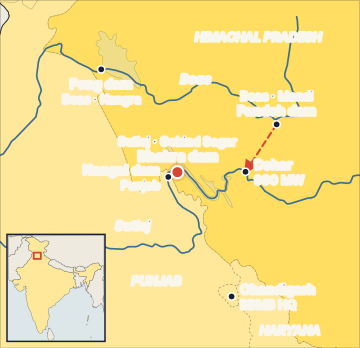
- Bhakra-Nangal Project: The Bhakra dam on the Sutlej river in Bilaspur district, Himachal Pradesh, completed in 1963. It is a concrete gravity dam about 226 metres high, among the tallest of its kind in the world. Its reservoir is Gobind Sagar, named after Guru Gobind Singh. The Nangal dam a little downstream feeds the canals.
- Beas-Sutlej Link Project: The Pandoh dam on the Beas in Mandi district turns part of the Beas water into tunnels and channels. This water drops down to the Dehar power house (990 MW, completed 1977) and then flows into the Sutlej.
- Pong Dam (Beas Dam): An earth-fill dam on the Beas in Kangra district, Himachal Pradesh. Its reservoir is the Maharana Pratap Sagar, also a Ramsar wetland famous for migratory birds. Its power station is about 396 MW.
How does the BBMB work?
The BBMB does not own the water or the power. It runs the projects and divides the water and electricity among the partner states in the shares fixed by law, agreements and court orders. The states pay for the running costs in proportion to their shares.
- Under Section 79(2), the Board has a whole-time Chairman and two whole-time members, all appointed by the central government. The two members handle power and irrigation.
- Partner states and the Centre also send representatives to the Board.
- The headquarters is in Chandigarh.
- The Board decides, season by season, how much water to release from each dam, based on reservoir levels and the states' demands.
How Himachal's share became a dispute
Himachal was given some of old Punjab's hill areas in 1966. It argued that, as a successor state, it was entitled to a share of power from the projects under Section 78. For decades it did not get this share in full. In 1996, Himachal filed an original suit in the Supreme Court (a case filed directly in the Supreme Court between governments, under Article 131).
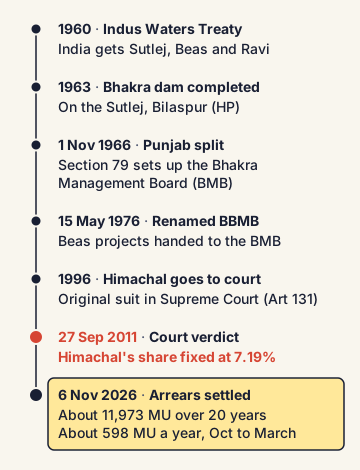
On 27 September 2011, the Court decided in Himachal's favour and fixed its share at 7.19%. The arrears (unpaid past dues) were then calculated in units of electricity by the Central Electricity Authority. For years after that, the states argued over how and when to pay these dues.
- The 2026 settlement: On 6 November 2026, a Supreme Court bench led by Chief Justice Surya Kant closed the case. Punjab and Haryana must supply Himachal about 11,973 million units (MU) of electricity over 20 years, instead of paying cash.
- How the number was worked out: The Centre computed the arrears at 13,066 MU for November 1966 to October 2011. Himachal's 7.19% share of the projects' building cost (about ₹420.77 crore) was then subtracted. That share was worth about 1,093 MU.
- How it will be paid: About 598 MU a year will go to Himachal in the lean season (October to March), when rivers carry less water. Himachal pays the BBMB its normal charges for that year for the power it receives.
- Why 20 years: The Centre had suggested 15 years, Himachal wanted 10 and Punjab wanted 30. The Court chose 20 years to ease the burden on Punjab and Haryana.
India's position and the bigger picture
The Sutlej, Beas and Ravi are the eastern rivers of the Indus system. Under the Indus Waters Treaty, 1960, India got full use of these three rivers. Bhakra and Pong are central to India's use of this water. The Bhakra project was one of independent India's first big river valley projects, and is closely linked with the Green Revolution in Punjab and Haryana, because its canals made large-scale wheat and rice farming possible.
Commonly confused concepts
- BBMB vs Inter-State River Water Disputes Tribunal: The BBMB is a manager that runs dams day to day. A tribunal under the Inter-State River Water Disputes Act, 1956 (made under Article 262) is a court-like body that decides how much water each state should get. The BBMB does not settle legal rights; it carries them out.
- Bhakra dam vs Nangal dam: Bhakra is the large storage dam in Himachal Pradesh. Nangal is a smaller dam downstream, in Punjab, that feeds the canals.
- Pong dam vs Pandoh dam: Both are on the Beas. Pong is a big storage dam in Kangra. Pandoh is a diversion dam in Mandi that sends Beas water to the Sutlej through the Dehar power house.
- Gobind Sagar vs Maharana Pratap Sagar: Gobind Sagar is behind the Bhakra dam on the Sutlej. Maharana Pratap Sagar is behind the Pong dam on the Beas.
Issues, criticism and the way forward
- Representation disputes: By convention, the two whole-time members came from Punjab and Haryana. In 2022, the Centre changed the BBMB rules on how these members are chosen. Punjab objected, saying it weakened its role, while other partner states have sought more representation.
- Water release fights: In 2025, the Board decided by majority to release extra water to Haryana, and Punjab opposed it. The matter went to the Punjab and Haryana High Court, and the Centre approved deployment of the Central Industrial Security Force (CISF) at the Bhakra-Nangal project.
- Old constitutional challenge: Punjab has challenged the validity of Sections 78 and 79 of the Punjab Reorganisation Act in the Supreme Court, arguing that water and dams are state subjects.
- Delayed justice: Himachal's case took from 1996 to 2011 to decide, and another 15 years, until November 2026, to settle the dues.
- Way forward: Experts suggest clear, written sharing rules, real-time data on reservoir levels, and quicker dispute settlement through cooperative bodies like the Northern Zonal Council.
Concepts to Know
- Successor state: A state that takes over part of the territory, assets and liabilities of an older state that was divided.
- Million units (MU): One "unit" of electricity is 1 kilowatt-hour (kWh), the same unit on your home electricity bill. One million units is ten lakh such units.
- Arrears: Money or goods that should have been paid in the past but were not paid on time.
- Concrete gravity dam: A dam that holds back water mainly by its own huge weight.
- Ramsar site: A wetland of international importance listed under the Ramsar Convention, 1971, a global treaty to protect wetlands.
- Punjab Reorganisation Act, 1966: Section 78 (rights in Bhakra-Beas projects), Section 79 (Bhakra Management Board), Section 80 (Beas construction board)
- Renamed BBMB: with effect from 15 May 1976; headquarters: Chandigarh
- Whole-time Chairman and two whole-time members appointed by the Centre
- Bhakra dam: Sutlej, Bilaspur (HP), completed 1963, about 226 m high, reservoir Gobind Sagar
- Dehar power house: 990 MW, 1977; diversion via Pandoh dam on the Beas
- Pong dam: Beas, Kangra (HP), reservoir Maharana Pratap Sagar (Ramsar site)
- Supreme Court verdict, 27 September 2011: Himachal 7.19%, Punjab 51.80%, Haryana 37.51%
- Supreme Court settlement, 6 November 2026: Punjab and Haryana to supply Himachal about 11,973 MU of arrears over 20 years (about 598 MU a year, October to March)
- Indus Waters Treaty, 1960: eastern rivers (Ravi, Beas, Sutlej) for India's use
- 8 Nov 2026Added the November 2026 Supreme Court settlement: Punjab and Haryana will supply Himachal about 11,973 MU of power over 20 years.
● Tracked since November 06, 2026 · last seen November 07, 2026 · updates as the daily brief publishes