Article 131
Original Jurisdiction of the Supreme Court
Updated 8 Nov 2026: Added the 6 November 2026 Supreme Court order settling Himachal's Bhakra-Beas power arrears, closing its 1996 Article 131 suit.
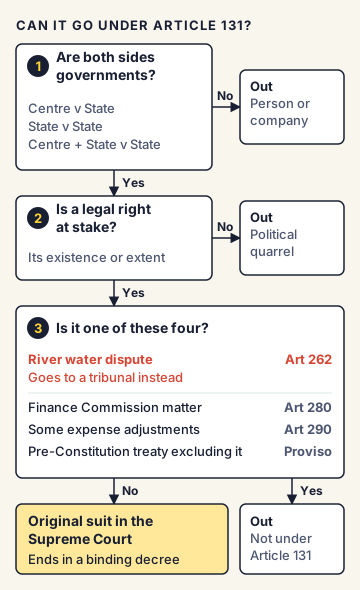
Article 131 of the Constitution says that some kinds of disputes between governments can be taken straight to the Supreme Court, and to no other court. These are disputes between the Centre and one or more states, or between two or more states. Such a case is filed as an "original suit", like a civil case filed in a trial court. The Supreme Court here acts as the first and only court, not as an appeal court. This is called its original jurisdiction.
Why does it exist?
India is a federation, which means power is shared between the Centre and the states. Sometimes they disagree about legal rights, money, property or powers. It would not look fair if the Centre's own courts below, or a state's High Court, decided a fight involving that very state. So the Constitution makes the Supreme Court a neutral umpire for such disputes. Think of two teams in a match: they need an umpire who belongs to neither team.
What exactly does Article 131 cover?
The Supreme Court has original and exclusive jurisdiction over a dispute:
- between the Government of India and one or more states; or
- between the Government of India and one or more states on one side, and one or more other states on the other side; or
- between two or more states.
There is one more condition. The dispute must involve a question of law or fact on which the existence or extent of a legal right depends. A political quarrel is not enough; a real legal right must be at stake.
What is left out?
- Proviso (exception): Article 131 does not cover disputes arising out of a treaty, agreement, covenant, engagement or similar document signed before the Constitution came into force, if that document says such disputes are excluded. The present wording of this proviso was put in by the Seventh Amendment Act, 1956.
- Inter-state river water disputes: Under Article 262, Parliament can bar all courts, including the Supreme Court, from hearing water disputes. Parliament did this in the Inter-State River Water Disputes Act, 1956. Such disputes go to tribunals instead.
- Some financial matters: Matters referred to the Finance Commission (Article 280) and certain adjustments of expenses between the Centre and states (Article 290) are also kept out.
- Private parties: Only governments can be parties. A citizen or a company cannot file under Article 131.
History of Article 131A
The 42nd Amendment, 1976 added Article 131A, which gave the Supreme Court exclusive power to decide whether central laws were valid. The 43rd Amendment, 1977 removed it.
How does an Article 131 case work?
A state (or the Centre) files a "suit" in the Supreme Court. The other governments are made defendants. The Court frames issues (the exact questions to decide), parties can bring evidence and witnesses, and the Court gives a decree, a binding final order. Many such suits take years, and the Court often encourages a negotiated settlement, as it did in the Himachal power case.
Landmark cases (memorise these)
- State of West Bengal v. Union of India (1962): One of the first big Article 131 cases. West Bengal challenged a central law that let the Centre acquire coal-bearing land owned by states. The Court upheld the central law and described India's federation as one with a strong Centre.
- State of Rajasthan v. Union of India (1977): States challenged the Centre's advice to dissolve their Assemblies. The Court held that a dispute affecting a state government's legal powers can be heard under Article 131, though it dismissed the suits.
- State of Bihar v. Union of India (1970): Bihar sued the Centre and Hindustan Steel Ltd., a company. The Court said a suit involving a private party or a company falls outside Article 131.
- State of Madhya Pradesh v. Union of India (2011): A two-judge bench said a state cannot use Article 131 to challenge the validity of a central law. A later bench in State of Jharkhand v. State of Bihar disagreed and sent the question to a larger bench. The issue is still not finally settled.
- State of West Bengal v. Union of India (2024): West Bengal said the CBI was registering cases in the state after the state had withdrawn its consent. The Court held the suit was maintainable (fit to be heard), rejecting the Centre's argument that the CBI is independent of the Union.
India's practice
States have used Article 131 more often in recent years. For example, Kerala filed a suit against the Citizenship (Amendment) Act, 2019 in 2020, Chhattisgarh challenged the NIA Act in 2020, and Kerala challenged limits on its borrowing in 2023-24. The Himachal power dues case was also an original suit, filed in 1996 and decided in 2011.
In that 2011 decree, the Court held that Himachal is entitled to a 7.19% share of power from the Bhakra-Nangal and Beas projects. Carrying out the decree took 15 more years. On 6 November 2026, a bench led by Chief Justice Surya Kant ordered Punjab and Haryana to make up Himachal's arrears (the share it was owed but never got) in electricity, not cash.
The arrears were fixed at about 13,066 million units (one unit is one kilowatt-hour of electricity). After setting off Himachal's own share of the projects' building cost, about 11,973 million units are to be supplied over 20 years, and the suit was closed.
Commonly confused concepts
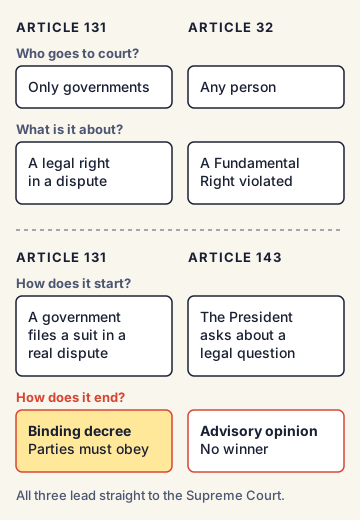
- Article 131 vs Article 32: Article 131 is for disputes between governments over legal rights. Article 32 lets any person go directly to the Supreme Court when their Fundamental Rights are violated.
- Article 131 vs Article 143: Article 143 lets the President ask the Supreme Court for its advice on a legal question. There is no dispute and no winner, and the opinion is advisory. Article 131 is a real dispute that ends in a binding decree.
- Article 131 vs Article 262: Article 262 allows Parliament to remove water disputes from all courts. So water-sharing fights between states go to tribunals, not to the Supreme Court under Article 131. (The Supreme Court can still hear appeals against tribunal awards under Article 136, as it did in the Cauvery case in 2018.)
- Original vs appellate jurisdiction: Original means the case starts in the Supreme Court. Appellate means the Supreme Court hears an appeal against a lower court's decision (Articles 132 to 136).
Issues, criticism and the way forward
- Delay: Article 131 suits often take decades, as Himachal's 15-year wait for its 2011 decree shows. Carrying out that decree took another 15 years, until November 2026. Delay weakens trust between states.
- Unsettled law: Whether states can challenge central laws under Article 131 is still pending before a larger bench, which creates uncertainty.
- Growing Centre-state litigation: More suits on taxes, borrowing, agencies and governors' roles show rising friction in federal relations.
- Way forward: Experts suggest using cooperative bodies such as the Inter-State Council (Article 263) and Zonal Councils first, and keeping court cases as a last resort. Time limits for deciding Article 131 suits have also been suggested.
Concepts to Know
- Jurisdiction: The power of a court to hear and decide a particular type of case.
- Original suit: A case that begins in the court itself, with evidence and arguments, instead of coming as an appeal from a lower court.
- Decree: The formal final order of a court in a civil case, which the parties must obey.
- Maintainable: A case that meets the legal conditions to be heard by the court. If a case is "not maintainable", the court will not even look at its merits.
- Proviso: A clause in a law that creates an exception or condition to the main rule.
- Arrears: Dues that should have been paid or delivered earlier but were not.
- Article 131: original and exclusive jurisdiction of the Supreme Court in disputes between the Centre and states, or between states, involving a legal right
- Proviso on pre-Constitution treaties and agreements: substituted by the Seventh Amendment Act, 1956
- Article 131A: added by 42nd Amendment (1976), omitted by 43rd Amendment (1977)
- Excluded: inter-state water disputes (Article 262), Finance Commission matters (Article 280), certain expense adjustments (Article 290)
- Private parties and companies cannot be parties (State of Bihar v. Union of India, 1970)
- Himachal Pradesh's BBMB share suit: filed 1996, decided 27 September 2011 (7.19% share); arrears settled 6 November 2026 (about 11,973 million units of power over 20 years from Punjab and Haryana)
- 8 Nov 2026Added the 6 November 2026 Supreme Court order settling Himachal's Bhakra-Beas power arrears, closing its 1996 Article 131 suit.
● Tracked since August 02, 2026 · last seen November 07, 2026 · updates as the daily brief publishes