Principles of Natural Justice
Audi Alteram Partem and the Rule Against Bias
Natural justice means a set of basic rules of fairness that every authority must follow when it takes a decision that hurts a person. The two main rules are: hear the other side before deciding (in Latin, audi alteram partem), and no one should be a judge in their own case (nemo judex in causa sua, the rule against bias).
Courts have added a third: the authority should give reasons for its decision. These rules are not written in one single law, but Indian courts treat them as part of the Constitution's promise of fairness under Articles 14 and 21.
Why does it exist?
Imagine a school principal who expels a student only because someone complained, without ever asking the student what happened. Even if the principal means well, the decision may be wrong, and it certainly looks unfair. Natural justice prevents this. It makes sure that:
- the person affected knows what is being alleged,
- they get a real chance to explain, and
- the person deciding has no personal interest in the outcome.
These rules protect people from arbitrary (random or unreasoned) decisions. They also improve the quality of decisions, because the authority hears all the facts before acting.
Where did it come from?
The idea is very old. It is found in Roman law and in old English law. English courts developed it over centuries. A famous modern English case is Ridge v. Baldwin (1964), in which the House of Lords said that a police chief could not be dismissed without being heard.
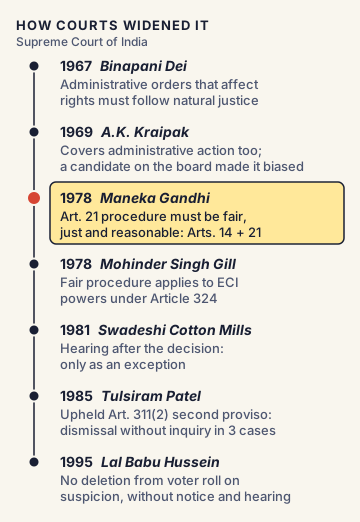
In India, courts gradually widened the reach of natural justice:
- Earlier, it was thought to apply only to judicial and quasi-judicial bodies (bodies that act like courts, such as tribunals).
- State of Orissa v. Dr. (Miss) Binapani Dei (1967): the Supreme Court held that even an administrative order that affects a person's rights (here, the age of a government doctor, which decided her retirement) must follow natural justice.
- A.K. Kraipak v. Union of India (1969): a selection board for the Indian Forest Service included an officer who was himself a candidate. The Court held that natural justice applies to administrative decisions too, and that the presence of an interested member made the selection biased. It also said natural justice does not replace the law, but supplements it.
- Maneka Gandhi v. Union of India (1978): the government impounded (took away) a passport without hearing its holder. The Court held that any procedure that takes away life or personal liberty under Article 21 must be "fair, just and reasonable", and that the right to be heard is part of this fairness. It linked natural justice firmly to Articles 14 and 21.
- Mohinder Singh Gill v. Chief Election Commissioner (1978): after ballot papers were destroyed in violence, the ECI cancelled a poll and ordered a fresh one for the whole constituency. A five-judge bench examined whether the ECI had to give affected candidates notice and a hearing. The case is important because it applied the idea of fair procedure to the ECI's powers under Article 324, while accepting that in emergencies the need for quick action must be balanced against a full hearing.
How does audi alteram partem work in practice?
A fair hearing usually has these parts:
- Notice: the person must be told, in advance and in clear terms, what action is proposed and why.
- Time to respond: they must get reasonable time to prepare.
- Chance to present their side: in writing or in person, with documents or evidence.
- Disclosure: material used against them should normally be shown to them.
- Reasoned order: the final decision should explain why it was taken, so that it can be checked on appeal.
Not every case needs a full court-like trial. The level of hearing depends on how serious the effect on the person is. Sometimes a written reply is enough.
What does the rule against bias cover?
A decision-maker must not have:
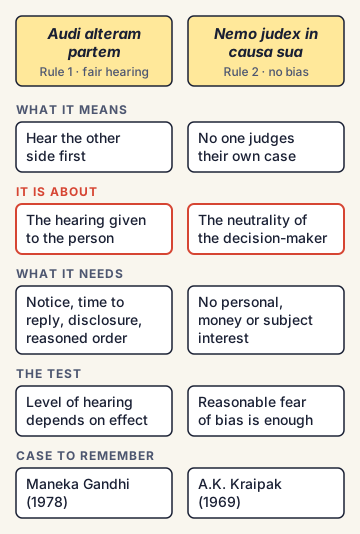
- Personal bias: friendship, enmity or family ties with a party.
- Financial (pecuniary) bias: any money interest in the outcome, even a small one.
- Subject-matter bias: a close link to the issue, like having already decided it in another role.
The test used by Indian courts is not whether the judge was actually biased, but whether there is a real likelihood or reasonable fear of bias in the mind of a fair-minded person. As the old saying goes, justice must not only be done but must also be seen to be done.
Can natural justice be left out?
Yes, in limited cases:
- By the Constitution itself: for example, the second proviso to Article 311(2) allows a government servant to be dismissed without an inquiry in three situations (conviction on a criminal charge; when holding an inquiry is not reasonably practicable; or in the interest of the security of the State). In Union of India v. Tulsiram Patel (1985), a Constitution Bench upheld these exceptions, while keeping the door open for judicial review.
- By a clear law, if the law itself is fair and reasonable.
- In emergencies, when quick action is essential (for example, to protect public health or safety).
- Post-decisional hearing: sometimes a hearing can come after the decision, when a prior hearing is impossible. Maneka Gandhi and Swadeshi Cotton Mills v. Union of India (1981) discussed this idea. Courts treat it as an exception, not the rule.
India's position and Indian examples
Natural justice runs through Indian law:
- Electoral rolls: Section 22 of the Representation of the People Act, 1950 and Rule 21A of the Registration of Electors Rules, 1960 require that a voter be given a reasonable opportunity of being heard before their name is deleted. In Lal Babu Hussein v. Electoral Registration Officer (1995), the Supreme Court held that a person already on the roll cannot be removed merely on suspicion of not being a citizen without notice and a fair chance to reply.
- Government jobs: Article 311(2) says a civil servant cannot be dismissed, removed or reduced in rank without an inquiry in which they are told the charges and heard.
- Anti-defection: the Speaker deciding a disqualification under the Tenth Schedule must give the member a chance to reply.
- Tribunals and regulators like SEBI, the Competition Commission and tax authorities must give show-cause notices and hearings before penalties.
Commonly confused concepts
- Natural justice vs due process: "Due process" is an American constitutional idea that lets courts check whether a law itself is fair. India's Constitution uses "procedure established by law" in Article 21, but after Maneka Gandhi (1978), the procedure must also be fair, just and reasonable. Natural justice is one part of this fairness.
- Audi alteram partem vs nemo judex in causa sua: The first is about hearing the affected person. The second is about the neutrality of the decision-maker.
- Pre-decisional vs post-decisional hearing: The normal rule is a hearing before the decision. A hearing after the decision is only allowed in special situations.
- Administrative vs quasi-judicial action: Earlier, only quasi-judicial bodies had to follow natural justice. Since Kraipak (1969), administrative actions that affect people's rights must follow it too.
Issues, criticism and the way forward
- Delay: Hearings take time. In mass exercises, like large-scale verification of voter lists or welfare beneficiary lists, giving every person a full hearing is hard. Authorities may be tempted to cut corners.
- Mass deletion vs individual hearing: Critics argue that bulk deletions based on software checks or missing forms can deny many people their hearing. Authorities point out that drafts, claims and objections, and appeals offer a chance to correct mistakes.
- "Useless formality" argument: Courts sometimes refuse relief if a hearing would not have changed the result. Critics say this weakens the rule.
- Way forward: Clear written notices in local languages, enough time to respond, reasoned orders, published lists of affected persons, and easy appeal and restoration systems make natural justice real for large numbers of people.
Concepts to Know
- Quasi-judicial body: A body that is not a court but decides disputes in a court-like way, such as a tribunal or the ERO deciding claims and objections.
- Administrative action: A decision taken by a government officer while running the government, like granting a licence or deleting a name from a list.
- Show-cause notice: A notice asking a person to explain why a proposed action should not be taken against them.
- Reasoned order: A decision that states the reasons for reaching it.
- Judicial review: The power of courts to check whether a government action or law is legal and constitutional.
- Proviso: A part of a legal provision that adds an exception or condition to the main rule.
- Two classic rules: audi alteram partem (hear the other side) and nemo judex in causa sua (no one should be a judge in their own cause); third: reasoned decisions
- Constitutional link: Articles 14 and 21 (Maneka Gandhi v. Union of India, 1978: procedure must be fair, just and reasonable)
- State of Orissa v. Binapani Dei (1967): administrative orders affecting rights must follow natural justice
- A.K. Kraipak v. Union of India (1969): natural justice applies to administrative action; bias of a selection board member
- Mohinder Singh Gill v. CEC (1978): fair procedure and the ECI's Article 324 powers
- Union of India v. Tulsiram Patel (1985): upheld the second proviso to Article 311(2), which allows dismissal without inquiry in three cases
- Swadeshi Cotton Mills v. Union of India (1981): post-decisional hearing as an exception
- Electoral rolls: Section 22, RP Act, 1950 and Rule 21A, Registration of Electors Rules, 1960; Lal Babu Hussein (1995)
- Bias test: real likelihood or reasonable fear of bias, not proof of actual bias
● Tracked since May 05, 2026 · last seen October 12, 2026 · updates as the daily brief publishes