Article 32
Right to Constitutional Remedies
Article 32 gives every person the right to go directly to the Supreme Court if their Fundamental Rights are violated. The Supreme Court can then issue orders, directions or writs (formal written commands) to protect those rights. This article is itself a Fundamental Right, in Part III of the Constitution. Without it, Fundamental Rights would be only promises on paper, because there would be no sure way to enforce them.
Why does it exist?
A right is meaningful only if you can enforce it. Suppose the Constitution says you have freedom of speech, but the police arrest you for a peaceful speech and no court will hear you. Your right is then useless. Article 32 solves this problem. It guarantees a remedy at the highest court of the land. This is why Dr. B.R. Ambedkar called Article 32 the most important article of the Constitution: "the very soul of the Constitution and the very heart of it."
What does Article 32 say, clause by clause?
- Article 32(1): the right to move the Supreme Court by "appropriate proceedings" to enforce the rights in Part III is guaranteed.
- Article 32(2): the Supreme Court can issue directions, orders or writs, including writs in the nature of habeas corpus, mandamus, prohibition, quo warranto and certiorari, whichever is appropriate.
- Article 32(3): Parliament may by law allow any other court to use these powers within its local limits, without reducing the Supreme Court's power.
- Article 32(4): this right cannot be suspended, except as the Constitution itself provides (for example, during an Emergency under Article 359).
A related provision, Article 139, lets Parliament by law give the Supreme Court power to issue writs for purposes other than Fundamental Rights.
What are the five writs?
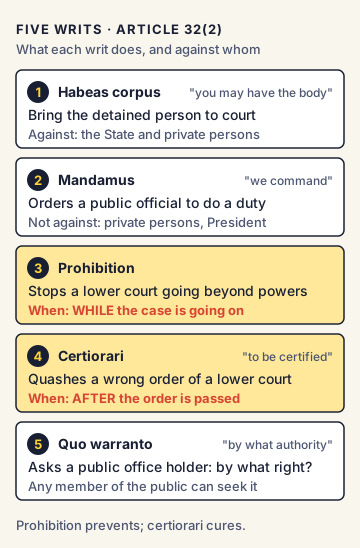
- Habeas corpus ("you may have the body"): orders that a detained person be brought before the court, so the court can check if the detention is legal. It can be issued against both the State and private persons.
- Mandamus ("we command"): orders a public official or body to perform a legal duty it has failed to do. It cannot be issued against a private person, or against the President or a Governor in their personal capacity.
- Prohibition: stops a lower court or tribunal from going beyond its powers, while the case is still going on.
- Certiorari ("to be certified"): cancels (quashes) an order already passed by a lower court, tribunal or authority that acted beyond its powers or wrongly.
- Quo warranto ("by what authority"): asks a person holding a public office to show their legal right to hold it. Any member of the public can seek it.
How does it work, step by step?
- A person whose Fundamental Right is violated files a writ petition directly in the Supreme Court under Article 32. They do not have to go to a High Court first.
- The Court decides whether to admit the case (take it up). If it does, it issues notice to the government or authority concerned.
- The Court may pass interim orders (temporary orders, like a stay) while the case continues.
- After hearing both sides, it passes a final order or writ.
How did the courts shape Article 32?
- Romesh Thappar v. State of Madras (1950): the Supreme Court said it is the protector of Fundamental Rights and cannot refuse to hear a genuine Article 32 petition just because the person could have gone to a High Court.
- Daryao v. State of U.P. (1961): if a High Court has already dismissed a writ petition on merits, the same person cannot file the same case again under Article 32. This is the rule of res judicata (a matter already decided cannot be reopened).
- Kesavananda Bharati v. State of Kerala (1973): an Article 32 petition led to the basic structure doctrine.
- ADM Jabalpur v. Shivkant Shukla (1976): during the 1975 Emergency, the Court held that people could not go to court even against illegal detention. This much-criticised ruling was later declared wrong in K.S. Puttaswamy v. Union of India (2017).
- 44th Amendment Act, 1978: changed Article 359 so that the right to move courts for Articles 20 and 21 can never be suspended, even in an Emergency.
- Public Interest Litigation (PIL): from the late 1970s, the Court relaxed the rule that only the affected person can file a case (locus standi). In S.P. Gupta v. Union of India (1981) and Bandhua Mukti Morcha v. Union of India (1984), it allowed public-spirited persons to file cases for the poor and voiceless. Even a letter or postcard has been treated as a petition (epistolary jurisdiction).
- L. Chandra Kumar v. Union of India (1997): a seven-judge bench held that the power of judicial review of the Supreme Court under Article 32 and of High Courts under Articles 226 and 227 is part of the basic structure. So even a constitutional amendment cannot take it away.
India's position and Indian examples
Article 32 has been used to:
- protect detained persons (habeas corpus),
- challenge laws and constitutional amendments,
- frame guidelines where no law existed, such as the Vishaka v. State of Rajasthan (1997) guidelines against sexual harassment at the workplace,
- protect the environment, free bonded labourers, and help undertrial prisoners.
Election-related challenges also reach the Court through Article 32 when people allege that an action breaks Fundamental Rights such as equality (Article 14) or life and liberty (Article 21). However, Article 329(b) says that an election, once held, can be challenged only through an election petition under the law, not through a writ. So courts usually avoid stopping the election process midway, but they can examine issues like the preparation of voter lists.
Commonly confused concepts
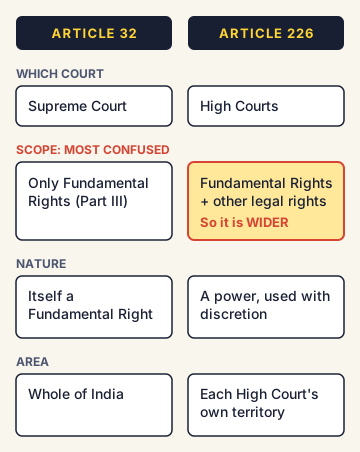
- Article 32 vs Article 226:
- Court: Article 32 = Supreme Court; Article 226 = High Courts.
- Scope: Article 32 = only Fundamental Rights; Article 226 = Fundamental Rights and any other legal right ("for any other purpose"). So Article 226 is wider in scope.
- Nature: Article 32 is itself a Fundamental Right; Article 226 is a power of the High Court, which it can use with discretion.
- Area: Article 32 covers the whole of India; Article 226 covers the territory of each High Court (and cases where the cause arose there).
- Writ petition vs appeal: A writ petition starts a fresh case to enforce a right. An appeal asks a higher court to review a lower court's decision.
- Article 32 vs Article 136: Article 136 (Special Leave Petition) lets the Supreme Court hear appeals against any judgment of any court or tribunal in India, at its discretion. Article 32 is a direct remedy for violation of Fundamental Rights.
- Article 32 vs Article 142: Article 142 lets the Supreme Court pass any order needed for "complete justice" in a case already before it. It is not a separate route to approach the Court.
Issues, criticism and the way forward
- Heavy caseload: Many petitions come straight to the Supreme Court. The Court has often asked petitioners to approach the High Court first, which some see as weakening a "guaranteed" right.
- Misuse of PIL: Some PILs are filed for publicity or political or private gain. The Court has warned against such petitions and imposed costs.
- Judicial overreach: Critics say broad directions under Article 32 sometimes move into areas meant for the legislature or executive. Supporters argue the Court steps in only when other branches fail to protect rights.
- Delays: Even urgent rights cases can take years to be decided.
- Way forward: Better filtering of PILs, faster listing of liberty-related cases, more judges, and strengthening High Courts as the first stop for most writ cases.
Concepts to Know
- Fundamental Rights: The basic rights listed in Part III of the Constitution (Articles 12 to 35), such as equality, freedom of speech, and life and personal liberty.
- Writ: A formal written order of a court, commanding someone to do or not do something.
- Locus standi: The legal right of a person to bring a case to court. Traditionally, only the affected person had it.
- Public Interest Litigation (PIL): A case filed in court for the benefit of the public or a group that cannot approach the court itself.
- Basic structure: The core features of the Constitution that Parliament cannot destroy, even by amendment.
- Res judicata: The rule that a matter finally decided by a court cannot be reopened between the same parties.
- Interim order: A temporary order passed while a case is still being heard, such as a stay.
- Article 32 is in Part III; it is itself a Fundamental Right
- Ambedkar: "the very soul of the Constitution and the very heart of it"
- Five writs: habeas corpus, mandamus, prohibition, certiorari, quo warranto (Article 32(2))
- Article 32(3): Parliament may empower other courts; Article 32(4): cannot be suspended except as the Constitution provides
- Article 139: Parliament may give the Supreme Court writ powers for other purposes
- Article 359 (as amended by the 44th Amendment, 1978): enforcement of Articles 20 and 21 cannot be suspended in an Emergency
- Romesh Thappar (1950); Daryao (1961, res judicata); L. Chandra Kumar (1997, judicial review under Articles 32 and 226 is basic structure)
- PIL: S.P. Gupta (1981), Bandhua Mukti Morcha (1984)
- Article 329(b): elections can be challenged only by an election petition
● Tracked since March 18, 2026 · last seen October 15, 2026 · updates as the daily brief publishes