Pradhan Mantri Jan Dhan Yojana (PMJDY)
India's Bank Account for Every Household
The Pradhan Mantri Jan Dhan Yojana (PMJDY) is a central government scheme that gives every Indian adult a basic bank account with zero minimum balance. The account comes with a free RuPay debit card, accident insurance and, for eligible people, a small overdraft (a short loan). It is India's National Mission for Financial Inclusion. Its idea is simple: before a poor family can save, get insurance, get a pension or receive government money directly, it first needs a bank account.
Why was it needed?
Before 2014, a large part of India's poor had no bank account. They kept cash at home, where it could be stolen or lost. They borrowed from moneylenders at very high interest rates. Government help, like pensions or scholarships, often passed through many hands, and part of it leaked away on the way. Without a bank account, a person also could not easily get insurance, a pension plan or a formal loan. PMJDY was designed to fix the first step of this chain: getting everyone into the formal banking system.
Where did it come from?
India had tried to spread banking for decades:
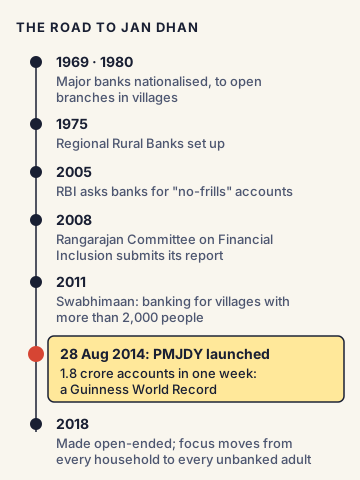
- 1969 and 1980: The government nationalised major private banks (took them over), partly so that banks would open branches in villages.
- 1975: Regional Rural Banks were set up to serve rural people.
- 2005: The RBI asked banks to offer "no-frills" accounts with low or zero balance.
- 2008: The Rangarajan Committee on Financial Inclusion submitted its report, describing how many poor households were left out of banking.
- 2011: The "Swabhimaan" campaign aimed to bring banking to villages with more than 2,000 people.
These efforts helped, but many households were still left out. On 15 August 2014, the Prime Minister announced PMJDY in the Independence Day speech, and the scheme was launched on 28 August 2014. It set a Guinness World Record: 18,096,130 (about 1.8 crore) bank accounts opened in one week, from 23 to 29 August 2014. In September 2018, the government made the scheme open-ended (with no end date) and added more benefits. It also shifted the focus from "every household" to "every unbanked adult".
How does it work?
Any Indian aged 10 years or above who does not have a bank account can open a PMJDY account. This is called a Basic Savings Bank Deposit (BSBD) account. The steps are simple:
- The person goes to a bank branch or a Business Correspondent (Bank Mitra), a local agent who works for the bank in villages.
- They give identity proof, usually Aadhaar. People without documents can open a "small account" with simple rules, which is later converted into a full account.
- The account is opened with zero balance, and a free RuPay debit card is issued.
- The account can then receive government money, savings, and payments for insurance and pension schemes.
Think of it like getting a ration card for the banking world. Once you have it, many other benefits can reach you through it.
What benefits does a PMJDY account give?
- No minimum balance: The account holder does not have to keep any fixed amount in it.
- Interest: The money in it earns interest like any savings account.
- RuPay debit card: Free, with accident insurance of ₹2 lakh for accounts opened after 28 August 2018 (₹1 lakh for earlier accounts). To claim, the card must have been used at least once in the 90 days before the accident.
- Overdraft (OD): Up to ₹10,000 for eligible account holders, raised from ₹5,000 in 2018. It is given to one account per household, preferably a woman of the household. The upper age limit for the overdraft was raised from 60 to 65 years in 2018.
- Direct Benefit Transfer (DBT): The account can receive government subsidies and payments directly.
- Gateway to other schemes: PMJJBY (life insurance), PMSBY (accident insurance), APY (pension) and MUDRA loans can be linked to it.
The JAM trinity
PMJDY works together with Aadhaar (a unique ID for each person) and Mobile phones. This combination is called the JAM trinity (Jan Dhan, Aadhaar, Mobile). The Jan Dhan account is where money lands. Aadhaar proves the person is genuine, so fake names cannot claim benefits. The mobile phone sends alerts and allows digital payments. Together, JAM is the backbone of Direct Benefit Transfer.
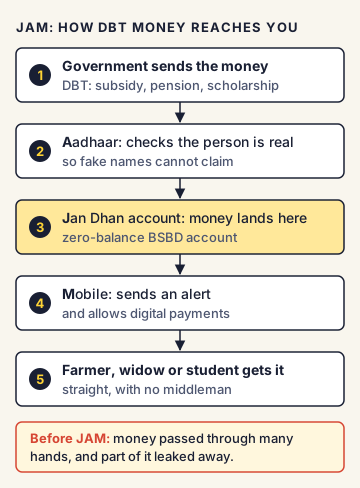
Money can now move from the government straight into the bank account of a farmer, a widow or a student, without a middleman.
How big has it become?
As of 19 August 2026 (the scheme's 12th anniversary):
- About 59.09 crore accounts have been opened.
- Total deposits are about ₹3.17 lakh crore.
- The average balance per account is about ₹5,356, about 3.4 times the level at launch.
- About 56% of account holders are women.
- Most accounts are in rural and semi-urban areas.
- About 41.29 crore RuPay cards have been issued.
India's position and Indian examples
PMJDY is often cited as one of the largest financial inclusion programmes in the world. During the COVID-19 lockdown in 2020, the government sent ₹500 a month for three months into the Jan Dhan accounts of women under the Pradhan Mantri Garib Kalyan Package. This was possible only because those accounts already existed. The RBI's Financial Inclusion Index (a score from 0 to 100) rose from 43.4 in March 2017 to 70.0 in March 2026.
Banks also run regular campaigns, like the present saturation drive, to open accounts for those still left out and to bring dormant accounts back into use.
Commonly confused concepts
- PMJDY account vs ordinary savings account: An ordinary savings account may need a minimum balance and does not come with free accident insurance or an overdraft. A PMJDY account is a BSBD account with zero balance and these extra benefits.
- PMJDY vs DBT: PMJDY is the scheme that opens the account. DBT is the method of sending government money into that account. One is the pipe; the other is the water flowing through it.
- RuPay card insurance vs PMSBY: The RuPay card gives free accident cover linked to card use. PMSBY is a separate accident insurance scheme for which the person pays a small yearly premium.
- Overdraft vs loan: An overdraft lets you withdraw more than your balance up to a fixed limit, for short needs. A loan is a fixed amount given for a fixed period with a repayment schedule.
Issues, criticism and the way forward
- Dormant accounts: A large number of Jan Dhan accounts are inoperative (no transactions for a long time). Many were opened in the rush of campaigns and never used.
- Zero-balance accounts: Some accounts hold little or no money, which raises questions about how much real saving has happened.
- Cost to banks: Banks, especially public sector banks, bear the cost of running crores of small accounts that earn them little.
- Access and literacy: Many people, especially older people and women in remote areas, still find it hard to use ATMs, cards or apps. They also face risks of digital fraud.
- Way forward: Experts and the government stress moving from "access" to "usage": re-KYC of old accounts, financial literacy camps, more Bank Mitras, linking accounts to insurance and pension schemes, and simple credit products for small borrowers. The DFS saturation campaigns are one tool for this.
Concepts to Know
- Financial inclusion: Making sure every person, including the poor, can use basic financial services like a bank account, savings, loans, insurance and pension, at a low cost and in a safe way.
- Business Correspondent (Bank Mitra): A local person or agency appointed by a bank to provide basic banking services in places where there is no bank branch.
- RuPay: India's own card payment network, run by the National Payments Corporation of India (NPCI). It works like Visa or Mastercard, but is Indian.
- KYC (Know Your Customer): The process by which a bank checks a customer's identity and address using documents. Re-KYC means updating these documents after some years.
- Dormant (inoperative) account: A savings account in which the customer has made no transaction for two years.
- Direct Benefit Transfer (DBT): Sending subsidies, pensions and other government payments directly into the bank accounts of beneficiaries.
- Announced 15 August 2014; launched 28 August 2014; National Mission for Financial Inclusion; run by the Department of Financial Services, Ministry of Finance
- Guinness World Record: 18,096,130 accounts opened in one week (23 to 29 August 2014)
- Made open-ended in 2018; focus shifted from "every household" to "every unbanked adult"
- RuPay accident cover: ₹2 lakh for accounts opened after 28 August 2018 (₹1 lakh earlier)
- Overdraft: up to ₹10,000 (raised from ₹5,000 in 2018); age limit raised to 65
- As of 19 August 2026: about 59.09 crore accounts; deposits about ₹3.17 lakh crore; average balance about ₹5,356; about 56% women; about 41.29 crore RuPay cards
- RBI FI-Index: 43.4 (March 2017) to 70.0 (March 2026)
- Rangarajan Committee on Financial Inclusion: report in 2008
● Tracked since April 28, 2026 · last seen October 19, 2026 · updates as the daily brief publishes