Financial Inclusion Index (FI-Index) of the RBI
The Financial Inclusion Index, or FI-Index, is a single number created by the Reserve Bank of India to show how well ordinary people in India are connected to formal financial services. It covers banking, investments, insurance, postal services and pensions. The index runs from 0 to 100. A score of 0 means everyone is completely left out of formal finance, and 100 means full inclusion.
What is financial inclusion?
Financial inclusion means that every person, including the poor and people in villages, can easily use safe, affordable financial services: a bank account, savings, small loans, insurance, pensions and digital payments. The C. Rangarajan Committee on Financial Inclusion (report, January 2008) gave India's widely used definition: making sure vulnerable groups, such as weaker sections and low-income groups, get access to financial services and timely and adequate credit, at an affordable cost.
Why do we need an index?
Imagine a school that only counts how many students joined, but never checks whether they attend classes or learn anything. India faced a similar problem. It could count new bank accounts, but that alone did not show whether people used them or whether the services were good. One combined score helps the government and the RBI track progress every year, compare years, and see which part (access, use or quality) is weak.
Where did it come from?
India's push for financial inclusion is old. Key steps include:
- 1969: Bank nationalisation and the Lead Bank Scheme, to take banks to villages.
- 1975: Regional Rural Banks set up; 1982: NABARD set up for rural credit.
- 1992: The Self-Help Group (SHG) bank linkage programme began.
- 2005: The RBI asked banks to offer basic "no-frills" accounts with zero or very low minimum balance.
- 2008: The Rangarajan Committee report.
- 28 August 2014: The Pradhan Mantri Jan Dhan Yojana (PMJDY) launched to give every household a bank account.
- 2016: UPI launched, making digital payments easy.
The RBI then built the FI-Index and released it on 17 August 2021. It had no base year: it measures the total progress made over the years by all agencies together. The RBI publishes it once a year, in July.
How does it work? The three parameters
The index is built from 97 indicators, grouped into three parameters, each with a fixed weight:
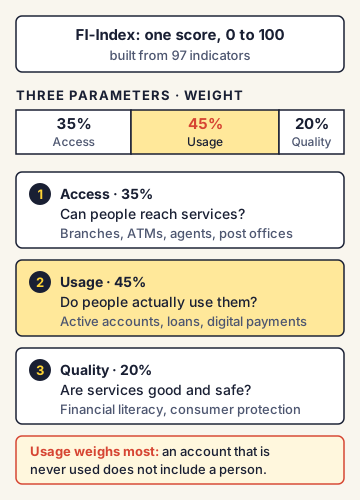
- Access (35%): Can people reach financial services? For example, the number of bank branches, ATMs, banking agents (business correspondents) and post offices near people.
- Usage (45%): Do people actually use them? For example, active accounts, savings, loans taken, insurance policies, pension accounts and digital payments.
- Quality (20%): Are the services good and safe? This covers financial literacy (people's understanding of money matters), consumer protection, and gaps and inequalities in services.
Usage has the biggest weight because an account that is never used does not really include a person in the financial system.
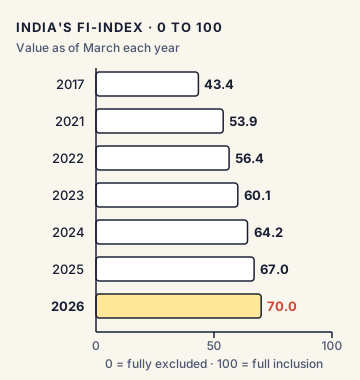
How has India scored?
- March 2017: 43.4
- March 2021: 53.9
- March 2022: 56.4
- March 2023: 60.1
- March 2024: 64.2
- March 2025: 67.0
- March 2026: 70.0 (released on 16 July 2026), with all three parameters improving and the biggest rise coming from Usage
India's position and Indian examples
Several schemes feed into the index:
- PMJDY: Over 59 crore accounts opened since 2014. Accounts have no minimum balance requirement and come with a RuPay debit card. About 56% of account holders are women.
- Pradhan Mantri MUDRA Yojana: Small business loans without collateral, in categories called Shishu, Kishore, Tarun and Tarun Plus.
- JAM trinity: Jan Dhan accounts, Aadhaar identity and Mobile phones, used together to send subsidies directly into bank accounts (Direct Benefit Transfer).
- Social security schemes: Low-cost insurance and pension schemes like PMJJBY, PMSBY and Atal Pension Yojana.
The RBI also releases a five-year National Strategy for Financial Inclusion (NSFI). The current one, NSFI 2025-30, was released on 1 December 2025. It has five main goals, called "Panch Jyoti", and 47 action points, including a gender-sensitive approach, linking livelihoods with finance, financial education and stronger customer protection.
Commonly confused concepts
- RBI FI-Index vs World Bank Global Findex: The FI-Index is the RBI's yearly score for India only, on a 0-100 scale. The Global Findex is a World Bank survey of adults in about 140 economies, reporting percentages such as how many adults own an account.
- RBI FI-Index vs CRISIL Inclusix: CRISIL Inclusix was an earlier, private index made by the rating agency CRISIL, mainly based on bank branches, deposits and loans. The FI-Index is official and much wider (insurance, pensions, investments, post).
- Access vs usage: Access means a service is available; usage means people actually use it. A village with a bank branch but no active accounts has access without usage.
- Financial inclusion vs financial literacy: Inclusion is about reaching and using services. Literacy is about understanding them (interest, fraud, insurance). Literacy is one part of the Quality parameter.
Issues, criticism and the way forward
- Accounts that are not used: World Bank Global Findex data for 2021 found that about 35% of Indian account holders had an inactive account (no deposit or withdrawal in a year), higher than the developing-country average.
- Gender and regional gaps: Women, rural people and residents of some states still use formal credit and insurance much less.
- Digital fraud: As more people pay digitally, more first-time users face scams. The government runs the 1930 helpline for reporting cyber financial fraud.
- Over-borrowing: Easy small loans, especially from microfinance lenders, can trap poor borrowers in debt if not handled carefully.
- One number hides details: A single national score can hide weak districts. Experts suggest state-level and district-level indices.
- Way forward: The NSFI 2025-30 focuses on making accounts useful, closing the gender gap, linking credit with livelihoods and skills, and strengthening grievance redress.
Concepts to Know
- Formal financial services: Services from regulated institutions like banks, post offices, insurers and pension funds, as opposed to moneylenders or informal chit groups.
- Business correspondent: A local agent, often a shopkeeper, who provides basic banking services (deposits, withdrawals) in villages on behalf of a bank.
- Indicator: A single measurable item, such as the number of ATMs per lakh people, used to build a bigger index.
- Weight (in an index): How much a part counts in the final score. Usage has 45% weight, so it counts more than Access (35%) or Quality (20%).
- Collateral: Property or assets a borrower pledges to a bank, which the bank can take if the loan is not repaid.
- Released by the RBI on 17 August 2021; published annually in July; no base year
- Scale: 0 (complete exclusion) to 100 (full inclusion)
- 97 indicators; Access 35%, Usage 45%, Quality 20%
- Covers banking, investments, insurance, postal and pension sectors
- Values: 43.4 (March 2017), 53.9 (March 2021), 56.4 (March 2022), 60.1 (March 2023), 64.2 (March 2024), 67.0 (March 2025), 70.0 (March 2026)
- Rangarajan Committee on Financial Inclusion: report January 2008
- PMJDY launched 28 August 2014; over 59 crore accounts
- NSFI 2025-30: released 1 December 2025; "Panch Jyoti" (5 objectives), 47 action points
● Tracked since October 16, 2026 · last seen October 16, 2026 · updates as the daily brief publishes