Public Sector Banks (PSBs) in India
From Nationalisation to the 4R Reforms
Public sector banks (PSBs) are banks in which the Government of India owns more than half of the shares. India has 12 of them today, including the State Bank of India (SBI), Punjab National Bank, Bank of Baroda and Canara Bank. They are regulated by the Reserve Bank of India (RBI) like any other bank, but their owner is the government. Together they still hold a very large share of India's bank deposits and loans.
Why does India have government-owned banks?
Before 1969, most big banks were privately owned and were often linked to large business houses. They lent mostly to big industry and traders in cities. Farmers, small businesses and villages got very little credit. The government wanted banks to serve national goals, such as reaching villages, lending to farmers and small industry, and collecting the savings of ordinary people.
Owning the banks was seen as the fastest way to do this. This idea is called social banking: banking that serves social goals and not only profit.
Where did they come from?
PSBs came about in three steps.
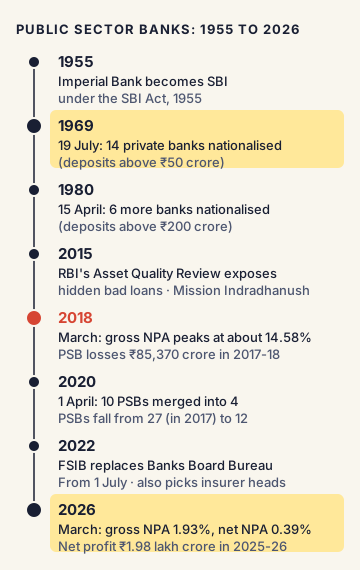
- 1955: The Imperial Bank of India was taken over and became the State Bank of India under the SBI Act, 1955.
- 19 July 1969: The government nationalised (took ownership of) 14 private banks, each with deposits of more than ₹50 crore. This was first done by an ordinance and then by the Banking Companies (Acquisition and Transfer of Undertakings) Act, 1970.
- 15 April 1980: Six more banks with deposits above ₹200 crore were nationalised under a similar Act of 1980.
After nationalisation, bank branches spread rapidly into villages. Banks were also told to give a fixed share of loans to "priority sectors" like farming and small industry.
What went wrong later?
From the late 2000s, PSBs lent heavily to big infrastructure, steel and power projects. Many of these projects got stuck, and the loans stopped being repaid. Such bad loans are called non-performing assets (NPAs). For years, many bad loans were hidden by restructuring them (changing the repayment terms to avoid calling them bad). In 2015, the RBI ordered an Asset Quality Review (AQR), a strict check of bank books, which forced banks to declare bad loans honestly.
The gross NPA ratio of PSBs then shot up to a peak of about 14.58% in March 2018. PSBs together posted net losses of about ₹85,370 crore in 2017-18 and ₹81,752 crore in 2018-19 (as per figures given in Parliament).
What is the 4R strategy?
To fix this, the government followed a four-part plan, known as the 4R strategy:
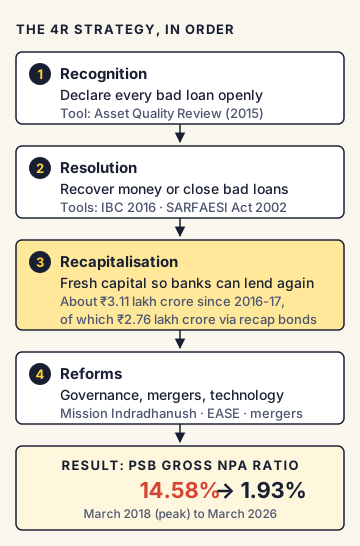
- Recognition: Make banks declare all bad loans openly, as the AQR did.
- Resolution: Recover money or close bad loans through new laws, mainly the Insolvency and Bankruptcy Code (IBC), 2016, along with the older SARFAESI Act, 2002.
- Recapitalisation: Put fresh capital into banks so their losses did not wipe out their ability to lend. The government infused about ₹3.11 lakh crore from 2016-17 onwards, of which about ₹2.76 lakh crore came through recapitalisation bonds.
- Reforms: Change how banks are run, through better governance, mergers and technology.
What other reforms were made?
- Mission Indradhanush (14 August 2015): a seven-point plan for PSBs, often remembered as A to G: Appointments, Bank Board Bureau, Capitalisation, De-stressing, Empowerment, Framework of accountability and Governance reforms.
- Banks Board Bureau (2016): a body to pick top bank bosses on merit, based on the P.J. Nayak Committee (2014) on bank board governance. It was replaced by the Financial Services Institutions Bureau (FSIB) from 1 July 2022, which also selects heads of public sector insurers.
- EASE (Enhanced Access and Service Excellence), January 2018: a common reform agenda for all PSBs, run with the Indian Banks' Association. Each year's version sets new goals, such as better customer service, digital lending, stronger risk checks and technology resilience. Banks are ranked on an EASE index.
- Mergers: PSBs were merged into fewer, larger banks. SBI absorbed its five associate banks and Bharatiya Mahila Bank on 1 April 2017. Vijaya Bank and Dena Bank merged into Bank of Baroda on 1 April 2019. On 1 April 2020, ten PSBs were merged into four. The number of PSBs fell from 27 in 2017 to 12.
- Prompt Corrective Action (PCA): an RBI framework, first set up in 2002 and made stricter in 2017, that puts limits on weak banks (for example on lending and expansion) when their capital, bad loans or profits cross set danger lines. The current version applies from 1 January 2022.
How a recapitalisation bond works
Think of it like this. The government wants to give a bank ₹100 of capital but does not want to spend ₹100 of cash from the budget. So it gives the bank a ₹100 government bond (a promise to repay with interest). The bank pays for that bond with ₹100, and the government puts the same ₹100 back into the bank as shares. The bank now has more capital, and the government has spread the cost over many years through interest payments.
Where do PSBs stand now?
As of March 2026, PSBs reported:
- Net profit of ₹1.98 lakh crore in 2025-26 (₹1.78 lakh crore in 2024-25; ₹1.41 lakh crore in 2023-24).
- Gross NPA ratio of 1.93% and net NPA ratio of 0.39%.
- A capital adequacy ratio (CRAR) of about 16.6%, well above the required 11.5% (including the capital conservation buffer).
- Provision coverage above 90% in every PSB, meaning banks have already set aside money to cover most of their bad loans.
The legal rules on ownership
For the nationalised banks, the 1970 and 1980 Acts say the central government must hold at least 51% of their equity shares. So the government can sell some shares to the public, but cannot drop below majority control without changing the law. Because PSBs are owned by the government but regulated by the RBI, critics speak of dual control.
Some powers the RBI has over private banks (such as removing a bank's board) do not fully apply to PSBs, under Section 51 of the Banking Regulation Act, 1949.
Commonly confused concepts
- Public sector bank vs private sector bank: In a PSB, the government owns more than 50%. In a private bank, private shareholders own most of it. Both follow RBI rules.
- Nationalised bank vs SBI: Both are PSBs, but nationalised banks come under the 1970 and 1980 Acts, while SBI has its own law, the SBI Act, 1955.
- PSB vs Regional Rural Bank (RRB): RRBs are small rural banks jointly owned by the Centre (50%), the state (15%) and a sponsor bank (35%). They are not counted among the 12 PSBs.
- Recapitalisation vs disinvestment: Recapitalisation means the government puts money into a bank. Disinvestment means the government sells its shares to raise money.
- Gross NPA vs net NPA: Gross NPA is all bad loans. Net NPA is what is left after removing the money the bank has already set aside (provisions) for those loans.
- Banks Board Bureau vs FSIB: The FSIB replaced the Banks Board Bureau in 2022 and has a wider role, covering insurers as well.
Issues, criticism and the way forward
- Will the gains last? Critics point out that low NPAs follow a long clean-up, large write-offs and a good economy. Bad loans can rise again if lending standards slip, especially in fast-growing unsecured retail loans.
- Governance and autonomy: The P.J. Nayak Committee said the government's control over appointments and decisions weakens PSB boards. Experts suggest more independent boards and longer, fixed terms for top management.
- Losing market share: Private banks have grown faster in deposits, loans and digital services. PSBs must keep investing in technology and skilled staff to compete.
- Cost to taxpayers: Recapitalisation used public money. Supporters say it saved the banking system; critics say better governance could have prevented the losses.
- Further consolidation and privatisation: The government's 2021 Budget announced plans to privatise two PSBs, and there are reports of more mergers. As of early 2026, the government told Parliament that no merger proposal was under consideration, so the path ahead remains open.
- Way forward: Committees and experts recommend stronger risk management, early warning of stress, better board governance, and using the expected credit loss (ECL) rules from April 2027 to set aside money for likely losses earlier.
Concepts to Know
- Capital (of a bank): The bank's own money, mainly from its shareholders and saved profits. It acts as a cushion. If loans go bad, capital absorbs the loss so depositors stay safe.
- Capital adequacy ratio (CRAR): A bank's capital compared with its risky loans and assets. A higher ratio means a stronger bank. The RBI sets a minimum.
- Provision: Money a bank sets aside from its profits to cover a loan it expects may not be repaid.
- Nationalisation: When the government takes over ownership of a private company, here a bank.
- Insolvency and Bankruptcy Code (IBC): A 2016 law that gives a time-bound process to rescue or close a company that cannot repay its debts, so lenders can recover money.
- Priority sector lending: RBI rules that require banks to give a part of their loans to areas like agriculture, small businesses, education and housing for the poor.
- Number of PSBs: 12 (down from 27 in 2017); 10 PSBs merged into 4 on 1 April 2020
- SBI Act, 1955; nationalisation of 14 banks on 19 July 1969 (deposits above ₹50 crore); 6 banks on 15 April 1980 (deposits above ₹200 crore)
- Government must hold at least 51% of equity in nationalised banks
- AQR: 2015; PSB gross NPA peak about 14.58% (March 2018)
- PSB net losses: ₹85,370 crore (2017-18), ₹81,752 crore (2018-19)
- 4R: Recognition, Resolution, Recapitalisation, Reforms
- Recapitalisation since 2016-17: about ₹3.11 lakh crore (about ₹2.76 lakh crore via recap bonds)
- Mission Indradhanush: 14 August 2015; Banks Board Bureau: 2016; FSIB: from 1 July 2022
- EASE reform agenda: January 2018
- PCA framework: 2002, revised 2017, current version from 1 January 2022
- FY26: net profit ₹1.98 lakh crore; gross NPA 1.93%; net NPA 0.39%; CRAR about 16.6% (minimum 11.5%)
● Tracked since October 16, 2026 · last seen October 16, 2026 · updates as the daily brief publishes