Jan Suraksha Schemes
PMJJBY, PMSBY and APY
The Jan Suraksha schemes are three low-cost social security schemes of the Government of India: Pradhan Mantri Jeevan Jyoti Bima Yojana (PMJJBY) for life insurance, Pradhan Mantri Suraksha Bima Yojana (PMSBY) for accident insurance, and Atal Pension Yojana (APY) for old-age pension. They are meant for ordinary people, especially workers in the unorganised sector, who have no insurance or pension from an employer. All three are linked to a person's bank account, and the money is paid through auto-debit (automatic cut from the account).
Why do these schemes exist?
Most Indian workers, such as farm labourers, street vendors, domestic workers and small shopkeepers, have no job security. If the earning member of a poor family dies or is disabled in an accident, the family can fall into deep poverty overnight. When these workers grow old, they have no pension. Private insurance and pension plans were often too costly or too complicated for them.
The Jan Suraksha schemes give basic protection for a very small yearly amount. Once Jan Dhan accounts reached crores of people, the government could use those accounts to offer such cover.
Where did they come from?
The three schemes were announced in the Union Budget 2015-16 and launched together on 9 May 2015. They are run by the Department of Financial Services (DFS), Ministry of Finance. In May 2025, they completed 10 years. As of May 2026, they had crossed about 94.56 crore total enrolments together. In June 2022, the premiums of PMJJBY and PMSBY were raised for the first time since launch, because claims had been higher than the premiums collected.
How do PMJJBY and PMSBY work?
Both are one-year insurance covers that renew every year:
- A person with a savings bank account (or post office account) fills a simple form and gives consent for auto-debit.
- The yearly premium is cut from the account. The cover period runs from 1 June to 31 May.
- The cover is renewed every year by auto-debit, as long as there is enough money in the account.
- If the insured event happens, the nominee (or the insured person, for disability) claims the money through the bank.
The insurance itself is given by public and private insurance companies, such as the Life Insurance Corporation of India (LIC), working with banks.
PMJJBY (life insurance): the key facts
- Who can join: People aged 18 to 50 years with a bank account.
- Cover: ₹2 lakh paid to the nominee if the insured person dies from any cause (illness or accident).
- Premium: ₹436 per year (raised from ₹330 in June 2022).
- Cover lasts: Up to age 55, if the premium is paid every year.
- No medical test is needed to join.
- Enrolments: Over 23 crore (as of April 2025).
This is a term insurance plan. It pays only if the person dies during the cover period. Nothing is returned if the person stays alive. That is why the premium is so low.
PMSBY (accident insurance): the key facts
- Who can join: People aged 18 to 70 years with a bank account.
- Cover: ₹2 lakh for accidental death or full permanent disability (for example, loss of both eyes or both hands or feet); ₹1 lakh for partial permanent disability (for example, loss of one eye or one hand or foot).
- Premium: ₹20 per year (raised from ₹12 in June 2022), less than ₹2 a month.
- Enrolments: About 51 crore (as of April 2025).
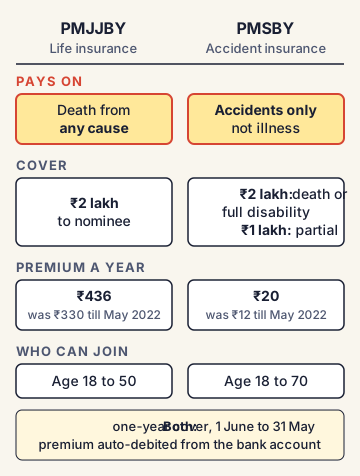
PMSBY pays only for accidents, not for death from illness. This is the main difference from PMJJBY.
How does APY (pension) work?
APY is a guaranteed pension scheme for old age:
- Who can join: Indian citizens aged 18 to 40 years with a bank account. Since 1 October 2022, anyone who is or has been an income tax payer cannot join.
- What you get: A fixed monthly pension of ₹1,000, ₹2,000, ₹3,000, ₹4,000 or ₹5,000 from the age of 60. The person chooses the amount when joining.
- What you pay: A monthly contribution of about ₹42 to ₹1,454, depending on the age at which you join and the pension amount you choose. The younger you join, the less you pay each month, because you pay for more years.
- After the subscriber's death: The same pension goes to the spouse. After both die, the money saved (the corpus) goes to the nominee.
- Regulator: APY is regulated by the Pension Fund Regulatory and Development Authority (PFRDA), under the National Pension System (NPS) framework.
- Government co-contribution: For people who joined between 1 June 2015 and 31 March 2016 (and were not tax payers), the government added 50% of their contribution, up to ₹1,000 a year, for five years (2015-16 to 2019-20). This benefit is over now.
- Enrolments: Over 9.1 crore gross enrolments (as of May 2026). APY replaced the earlier Swavalamban pension scheme.
A simple example: a 20-year-old who wants a ₹1,000 monthly pension pays a small amount every month for 40 years. At 60, the government guarantees the ₹1,000 every month, even if the market returns on the saved money are lower than expected.
India's position and Indian examples
These schemes cover a huge number of people at very low cost. They are an important part of India's social security net for the unorganised sector. They are promoted through banks, post offices, Bank Mitras and special camps in gram panchayats. Women form a large share of new APY subscribers. Together with Jan Dhan accounts, they turn a simple bank account into a basic safety net of life cover, accident cover and pension.
Commonly confused concepts
- PMJJBY vs PMSBY: PMJJBY covers death from any cause and costs ₹436 a year (age 18-50). PMSBY covers only accidental death or disability and costs ₹20 a year (age 18-70). Both give ₹2 lakh.
- APY vs NPS: APY gives a fixed, guaranteed pension of ₹1,000-₹5,000. The National Pension System (NPS) gives a pension based on how the invested money grows in the market, so the amount is not fixed. Both are regulated by PFRDA.
- APY vs PM-SYM: The Pradhan Mantri Shram Yogi Maan-dhan (PM-SYM), run by the Ministry of Labour and Employment, gives a fixed ₹3,000 monthly pension to unorganised workers who join between 18 and 40, with the government matching their contribution. APY is run under the Finance Ministry and lets the person choose from five pension amounts.
- Term insurance vs savings insurance: PMJJBY is term insurance: it pays only on death. Savings-type policies (like many LIC endowment plans) return money at maturity, but cost much more.
Issues, criticism and the way forward
- Low renewals: Many people join during campaigns but their policies lapse when there is not enough money in the account on the renewal date.
- Low awareness of claims: Families often do not know that the deceased person was insured, so many claims are never made.
- Small cover: ₹2 lakh is useful but small compared with the loss of a family's earning member. ₹5,000 a month as pension may lose much of its value to inflation by the time a young person turns 60.
- High claims: Claims were higher than premiums for years, which forced the 2022 premium hike.
- Way forward: Suggestions include automatic renewal reminders, simpler claim processes, linking enrolment to Jan Dhan and DBT more tightly, financial literacy, and campaigns like the present saturation drive in every panchayat.
Concepts to Know
- Premium: The amount a person pays to an insurance company to keep the insurance cover active.
- Auto-debit: A standing permission given to the bank to cut a fixed amount from your account on a fixed date.
- Nominee: The person you name to receive the money from your account or insurance after your death.
- Unorganised sector: The part of the economy where workers have no formal job contract, fixed salary, pension or employer insurance, such as farm workers, hawkers and domestic workers.
- Corpus: The total money collected in a pension account over the years, including contributions and the returns earned on them.
- PFRDA (Pension Fund Regulatory and Development Authority): The statutory body that regulates pension schemes like NPS and APY in India.
- All three launched on 9 May 2015; announced in Budget 2015-16; nodal department: Department of Financial Services, Ministry of Finance
- PMJJBY: age 18-50; ₹2 lakh on death from any cause; premium ₹436/year (was ₹330 till May 2022); cover till age 55; over 23 crore enrolments (April 2025)
- PMSBY: age 18-70; ₹2 lakh accidental death or full disability, ₹1 lakh partial disability; premium ₹20/year (was ₹12 till May 2022); about 51 crore enrolments (April 2025)
- Premium revision effective 1 June 2022; cover period 1 June to 31 May
- APY: age 18-40; guaranteed pension ₹1,000-₹5,000 from age 60; contribution about ₹42-₹1,454/month; regulated by PFRDA; income tax payers barred from 1 October 2022; over 9.1 crore gross enrolments (May 2026)
- Combined enrolments of the three schemes: about 94.56 crore (May 2026)
● Tracked since October 19, 2026 · last seen October 19, 2026 · updates as the daily brief publishes