National Tuberculosis Elimination Programme (NTEP)
The National Tuberculosis Elimination Programme, or NTEP, is the Government of India's main programme to find, treat and prevent tuberculosis (TB). It gives free tests, free medicines and money for food to every TB patient in the country, in government and private hospitals alike. It is run by the Union Ministry of Health and Family Welfare through its Central TB Division. Its goal is not just to control TB but to end it as a public health problem.
Why does India need a TB programme?
TB is caused by a bacterium called Mycobacterium tuberculosis. It mostly attacks the lungs and spreads through the air when a sick person coughs, sneezes or spits. India has the largest number of TB patients in the world, about one in every four cases on Earth. TB hits the poor hardest: people who are hungry, live in crowded homes, or have diabetes or HIV fall sick more easily.
A patient who stops medicines midway can develop a much harder form of TB that normal drugs cannot kill. So the country needs one organised system that finds every patient early and makes sure each one finishes the full treatment.
Where did it come from?
India's fight against TB has gone through four stages:
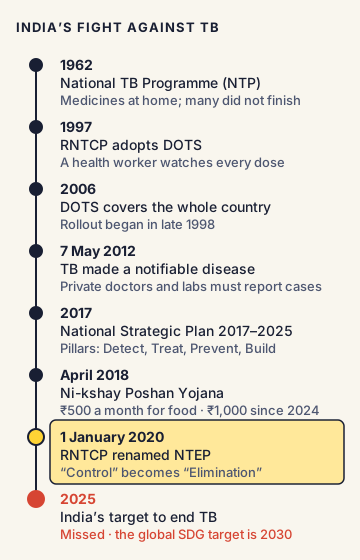
- 1962: National TB Programme (NTP). Treatment was given at home, and patients took medicines on their own. Many did not finish the course, so results were poor.
- 1997: Revised National TB Control Programme (RNTCP). India adopted DOTS (Directly Observed Treatment, Short-course), the method WHO recommended. A health worker or volunteer watched the patient swallow each dose. Large-scale rollout began in late 1998, and the whole country was covered by 2006.
- 2012: TB made a notifiable disease. On 7 May 2012, the government ordered every doctor, hospital and laboratory, including private ones, to report every TB case they find. Before this, most patients treated privately were invisible to the government.
- 1 January 2020: renamed NTEP. The word "Control" was replaced by "Elimination" to show that India now aims to end TB, not just manage it.
What is India's target?
The UN's Sustainable Development Goals (SDGs) ask the world to end the TB epidemic by 2030 (SDG target 3.3). India set itself a tougher deadline of 2025, five years earlier. This was written into the National Strategic Plan (NSP) for TB Elimination 2017–2025. Against a 2015 baseline of about 217 new cases per lakh people, the NSP aimed for:
- Incidence (new cases each year): down to 44 per lakh people by 2025
- Mortality (deaths each year): down to 3 per lakh people by 2025
India did not reach these 2025 numbers. WHO's 2025 report put India's incidence at about 187 per lakh in 2024, a fall of 21% from its revised 2015 estimate of 237 per lakh. The government now treats elimination as a goal to reach in the coming years rather than a missed deadline.
How does the programme work? The four pillars
The NSP organises all work under four words: Detect, Treat, Prevent, Build.
- Detect: Find every patient early. Health workers go door to door to screen high-risk people (this is called active case finding). Rapid molecular tests such as CBNAAT (sold as Xpert MTB/RIF) and the Indian-made TrueNat (developed by Molbio Diagnostics, Goa) can detect TB within hours and also tell whether the germ resists the drug rifampicin. AI-enabled hand-held X-ray machines help screen people in villages.
- Treat: Give free, good-quality medicines and make sure the patient completes the course. Normal TB needs about 6 months of treatment. Drug-resistant TB needs special, stronger medicines.
- Prevent: Stop new infections. This includes TB Preventive Treatment (TPT) for family members of patients and other high-risk people, and better air flow and infection control in hospitals.
- Build: Strengthen the system behind all this: trained staff, labs, digital tracking, money and partnerships with the private sector and communities.
The key schemes and tools under NTEP
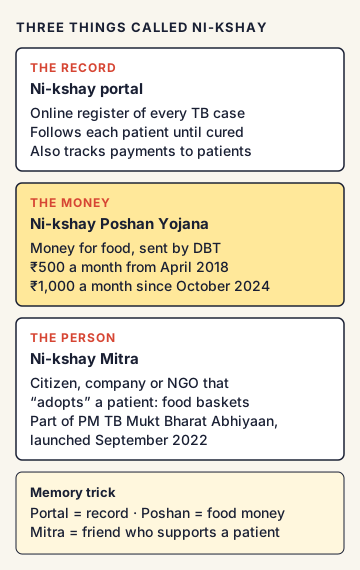
- Ni-kshay portal: An online system where every TB case is registered and followed until it is cured. It also tracks payments made to patients.
- Ni-kshay Poshan Yojana (NPY): Started in April 2018. Every TB patient gets money for nutritious food, sent straight to their bank account (Direct Benefit Transfer). It began at ₹500 a month. In October 2024 it was doubled to ₹1,000 a month for the whole treatment period, which means ₹3,000 to ₹6,000 per patient. Good food matters because a hungry body cannot fight TB well.
- Pradhan Mantri TB Mukt Bharat Abhiyaan (PMTBMBA): Launched in September 2022. It invites citizens, companies, NGOs and elected representatives to become Ni-kshay Mitras (friends of TB patients) and "adopt" patients by giving them monthly food baskets and support.
- 100-day intensified campaign: Launched on 7 December 2024 in 347 high-burden districts, then extended across the country. Health teams screened vulnerable groups such as people with diabetes, smokers, people living with HIV, the elderly and the undernourished.
India's position and results so far
India has made real progress. WHO data show TB deaths falling much faster than the world average, treatment coverage rising, and the gap between estimated and reported cases shrinking. India also hosts some of the world's largest TB research and vaccine trials. Yet India still has more TB patients than any other country, and it also carries the largest share of drug-resistant TB.
Commonly confused concepts
- NTEP vs RNTCP: They are the same programme at different stages. RNTCP (1997) was renamed NTEP on 1 January 2020.
- NTEP vs TB Mukt Bharat Abhiyaan: NTEP is the main government programme. TB Mukt Bharat Abhiyaan is a campaign under it that brings in community and public support.
- Ni-kshay portal vs Ni-kshay Poshan Yojana vs Ni-kshay Mitra: The portal is the digital record. Poshan Yojana is the monthly money for food. Ni-kshay Mitra is a person or organisation that voluntarily supports a patient.
- India's 2025 target vs the global 2030 target: India chose 2025; the SDGs and WHO aim for 2030 (and WHO's End TB Strategy for 2035).
- Incidence vs prevalence vs mortality: Incidence counts new cases in a year. Prevalence counts all people who have the disease at one point in time. Mortality counts deaths.
Issues, criticism and the way forward
- Missed 2025 target: India's incidence in 2024 was still about four times the 2025 target. Experts say the goal was very ambitious for a country with so many poor and undernourished people.
- Under-nutrition: Undernutrition is the single largest risk factor for TB in India. Money for food helps, but critics say ₹1,000 a month cannot fix long-term hunger alone.
- Private sector: A large share of patients first visit private doctors. Reporting and quality of treatment in the private sector are still uneven.
- Out-of-pocket costs: Even with free medicines, patients lose wages and pay for travel and tests. Many families still face catastrophic costs.
- Drug-resistant TB: These cases need costlier, longer treatment and are harder to find.
- Way forward: Experts suggest wider screening with molecular tests, stronger nutrition support, better tracking of patients in the private sector, preventive treatment for all contacts, and faster rollout of new vaccines and shorter treatments as they become available.
Concepts to Know
- Bacterium: A tiny living germ made of a single cell. Some bacteria cause disease; antibiotics are the medicines used to kill them.
- DOTS (Directly Observed Treatment, Short-course): A method where a health worker watches the patient take each dose. This makes sure patients do not skip medicines.
- Notifiable disease: A disease that doctors and labs are required by law or government order to report to the health authorities, so the government knows every case.
- Molecular test: A test that looks for the germ's genetic material (DNA). It is faster and more accurate than looking at spit under a microscope.
- Direct Benefit Transfer (DBT): A system where the government sends money directly into the bank account of the person who should receive it, with no middlemen.
- TB Preventive Treatment (TPT): A short course of medicines given to people who carry the TB germ but are not yet sick, so that they never develop the disease.
- National TB Programme: 1962; RNTCP with DOTS: 1997; renamed NTEP: 1 January 2020
- TB made notifiable: 7 May 2012
- National Strategic Plan 2017–2025: pillars Detect, Treat, Prevent, Build
- NSP 2025 targets: incidence 44 per lakh, mortality 3 per lakh (2015 baseline incidence about 217 per lakh)
- India's elimination target: 2025; SDG target 3.3: end TB epidemic by 2030
- Ni-kshay Poshan Yojana: April 2018, ₹500 a month; raised to ₹1,000 a month in October 2024
- PM TB Mukt Bharat Abhiyaan and Ni-kshay Mitra: September 2022
- 100-day intensified campaign: 7 December 2024, 347 districts, later nationwide
- TrueNat: indigenous rapid molecular test (Molbio Diagnostics, Goa)
● Tracked since March 25, 2026 · last seen November 12, 2026 · updates as the daily brief publishes