End TB Strategy (WHO)
The Global Plan to End Tuberculosis by 2035
The End TB Strategy is the World Health Organization's global plan to end the TB epidemic. It was approved by the World Health Assembly in May 2014 and covers the period from 2016 to 2035. It sets clear targets: by 2035, TB deaths should fall by 95% and new TB cases by 90%, compared with 2015. It also says no family should be pushed into poverty because of the cost of TB.
Why does the world need this plan?
TB is curable, yet it kills more people than any other disease caused by a single germ, about 1.1 to 1.3 million people every year. Most victims live in poor and middle-income countries in Asia and Africa. Earlier global efforts focused mainly on treating patients. They saved millions of lives but did not bring cases down fast enough. The End TB Strategy shifted the goal from "controlling" TB to "ending" it, and linked TB to poverty, nutrition and health coverage.
Where did it come from?
The global fight has moved through three stages:
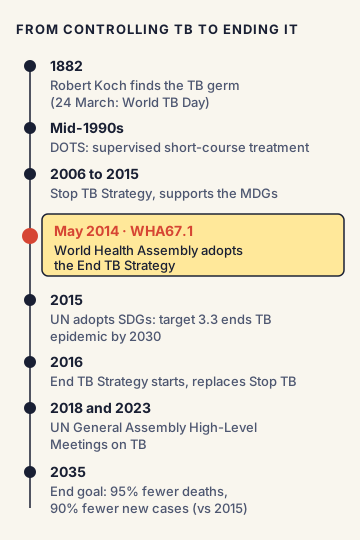
- DOTS strategy (mid-1990s): WHO promoted supervised short-course treatment as the standard method.
- Stop TB Strategy (2006–2015): It supported the Millennium Development Goals (MDGs), which aimed to halt and start reversing the spread of TB by 2015.
- End TB Strategy (2016–2035): Adopted through World Health Assembly resolution WHA67.1 in May 2014. It lines up with the Sustainable Development Goals, whose target 3.3 calls for ending the TB epidemic by 2030.
The targets and milestones
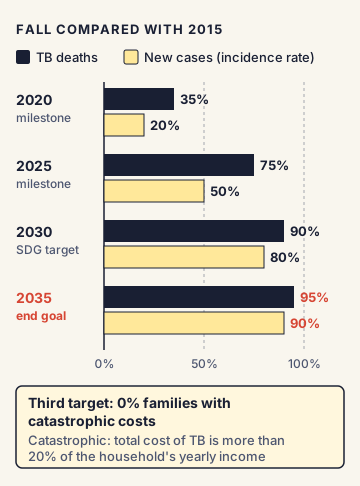
All numbers are compared with 2015 levels:
| By year | Fall in TB deaths | Fall in new cases (incidence rate) |
|---|---|---|
| 2020 (milestone) | 35% | 20% |
| 2025 (milestone) | 75% | 50% |
| 2030 (SDG target) | 90% | 80% |
| 2035 (end goal) | 95% | 90% |
There is one more target: 0% of TB-affected families should face catastrophic costs. WHO calls a cost "catastrophic" when the total cost of TB (medical bills, travel, food and lost wages) is more than 20% of the household's yearly income.
How does it work? The three pillars
- Integrated, patient-centred care and prevention: early diagnosis (including testing for drug resistance), treatment of all patients, preventive treatment for high-risk people, and vaccination.
- Bold policies and supportive systems: political will, enough money, universal health coverage, social protection (such as food or cash support) and action on poverty, malnutrition and other root causes.
- Intensified research and innovation: new tests, new medicines, shorter treatments and new vaccines.
How is progress tracked?
WHO publishes the Global Tuberculosis Report every year, usually in October or November. It is based on data from over 190 countries. It estimates how many people fell ill and died, how many were treated, how much money was spent and how far each country is from the targets. The 2026 edition used a new method that draws more on death-registration data, so its estimates may not match older editions exactly.
Every year on 24 March, the world marks World TB Day. It recalls 24 March 1882, the day German scientist Robert Koch announced that he had discovered the germ that causes TB.
The United Nations General Assembly has also held two High-Level Meetings on TB, in 2018 and 2023, where world leaders made political promises on funding, testing and treatment.
India's position
India supports the End TB Strategy and decided to go faster. Its National Strategic Plan 2017–2025 aimed to reach the SDG-level targets by 2025 instead of 2030. India's main tool for this is the National TB Elimination Programme. Free nutrition support and free treatment are India's way of attacking the "catastrophic costs" target.
Commonly confused concepts
- End TB Strategy vs SDG target 3.3: The End TB Strategy (WHO, 2014) runs to 2035. SDG target 3.3 (UN, 2015) aims to end TB, AIDS, malaria and neglected tropical diseases by 2030. The End TB Strategy's 2030 milestones match the SDG goal.
- End TB Strategy vs Stop TB Strategy: The Stop TB Strategy (2006–2015) supported the MDGs. The End TB Strategy replaced it from 2016.
- End TB Strategy vs Stop TB Partnership: The Stop TB Partnership is a global alliance of governments, donors and NGOs, hosted by the UN, that funds and pushes TB work. It is an organisation, not a strategy.
- "End the epidemic" vs "eliminate TB": Ending the epidemic means bringing cases and deaths down to the target levels. Elimination is stricter: WHO describes it as fewer than 1 case per million people each year.
Issues, criticism and the way forward
- Off track: WHO itself reports that the world missed the 2020 milestones and was not on course for the 2025 milestones.
- Funding gap: In 2023, only about US$ 5.7 billion of the US$ 22 billion needed each year was available for TB work in poorer countries.
- COVID-19 setback: The pandemic disrupted testing and treatment in 2020 and 2021, and deaths rose for a while.
- Root causes: Hunger, HIV, diabetes, smoking and alcohol use drive many cases. Health systems alone cannot fix them.
- Drug resistance: Many drug-resistant patients are never diagnosed or treated.
- Way forward: Experts call for more money, a new and effective vaccine for adults (the old BCG vaccine mainly protects young children), wider use of rapid tests, and social protection so that families do not fall into poverty.
Concepts to Know
- World Health Assembly (WHA): The top decision-making body of WHO. Health ministers of all member countries meet every May in Geneva.
- Incidence rate: The number of new cases in a year for every 1 lakh (100,000) people.
- Millennium Development Goals (MDGs): Eight global goals the UN set for the period 2000–2015, such as cutting poverty and fighting diseases. They were followed by the SDGs.
- Sustainable Development Goals (SDGs): 17 global goals adopted by the UN in 2015 for the period up to 2030.
- Universal health coverage: A situation where everyone can get the health care they need without facing money problems.
- BCG vaccine: A vaccine against TB given to babies at birth. It protects children from severe forms of TB but works poorly in adults.
- Adopted by the World Health Assembly in May 2014 (resolution WHA67.1); period 2016–2035
- 2035 targets (vs 2015): 95% fewer TB deaths, 90% lower incidence rate
- 2030 milestones: 90% fewer deaths, 80% lower incidence (match SDG target 3.3)
- 2025 milestones: 75% fewer deaths, 50% lower incidence
- Zero TB-affected families with catastrophic costs (above 20% of yearly household income)
- Three pillars: patient-centred care and prevention; bold policies and supportive systems; research and innovation
- World TB Day: 24 March (Robert Koch announced the TB germ in 1882)
- UN High-Level Meetings on TB: 2018 and 2023
● Tracked since November 12, 2026 · last seen November 12, 2026 · updates as the daily brief publishes