Drug-Resistant Tuberculosis (DR-TB)
MDR, XDR and the Shorter BPaLM Treatment
Drug-resistant tuberculosis (DR-TB) is TB caused by bacteria that are no longer killed by one or more of the main TB medicines. Normal TB can be cured in six months with cheap, common drugs. When the bacteria resist the two most powerful of these drugs, the disease becomes much harder, longer and costlier to treat. India has the largest number of TB patients in the world, and also a large share of the world's drug-resistant TB cases.
What is TB?
Tuberculosis is an infectious disease caused by a bacterium called Mycobacterium tuberculosis. It mostly attacks the lungs, but can affect other parts of the body too. It spreads through the air when a person with TB of the lungs coughs, sneezes or spits. Common signs are a cough lasting over two weeks, fever, night sweats and weight loss.
Many people carry the bacteria without falling ill (called latent TB); it becomes active disease when the body's defences weaken, for example due to poor nutrition, diabetes or HIV.
How is normal TB treated?
Drug-sensitive TB is treated for 6 months with four "first-line" drugs: isoniazid, rifampicin, pyrazinamide and ethambutol. Isoniazid and rifampicin are the most important.
Why does drug resistance happen?
Bacteria change over time. When a patient stops medicines early, takes them irregularly, gets the wrong dose or poor-quality drugs, the weaker bacteria die but the tougher ones survive and multiply. Soon the whole infection is resistant. A person with resistant TB can then spread these resistant bacteria directly to others, who get resistant TB without ever having been treated. Think of it like weeds that survive a weak spray: next season the field is full of weeds the spray cannot kill.
Types of drug-resistant TB
These definitions are favourite exam questions:
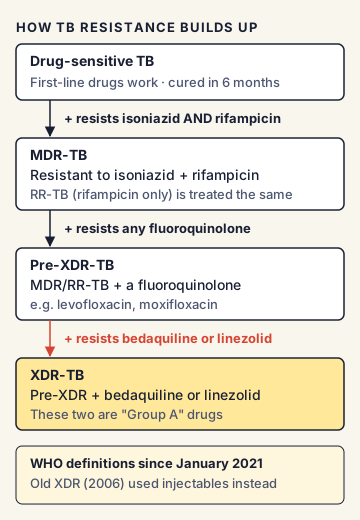
- Rifampicin-resistant TB (RR-TB): resistant to rifampicin.
- Multidrug-resistant TB (MDR-TB): resistant to both isoniazid and rifampicin. Because RR-TB is treated the same way, the two are often written together as MDR/RR-TB.
- Pre-extensively drug-resistant TB (pre-XDR-TB): MDR/RR-TB that is also resistant to any fluoroquinolone (a class of antibiotics such as levofloxacin and moxifloxacin).
- Extensively drug-resistant TB (XDR-TB): MDR/RR-TB resistant to a fluoroquinolone and to at least one more "Group A" drug: bedaquiline or linezolid.
- The WHO set these updated definitions of pre-XDR and XDR-TB in January 2021. Earlier (from 2006), XDR-TB meant resistance to a fluoroquinolone plus one of three injectable drugs (amikacin, kanamycin, capreomycin). The change came because injections are no longer central to treatment.
How was DR-TB treated before?
For many years, MDR-TB treatment lasted 18 to 24 months. It often included daily painful injections for months, and drugs with serious side effects, including permanent hearing loss. Patients had to swallow many pills a day. Many gave up halfway, and cure rates were low. This is why newer, shorter, all-oral treatments are seen as a turning point.
The new medicines
- Bedaquiline: developed by Johnson & Johnson; approved by the US Food and Drug Administration (FDA) in December 2012, the first new TB drug with a new mechanism in about four decades.
- Pretomanid: developed by the non-profit TB Alliance; approved by the US FDA on 14 August 2019, based on the Nix-TB trial in South Africa.
- Linezolid: an older antibiotic, later found to be powerful against TB.
- Moxifloxacin: a fluoroquinolone antibiotic.
BPaL and BPaLM: how do they work?
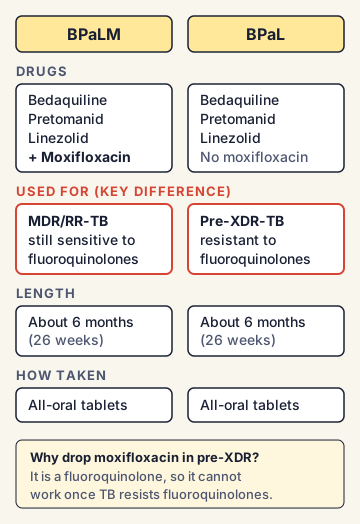
- BPaL = Bedaquiline + Pretomanid + Linezolid.
- BPaLM = BPaL + Moxifloxacin.
- Both are all-oral (only tablets, no injections) and last about 6 months (26 weeks).
- The WHO recommended these 6-month regimens for most forms of drug-resistant TB in 2022.
- Using several drugs together matters: if bacteria resist one, the others still kill them. This also slows the growth of new resistance.
- BPaLM is used for MDR/RR-TB when bacteria are still sensitive to fluoroquinolones; BPaL (without moxifloxacin) is used when there is fluoroquinolone resistance (pre-XDR-TB).
India's position and programme
- India had about 2.71 million new TB cases in 2024, about one-quarter of the world's total, according to the WHO's Global TB Report 2025.
- India's TB incidence (new cases per lakh people) fell from 237 in 2015 to 187 in 2024, a drop of about 21%, nearly double the global pace. Deaths per lakh fell from about 28 to 21. But this is still short of the WHO End TB Strategy milestone of a 50% fall in incidence by 2025.
- The National TB Elimination Programme (NTEP) (renamed in 2020 from the Revised National TB Control Programme) runs TB care. India aimed to end TB by 2025, five years ahead of the UN Sustainable Development Goal (SDG) target of 2030.
- The Union Health Ministry approved the nationwide rollout of the BPaLM regimen under NTEP in September 2024. India's national guidelines make BPaLM the first choice for eligible MDR/RR-TB patients aged 14 years and above.
- Ni-kshay Poshan Yojana: gives TB patients money for food. In October 2024 the support was doubled from ₹500 to ₹1,000 a month for the full treatment period.
- Ni-kshay Mitra (under the Pradhan Mantri TB Mukt Bharat Abhiyaan, 2022): individuals and companies can "adopt" TB patients and give them food baskets.
- Diagnosis uses rapid molecular tests such as CBNAAT/GeneXpert and India's own Truenat, which detect TB and rifampicin resistance within hours.
Commonly confused concepts
- MDR vs pre-XDR vs XDR: MDR = isoniazid + rifampicin resistance. Pre-XDR = MDR + fluoroquinolone. XDR = pre-XDR + bedaquiline or linezolid.
- BPaL vs BPaLM: BPaLM has the fourth drug moxifloxacin. They are the same length (6 months).
- Latent TB vs active TB: Latent TB has bacteria in the body but no illness and no spread; active TB causes illness and (in the lungs) can spread.
- BCG vaccine vs TB treatment: BCG (Bacillus Calmette-Guérin) is a vaccine given at birth that mainly protects children from severe TB. It does not cure TB and gives limited protection to adults.
- Antimicrobial resistance (AMR) vs DR-TB: AMR is the broad problem of germs resisting medicines. DR-TB is one serious form of AMR.
Issues, criticism and the way forward
- Missing cases: Many patients, especially those treated in the private sector, are never reported or tested for drug resistance.
- Testing gaps: Testing for resistance to bedaquiline and linezolid is not yet widely available, so new resistance to these key drugs could spread unnoticed.
- Side effects: Linezolid can damage nerves and lower blood counts, so patients need close monitoring.
- Cost and patents: New drugs can be costly while under patent. Patent rejections (bedaquiline in 2023, BPaL in 2026) and generic production can bring prices down, but supply, quality and fair pricing still need to be ensured.
- Social causes: Malnutrition, crowded housing, smoking, diabetes and stigma all drive TB. Medicines alone cannot end it.
- Way forward: Experts suggest universal drug-resistance testing at diagnosis, wider rollout of all-oral short regimens, better private-sector reporting, stronger nutrition support, and new vaccines.
Concepts to Know
- Incidence: The number of new cases of a disease in a year, usually per lakh (1,00,000) people.
- Regimen: A fixed plan of medicines: which drugs, what dose, and for how long.
- Fluoroquinolones: A family of strong antibiotics (such as levofloxacin and moxifloxacin) used against drug-resistant TB.
- Antimicrobial resistance (AMR): When bacteria, viruses, fungi or parasites change so that medicines no longer kill them.
- Generic drug: A cheaper version of a medicine, with the same active ingredient and effect, made by other companies once there is no patent block.
- End TB Strategy: The WHO's global plan (adopted 2014) to cut TB deaths by 95% and new cases by 90% by 2035, compared with 2015.
- TB is caused by the bacterium Mycobacterium tuberculosis; spreads through the air
- First-line drugs: isoniazid, rifampicin, pyrazinamide, ethambutol (6 months for drug-sensitive TB)
- MDR-TB: resistant to isoniazid and rifampicin; pre-XDR: plus any fluoroquinolone; XDR: plus bedaquiline or linezolid (WHO definitions from January 2021)
- BPaL = bedaquiline + pretomanid + linezolid; BPaLM adds moxifloxacin; both all-oral, about 6 months
- WHO recommended 6-month BPaL/BPaLM regimens in 2022; India approved nationwide BPaLM rollout in September 2024
- Bedaquiline: US FDA approval December 2012 (Johnson & Johnson); pretomanid: US FDA approval 14 August 2019 (TB Alliance)
- India: about 2.71 million TB cases in 2024 (about 25% of the world); incidence 237 → 187 per lakh (2015–2024), a 21% fall
- Ni-kshay Poshan Yojana: ₹1,000 per month since October 2024 (was ₹500)
- India's TB elimination goal: 2025; SDG target: 2030
● Tracked since October 29, 2026 · last seen October 29, 2026 · updates as the daily brief publishes