Patents Act, 1970
How India Decides What Can Be Patented
The Patents Act, 1970 is India's law on patents. A patent is a right given by the government to an inventor: for 20 years, nobody else can make, use, sell or import the invention in India without the inventor's permission. In return, the inventor must publish full details of how the invention works, so that everyone can use it once the patent ends. The Act also decides what cannot be patented, and lets the public object to a patent before or after it is granted.
Why does it exist?
Inventing a new medicine or machine can take many years and huge sums of money. If anyone could copy it the next day, few would bother to invent. A patent solves this by giving the inventor a limited monopoly (sole right to sell), so they can earn back their costs. But a monopoly also lets the owner charge high prices.
For medicines, this can mean life or death for poor patients. So every patent law tries to balance two goals: reward for the inventor and access for the public. India's law is known worldwide for leaning firmly towards public access, especially for medicines.
Where did it come from?
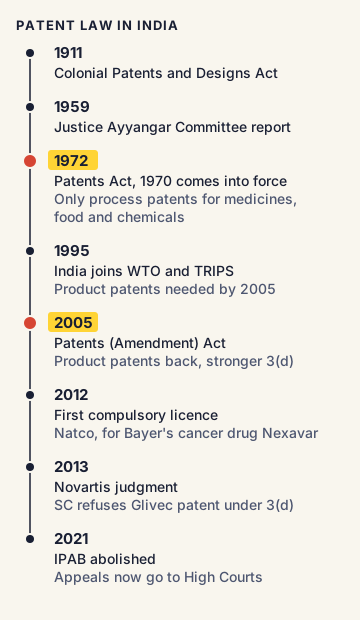
- Before 1970, India followed the colonial Indian Patents and Designs Act, 1911. Foreign companies held most patents, and medicine prices in India were among the highest in the world.
- The government set up a committee under Justice N. Rajagopala Ayyangar, whose report (1959) shaped the new law.
- The Patents Act, 1970 came into force on 20 April 1972. For food, medicines and chemicals, it allowed only process patents (a patent on a particular way of making a product), not product patents (a patent on the product itself). Indian companies could legally make the same medicine by a different method. This is how India's generic medicine industry grew.
- In 1995, India joined the World Trade Organization (WTO) and its TRIPS Agreement (Agreement on Trade-Related Aspects of Intellectual Property Rights). TRIPS required product patents in all fields of technology. Developing countries like India got time till 2005 to comply.
- The Act was amended in 1999, 2002 and 2005. The Patents (Amendment) Act, 2005 (in effect from 1 January 2005) brought back product patents for medicines, food and chemicals. At the same time, Parliament added safeguards: a stronger Section 3(d) and wider opposition rights.
- The Patents (Amendment) Rules, 2024, in force from 15 March 2024, made several process changes, such as a fee for pre-grant opposition and filing the working statement (Form 27) once every three financial years instead of every year.
What counts as an invention?
Under Section 2(1)(j), an invention must be a new product or process that:
- Is new (novelty): it was not already published or used anywhere in the world before the filing date. Earlier knowledge is called prior art.
- Involves an inventive step: under Section 2(1)(ja), it must be a technical advance or have economic importance, and must not be obvious to a skilled person in that field. Simply putting together known things in a way any expert would think of fails this test.
- Is capable of industrial application: it can be made or used in an industry.
What cannot be patented? Section 3
Even if something passes these tests, Section 3 lists things that are "not inventions". Important ones for medicines:
- Section 3(d): a new form of a known substance (for example, a new salt or crystal form of an old medicine) cannot be patented unless it shows significantly better "efficacy" (for medicines, better healing effect). This stops evergreening: a company making small changes to an old drug just to extend its monopoly.
- Section 3(e): a mere admixture (simple mixing) of known substances, where the result only adds up the properties of the parts, is not an invention. A new combination is patentable only if the parts work together in a synergistic way (the combined effect is greater than the sum of the parts).
- Section 3(i): methods of treating humans or animals (medical, surgical, diagnostic or therapeutic methods) cannot be patented. A doctor's way of treating a patient must remain free for all.
- Others include 3(j) (plants and animals, except micro-organisms), 3(k) (mathematical methods, business methods and computer programs "per se") and 3(p) (traditional knowledge).
How does a patent get granted, step by step?
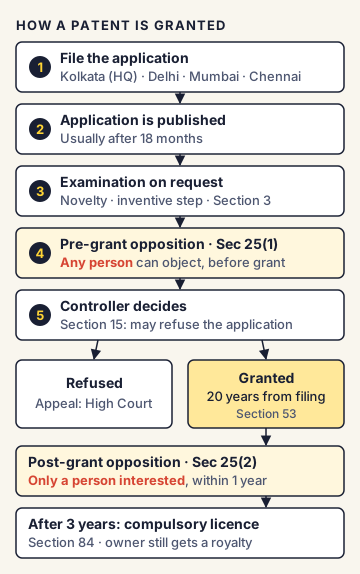
- The inventor files an application at one of the four patent offices (Kolkata (head office), Delhi, Mumbai, Chennai), run by the Controller General of Patents, Designs and Trade Marks under the Ministry of Commerce and Industry.
- The application is published (usually after 18 months).
- The applicant requests examination; an examiner checks novelty, inventive step and Section 3.
- Any person may file a pre-grant opposition (see below).
- The Controller decides. Under Section 15, the Controller can refuse an application that does not meet the law.
- If granted, the patent lasts 20 years from the filing date (Section 53), subject to yearly renewal fees.
Opposition: India's special safeguard
Section 25 lets the public challenge weak patents.
- Pre-grant opposition, Section 25(1): any person can object after the application is published and before it is granted. Patient groups, NGOs and generic companies use this often. Since 2024 there is a fee (₹4,000 for individuals and small entities; ₹20,000 for others).
- Post-grant opposition, Section 25(2): only a "person interested" (someone with a real stake, such as a company or researcher in the same field) can object, within one year of the grant being published.
- Grounds include lack of novelty, lack of inventive step, falling under Section 3, and insufficient disclosure (the application does not explain the invention clearly enough for an expert to repeat it).
Compulsory licensing
Even after a patent is granted, the law can let others make the product.
- Section 84: after 3 years from grant, any person can ask the Controller for a compulsory licence if the public's reasonable needs are not met, the product is not available at a reasonably affordable price, or it is not "worked" (made or supplied) in India. The patent holder still gets a royalty.
- Section 92: the government can allow compulsory licences in a national emergency or extreme urgency. Section 92A allows making medicines for export to countries that cannot make them.
- India's first compulsory licence was granted on 9 March 2012 to Natco Pharma for Bayer's cancer drug Nexavar (sorafenib). Natco's price was about ₹8,880 a month against Bayer's about ₹2.8 lakh, and it pays Bayer a 6% royalty.
Landmark cases
- Novartis AG v. Union of India (2013): On 1 April 2013, the Supreme Court refused a patent for a new form of Novartis's cancer drug Glivec (imatinib mesylate). It held that the new form did not show better therapeutic efficacy under Section 3(d). This is the key judgment upholding India's anti-evergreening rule.
- Bedaquiline (2023): In March 2023, the Patent Office rejected Johnson & Johnson's application on a salt form of the TB drug bedaquiline, which would have extended its monopoly beyond July 2023. This opened the drug to Indian generic makers.
Who hears appeals?
Earlier, appeals went to the Intellectual Property Appellate Board (IPAB). The Tribunals Reforms Act, 2021 abolished the IPAB (from 4 April 2021), and appeals now go to the High Courts.
Commonly confused concepts
- Patent vs copyright vs trademark: A patent protects an invention (20 years). A copyright protects creative work like books, music and software code (usually the author's life plus 60 years in India). A trademark protects a brand name or logo (10 years, renewable forever).
- Product patent vs process patent: A product patent covers the thing itself, however it is made. A process patent covers only one method of making it; others can make the same thing by another method.
- Pre-grant vs post-grant opposition: Pre-grant: any person, before grant, under Section 25(1). Post-grant: only a person interested, within one year after grant, under Section 25(2).
- Section 3(d) vs Section 3(e): 3(d) is about new forms of one known substance; 3(e) is about simple mixtures of several known substances.
- Compulsory licence vs voluntary licence: A compulsory licence is forced by the government. A voluntary licence is a deal the patent owner signs willingly, often through the Medicines Patent Pool.
- Generic medicine vs branded medicine: A generic has the same active ingredient, dose and effect as the original brand, but is sold under its chemical name, usually much cheaper.
Issues, criticism and the way forward
- Pressure from rich countries: The US Trade Representative has long kept India on its "Priority Watch List" in its Special 301 Report, partly because of Section 3(d) and compulsory licensing. Some foreign firms argue India's law discourages innovation.
- India's position: India says its law fully follows TRIPS, which allows countries to define patentability and to use compulsory licences. The Doha Declaration on TRIPS and Public Health (2001) confirmed that TRIPS should be read in a way that protects public health.
- Delays and backlog: Patent examination and opposition hearings can take many years. The BPaL opposition, for example, took over six years to decide.
- Free trade agreements: Some trade deals contain "TRIPS-plus" clauses (stronger patent rules than TRIPS), which health groups fear could weaken India's safeguards.
- Way forward: Experts suggest hiring more examiners, fixing time limits for oppositions, keeping Section 3(d) intact in trade talks, and supporting Indian research so India also produces new medicines, not only generics.
Concepts to Know
- Intellectual property (IP): Ownership rights over creations of the mind, like inventions, books, designs and brand names.
- Prior art: Everything already known to the public before a patent application is filed (papers, earlier patents, products). If the invention is already in the prior art, it is not new.
- Evergreening: Making small changes to an old medicine (new salt, new dose form) to get a fresh patent and keep out cheap copies for more years.
- Monopoly: A situation where only one seller controls a product, so it can set high prices.
- TRIPS Agreement: A WTO agreement (1995) that sets minimum rules on patents, copyrights and trademarks for all WTO members.
- Royalty: A payment made to the owner of a patent for using their invention.
- Patents Act, 1970 in force from 20 April 1972; replaced the Indian Patents and Designs Act, 1911; based on the Justice N. Rajagopala Ayyangar Committee report (1959)
- 1970 Act: only process patents for food, medicines and chemicals
- Patents (Amendment) Act, 2005: product patents restored for all fields, effective 1 January 2005 (TRIPS deadline)
- Patent term: 20 years from filing (Section 53)
- Invention test: novelty, inventive step (Section 2(1)(ja)), industrial application
- Section 3(d): no patent on new forms of known substances without enhanced efficacy; 3(e): mere admixtures; 3(i): methods of treatment
- Section 15: Controller's power to refuse an application
- Section 25(1) pre-grant opposition (any person); Section 25(2) post-grant opposition (person interested, within 1 year)
- Section 84 compulsory licence (after 3 years); Section 92 national emergency; Section 92A export
- First compulsory licence: Natco–Bayer (Nexavar), 9 March 2012, 6% royalty
- Novartis v. Union of India, 1 April 2013: Glivec patent refused under Section 3(d)
- IPAB abolished by the Tribunals Reforms Act, 2021; appeals now to High Courts
- Patents (Amendment) Rules, 2024: pre-grant opposition fee; Form 27 once every 3 financial years
● Tracked since October 29, 2026 · last seen October 29, 2026 · updates as the daily brief publishes