National Commission for Scheduled Tribes (NCST)
Article 338A
The National Commission for Scheduled Tribes (NCST) is a body created by the Constitution to protect the rights of Scheduled Tribes (STs), India's officially recognised tribal communities. It watches whether the safeguards promised to tribal people are actually working, listens to their complaints, and advises the government on their development. It was set up under Article 338A of the Constitution in 2004.
Why does it exist?
The Constitution gives STs many protections: reservation in jobs, colleges and legislatures, special rules for Scheduled Areas, and protection of land and culture. But a promise on paper is useless if no one checks whether it is being kept. Tribal people often live in remote areas, may not know their rights, and may lose land to outsiders or big projects.
The NCST acts like a watchdog, much as a school monitor reports problems to the principal. It can investigate, summon officials, and report directly to the President.
Where did it come from?
The idea of a watchdog for SCs and STs is as old as the Constitution.
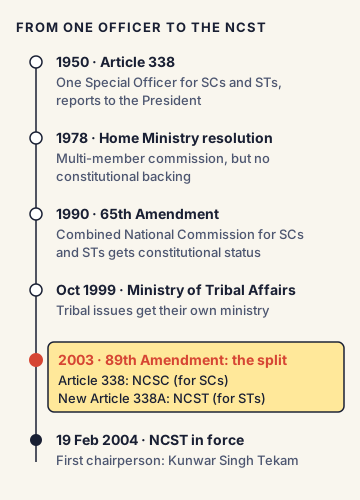
- The original Article 338 created a single Special Officer (later called the Commissioner for SCs and STs) to look into their safeguards and report to the President.
- In 1978, the Ministry of Home Affairs set up a multi-member commission for SCs and STs by an administrative order (a resolution), without any constitutional backing.
- The 65th Amendment Act, 1990 amended Article 338 and replaced the single officer with a multi-member National Commission for Scheduled Castes and Scheduled Tribes. This combined body got constitutional status and the powers of a civil court.
- In October 1999, a separate Ministry of Tribal Affairs was created, so that tribal issues got focused attention apart from caste issues.
- The 89th Amendment Act, 2003 split the combined commission into two. Article 338 now covers the National Commission for Scheduled Castes (NCSC), and a new Article 338A created the NCST. This came into force on 19 February 2004. The first NCST was set up in 2004, with Kunwar Singh Tekam as its chairperson.
The split happened because tribal problems are different from caste problems. STs face issues like loss of forest land, displacement by dams and mines, and protection of distinct cultures. These need different expertise.
Who is in the Commission?
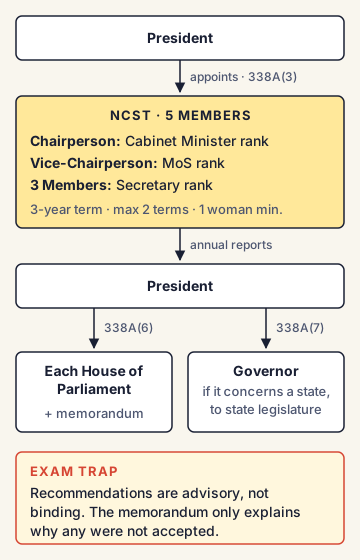
Under Article 338A(2) and the 2004 rules, the NCST has five members:
- a Chairperson, who has the rank of a Union Cabinet Minister;
- a Vice-Chairperson, with the rank of a Minister of State;
- three other Members, with the rank of a Secretary to the Government of India.
At least one member must be a woman. All are appointed by the President by warrant under his or her hand and seal (Article 338A(3)). Each serves a term of three years and cannot be appointed for more than two terms. The President decides their service conditions by rules. The Commission works under the administrative support of the Ministry of Tribal Affairs and has its headquarters in New Delhi, with regional offices in several states.
What does it do?
Article 338A(5) lists its duties:
- To investigate and monitor all matters relating to the safeguards for STs under the Constitution or any law, and to evaluate how well they work.
- To inquire into specific complaints where STs have been denied their rights.
- To take part in and advise on planning for the social and economic development of STs, and to check the progress of that development.
- To present reports to the President every year, and at other times it thinks fit, on how the safeguards are working.
- To recommend measures that the Union or states should take to implement the safeguards better.
- To do any other function the President may specify by rule.
Using clause 5(f), the Ministry of Tribal Affairs gave the NCST additional functions in 2005. These include giving ownership rights over minor forest produce to forest-dwelling STs, protecting tribal rights over mineral and water resources, better relief and rehabilitation for displaced tribal people, preventing land alienation (loss of tribal land to outsiders), and full implementation of the Panchayats (Extension to Scheduled Areas) Act, 1996 (PESA).
What powers does it have?
When it investigates a matter or inquires into a complaint, the NCST has all the powers of a civil court trying a suit (Article 338A(8)). This means it can:
- summon any person from anywhere in India and examine them on oath;
- order any document to be found and produced;
- receive evidence on affidavits (written sworn statements);
- ask for any public record from any court or office;
- issue commissions (authorise someone) to examine witnesses and documents.
What happens to its reports?
The President must place the NCST's reports before each House of Parliament, along with a memorandum explaining what action was taken on its recommendations and why any recommendation was not accepted (Article 338A(6)). If a report concerns a state, a copy goes to the Governor of that state, who places it before the state legislature with a similar memorandum (Article 338A(7)).
The duty to consult
Article 338A(9) says the Union and every state government shall consult the NCST on all major policy matters affecting STs. The same rule exists for the NCSC under Article 338(9). This duty matters in reservation policy. Courts have held that the consultation must be real and must come before the policy is decided, not after.
Commonly confused concepts
- NCST vs NCSC vs NCBC: NCSC is under Article 338 (for SCs). NCST is under Article 338A (for STs), both from the 89th Amendment (2003, effective 2004). The National Commission for Backward Classes (NCBC) got constitutional status under Article 338B through the 102nd Amendment Act, 2018.
- Constitutional vs statutory body: The NCST is a constitutional body (created by the Constitution itself). The National Commission for Safai Karamcharis and the National Commission for Minorities are statutory bodies (created by ordinary laws of Parliament).
- NCST vs Tribes Advisory Council: A Tribes Advisory Council (TAC) is set up under the Fifth Schedule in each state with Scheduled Areas, to advise the state government on tribal welfare. The NCST is a national body that reports to the President.
- NCST vs Scheduled Tribe listing: The NCST does not decide which communities are STs. Under Article 342, the President notifies the list for each state after consulting the Governor, and only Parliament can change it by law. The NCST gives its views on proposals to add or remove communities.
- Recommendations are advisory: The NCST's recommendations are not binding. The government must only explain in its memorandum why it did not accept them.
Issues, criticism and the way forward
- Advisory power only. The Commission can investigate and recommend, but cannot enforce its findings or punish anyone. Critics call it a "toothless" watchdog.
- Delayed reports. Annual reports have often been placed before Parliament years late, which reduces their usefulness.
- Vacancies. Posts of chairperson, vice-chairperson or members have remained vacant for long periods at different times, weakening its work.
- Consultation often skipped. Governments have sometimes made policies affecting STs without consulting the NCST, as the Karnataka High Court found in the reservation case.
- Limited staff and reach. Tribal areas are remote and scattered. The Commission's regional offices are few compared to the scale of complaints.
- Way forward: Experts suggest time limits for tabling reports and replying to recommendations, filling vacancies quickly, more staff and regional offices, and treating prior consultation under Article 338A(9) as a strict legal condition for policies affecting STs.
Concepts to Know
- Scheduled Tribes (STs): Tribal communities officially listed by the President under Article 342 for special protection and benefits. The 2011 Census counted STs at about 8.6% of India's population.
- Constitutional amendment: A change made to the text of the Constitution by Parliament under Article 368, usually needing a special majority.
- Warrant under hand and seal: A formal written order signed and sealed by the President, used for top constitutional appointments.
- Memorandum: A short official note explaining what the government did about each recommendation.
- Minor forest produce: Non-timber items collected from forests, like tendu leaves, honey, bamboo and medicinal plants, which are an important income for tribal families.
- Land alienation: When tribal land passes into the hands of non-tribals, through sale, lease, fraud or takeover.
- PESA (Panchayats (Extension to Scheduled Areas) Act, 1996): A law that gives gram sabhas in Fifth Schedule areas strong powers over local resources, land and customs.
- Article 338A inserted by the 89th Amendment Act, 2003; in force from 19 February 2004
- Earlier combined body: National Commission for SCs and STs, given constitutional status by the 65th Amendment Act, 1990
- 1978: non-statutory commission set up by Ministry of Home Affairs resolution
- Ministry of Tribal Affairs created: October 1999
- Composition: Chairperson (Union Cabinet Minister rank) + Vice-Chairperson (Minister of State rank) + 3 Members (Secretary rank); at least one woman member
- Appointed by the President; term 3 years; maximum two terms
- Duties: Article 338A(5); civil court powers: Article 338A(8); reports to Parliament: 338A(6); to state legislature through Governor: 338A(7); mandatory consultation: 338A(9)
- Additional functions notified by the Ministry of Tribal Affairs in 2005 (minor forest produce, displacement, land alienation, PESA)
- First chairperson: Kunwar Singh Tekam (2004)
- NCSC: Article 338; NCBC: Article 338B (102nd Amendment, 2018)
● Tracked since November 14, 2026 · last seen November 14, 2026 · updates as the daily brief publishes